
Phrases in Boxes
As we continue building our grammar potion, we will begin breaking sentences into boxes. Each box represents a different type of phrase. Over time, these boxes will help you see how sentences are built.
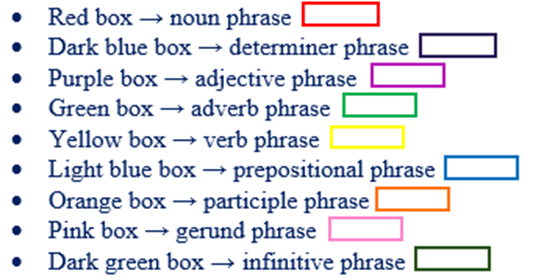
Think of these as compartments in your potion—each ingredient has its place and purpose.
Understanding Articles
To build strong noun phrases, we must understand articles.
English only has three articles: a, an, and the. Articles send the listener or reader a message about the noun phrase. They tell us whether the speaker has a specific noun in mind or is speaking more generally.
Where “The” Fits
The article “the” is part of the determiner phrase, which belongs inside the noun phrase.

This shows how phrases can exist inside other phrases—just like layers in a well-crafted potion.
What Determiners Do
Determiners, also known as pre-adjectives, are words that come before nouns and help identify or limit them. Determiners tell the audience which noun the speaker or writer is referring to by:
- whether the noun is general or specific
- whether the noun is near or far
- whether the noun is singular or plural
- how many or how much
- who or what the noun belongs to
The Power of “The” (Definite Article)
The article “the” tells us something very important: the noun is specific and identifiable.
But “the” works correctly only when two conditions are met.
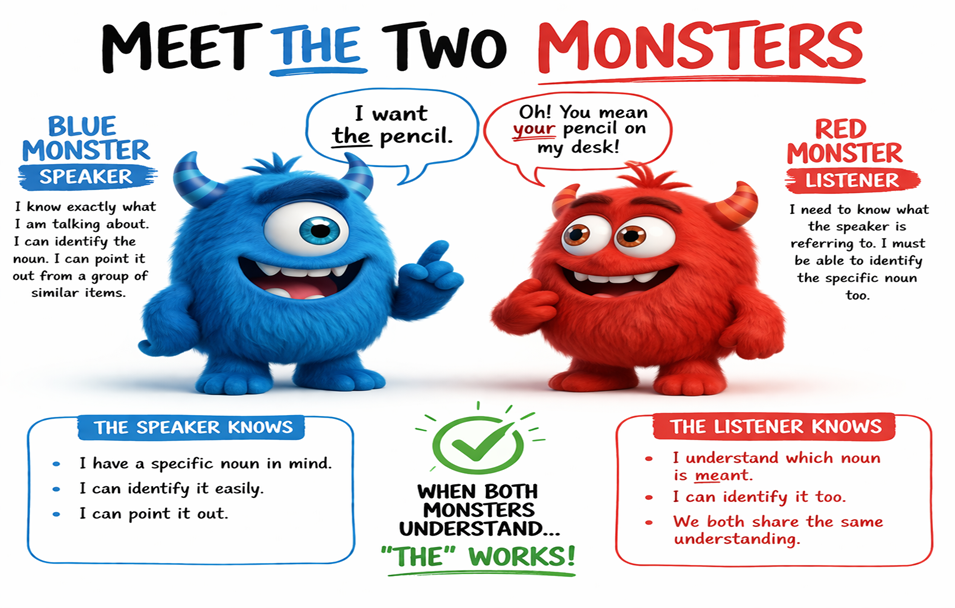
1. The speaker knows the exact noun.
- They can identify it from a group.
2. The listener also knows which noun is meant.
- They can identify it too.
Example: I want the pencil.
Both the speaker and listener know exactly which pencil is being discussed.
Think About It This Way
Imagine a group of identical items.
- If you can point to one exact item, you use “the.”
- If not, you usually should not.
Like recognizing the real Harry Potter among many look-alikes—you know exactly which one is real.
How the Listener Understands “The”
The listener knows which noun is being referenced for one of the following reasons:
1. It was mentioned before.
- I bought a computer. The computer works great.
2. The speaker or writer uses extra information to identify the exact noun, such as a name, a postmodifier, an adjective clause, a noun clause, or a prepositional phrase.
- The boy in the red shirt goes to school.
- The Sarah with curly hair is my cousin.
3. The speaker or writer expects the noun to have a normal or expected feature.
- My son reads a book and checks the index.
- A common feature in a book is the index.
4. You can find the noun in a particular environment.
- We are walking around the school, and I say, “She is going to the library.”
- Examples of environments: universities, cities, farms, hospitals, houses
5. When referring to unique nouns, use “the”. I think of these nouns as one-of-a-kind.
- the sun
- the earth
Special Uses of “The”
“The” is also used in the following:
- Cardinal directions referring to regions of the country: the Southwest, the Northwest
- Unions of countries: the UK, the United States
- Geographic features: the Gulf Stream, the Great Lakes
- Universities that have “of” in the title: the University of Iowa
- Superlatives: The man is the greatest.
- Decades: the 1980s
- Musical instruments: the flute
Flexibility of “The”
The article “the” has few restrictions when considering the noun classification.
You can use the definite article “the” with:
- count nouns, singular and plural
- some uncountable nouns
- some proper nouns as shown in the list above
- common nouns
- abstract nouns
- concrete nouns
I am waiting for the tea.
Monster Point of View
This is where your grammar potion comes alive.
- The blue monster, the speaker, knows exactly what the noun is.
- The red monster, the listener, must also understand which noun is being referenced.
If both monsters understand, your sentence works perfectly. If not, the potion fails.
Advanced Concept: For Deeper Thinkers
Sometimes “the” is used to show how something has changed over time:
“The language of today is not the same as the language spoken long ago.”
Here, “the” helps distinguish two versions of the same thing across time. This concept becomes especially useful when writing a history report!
Words of Wisdom
“The depth of your pain reflects the value of what was lost. When you put that truth into words, you find peace in being understood.”