
Welcome back, grammar potion brewer!
In the past several lessons, we have added many adverb ingredients to our grammar cauldron. We learned adverbs can place an action in time, guide it through space, alter its manner, measure its degree, focus the reader’s attention, and reveal the speaker’s evaluation. Now we add a lens charm: the viewpoint adverb.
Viewpoint adverbs tell the reader which perspective, field, or lens should be used to understand the statement. A sentence may look different when viewed medically, legally, financially, morally, personally, and scientifically.
Compare:
- The plan is acceptable.
- Legally, the plan is acceptable.
- Financially, the plan is acceptable.
- Morally, the plan is acceptable.
- Personally, the plan is acceptable.
The basic statement stays the same, but the viewpoint changes. A plan may be legal but not wise, affordable but not kind, scientifically possible but morally troubling. Viewpoint adverbs remind us that meaning often depends on the lens through which we look.
In other words, viewpoint adverbs are grammar spectacles. Put on the wrong pair, and the sentence may look very different.
Viewpoint Adverbs
Viewpoint adverbs show the perspective, field, or lens from which a statement is being made.
They may indicate:
- Whose point of view is being expressed
- What field or domain is being used
- What aspect of the topic is being considered
- In what respect is the statement accurate
Viewpoint adverbs often answer questions such as:
- From what viewpoint?
- From whose perspective?
- In what field?
- In what respect?
Example Sentences:
- Medically, the patient is stable.
- Legally, the contact is invalid.
- Financially, the plan is risky.
- Personally, I disagree.
- Technically, the answer is correct.
In each sentence, the viewpoint adverb tells the reader how to interpret the statement.
Viewpoint Adverbs and Scope
Like focusing adverbs and evaluative adverbs, viewpoint adverbs have scope. The scope of an adverb is the part of the sentence affected by its meaning.
Example:
- Legally, the contract is invalid.
- “Legally” affects the entire statement.
It tells the reader that the statement is true from a legal point of view.
Reference Note: In Lesson 38, we studied focusing adverbs and learned the term scope. In Lesson 39, we studied evaluative adverbs, which often comment on an entire clause. Viewpoint adverbs also often have scope over an entire clause.
Domain Adverbs
Domain adverbs are a subcategory of viewpoint adverbs. They specify the field, domain, or area of knowledge from which the speaker is analyzing or commenting on a situation.
Examples of domains include:
- medical
- legal
- moral
- cultural
- scientific
- financial
- historical
- statistical
- personal
Example Sentence:
- Medically, the patient is stable.
- Legally, the decision is questionable.
- Morally, the choice is difficult.
- Scientifically, the claim needs more evidence.
- Financially, the plan is risky.
- Historically, the event was unusual.
Common Viewpoint and Domain Adverbs
| biologically | mathematically | logically |
| environmentally | medically | socially |
| ideologically | morally | legally |
| financially | scientifically | practically |
| formally | technically | culturally |
| objectively | subjectively | statistically |
| historically | Theoretically | personally |
Note: Some viewpoint adverbs can overlap with other categories depending on the context. For example, “technically” can introduce a precise technical viewpoint, but in conversation, it may refer to the statement being a correction.
Example:
- Technically, the dragon did not steal the sheep; it relocated them.
This is the sort of sentence that gets a dragon banned from legal arguments.

Viewpoint Adverbial Phrases
People do not express all viewpoint meanings using one-word adverbs. Adverbial phrases, especially prepositional phrases, express many viewpoint meanings.
Examples:
- from a medical standpoint
- from a legal perspective
- from my point of view
- in financial terms
- in theory
- in practice
- from a moral standpoint
- form a scientific perspective
Example Sentences:
- From a medical standpoint, the patient is stable.
- From a legal perspective, the contract is invalid.
- From my point of view, the plan is unfair.
- In financial terms, the project is risky.
- In theory, the spell should work.
- In practice, the spell exploded.
Reference Note: We will study prepositional phrases more deeply in later lessons. Note that these phrases operate adverbially, showing the author’s viewpoint in making the statement.
Viewpoint Phrases with “Speaking”
Some viewpoint expressions use an adverb plus speaking, creating a participle phrase.
Examples:
- medically speaking
- legally speaking
- technically speaking
- scientifically speaking
- personally speaking
- generally speaking
Example Sentences:
- Medically speaking, the patient is stable.
- Legally speaking, the contract is invalid.
- Technically speaking, the answer is correct.
- Personally speaking, I would not enter that cave.
In these expressions, the entire phrase functions as a viewpoint adverbial.
Reference Note: The word “speaking” is a participle. We will study participles and participles phrases more deeply in Lesson 48.
Placement Viewpoint Adverbs: Modifying Clause
1. Introductory Position
- Viewpoint adverbs usually appear at the beginning of a clause. A comma sets them off.
- Medically, the patient is stable.
- Financially, the plan is risky.
Structure: (Adverb), NP subject + VP → (Auxiliary Verbs) + Verb + (Verb Complements)
2. End Position
- Viewpoint adverbs can also appear at the end of the clause. A comma usually sets them off.
- The patient is stable, medically.
- The plan is risky, financially.
Structure: NP subject + VP → (Auxiliary Verbs) + Verb + (Verb Complements), (Adverb)
The end-position can sound conversational, reflective, or like an afterthought.
Potion Note: The introduction position usually announces the viewpoint before the claim, and the end-position often adds the viewpoint after the claim, as if the speaker is clarifying the lens.
Placement of Viewpoint Adverbial Phrases
1. Introductory Position
- A prepositional phrase or participial phrase expressing viewpoint often appears at the beginning of a sentence, and a comma follows it.
- Personally speaking, I disagree.
- From a legal perspective, the decision is questionable.
Structure: (Viewpoint Adverbial Phrase), NP subject + VP → (Auxiliary Verbs) + Verb + (Verb Complements)
2. End position
- An adverbial phrase of viewpoint may also appear at the end, and a comma precedes it.
- I disagree, personally speaking.
- The decision is questionable, from a legal perspective.
Structure: NP subject + VP → (Auxiliary Verbs) + Verb + (Verb Complements), (Viewpoint Adverbial Phrase)
Creative Writing: Choosing a Narrative Lens
In Lessons 36-39, we practiced choosing a story’s main time frame and shifting aspects within that time frame. Now we add another writing tool: narrative lens.
A narrative lens is the viewpoint through which a writer presents information. Viewpoint adverbs can help a narrator show which lens is being used.
Compare:
- Legally, the dragon escaped.
- Technically, the dragon escaped.
Same Even, Different Viewpoints
Examples:
- Legally, the apprentice stole the forbidden book.
- This sentence uses a legal lens. It frames the action as a violation of rules or laws.
- Personally, the apprentice needed the forbidden book.
- This sentence uses a personal lens. It suggests that the narrator is considering the apprentice’s individual needs.
- Morally, the apprentice faced a difficult choice.
- This sentence uses a moral lens. It frames the situation as an ethical problem.
- Practically, the apprentice had no better option.
- This sentence uses a practical lens. It focuses on what worked or what could realistically be done.
Potion Note: Viewpoint adverbs are powerful in creative writing because they reveal not only what happened, but which lens the narrator wants the reader to use.
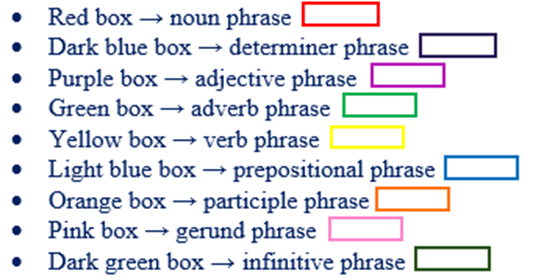
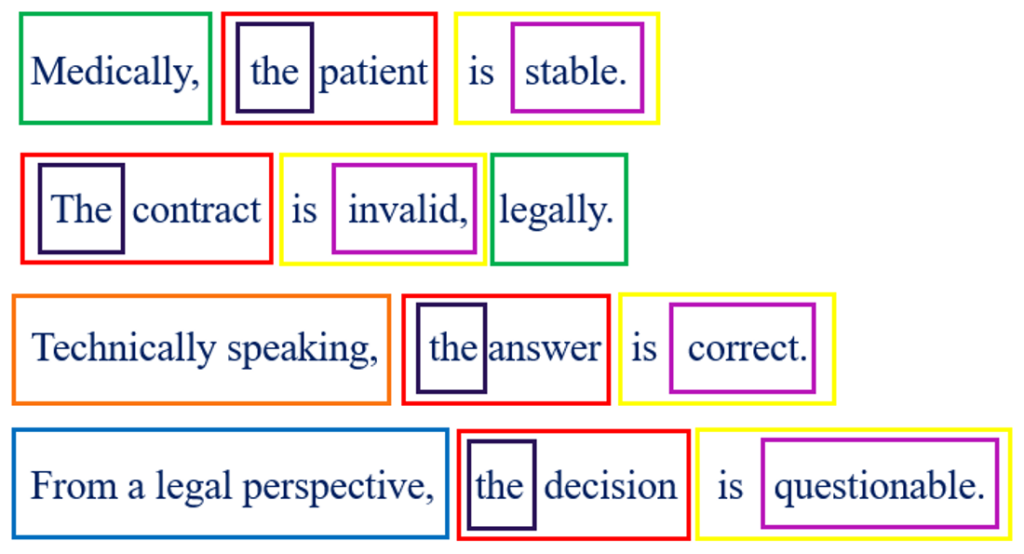
Boxing in Phrases
Place a green box around the viewpoint adverbs. Since viewpoint adverbs modify the entire clause, do not place them inside the verb phrase. Think of the viewpoint adverb as a lens charm: it tells the reader how to look at the statement. It may appear at the beginning, or end of the sentence, but its meaning often reaches over the whole clause.
Words of Wisdom
“Wisdom begins when you learn to see from more than one viewpoint.”