
Welcome back, grammar potion brewer!
In Lesson 34, we placed actions in time. In Lesson 35, we guided actions through space. In Lesson 36, we altered how actions were performed. In Lesson 37, we measured intensity with adverbs of degree. Now we add a tiny but powerful spell: the focusing adverb.
Focusing adverbs are spotlight charms. They tell the reader which word, phrase, or idea deserves special attention. A small word like “only,” “also,” “especially,” or “mostly” can shine a beam of meaning onto one part of the sentence.
Compare:
- Only Jason opened the vault.
- Jason only opened the vault.
- Jason opened only the vault.
The words are almost the same, but the meaning changes. In the first sentence, Jason—and no one else—opened the vault. In the second, Jason opened it but did not do anything else to it. In the third, he opened the vault and nothing else.
Focusing adverbs are small, but they can redirect the entire sentence. Place them carefully.
Focusing Adverbs
Focusing adverbs draw the reader’s or listener’s attention to a particular word, phrase, or idea in the clause.
They may focus on:
- a verb phrase
- a noun phrase
- a prepositional phrase
- an adjective phrase
- an adverbial phrase
- sometimes an entire clause
The part being focused on is called the adverb’s scope. Scope means the part of the sentence affected by the focusing adverb.
Example:
- Mark is operating only the tractor.
In this sentence, “only” focuses on “the tractor.” Mark is not operating the truck, the wagon, or the cursed lawn mower.
Types of Focusing Adverbs
1. Additive Focusing Adverbs
Additive focusing adverbs add information to the context. They show that something is included in addition to something else.
Examples:
- also
- too
- as well
Example Sentences:
- Mara studies potions. Jace studies potions too.
- The dragon also guards the tower.
- The apprentice brought herbs as well.
We are adding this information to what we already know.
2. Limiting Focusing Adverbs
Limiting focusing adverbs restrict the meaning. They show that the focus is limited to one person, thing, action, or idea.
Examples:
- only
- just
- merely
- solely
- alone
- exclusively
- simply
- purely
- precisely
- exactly
Depending on their usage, some words can belong to more than one adverb category. For example, “exactly” can function as a focusing adverb or an adverb of degree.
Example Sentences:
- Only Jason accesses the bank account.
- The answer is just a guess.
- She came solely to help.
- The spell works only at midnight.
We limit the focus and exclude other possibilities.
3. Partial Focusing Adverbs
Partial focusing adverbs narrow the focus without completely excluding everything else. They highlight one part as especially important.
Examples:
- especially
- mainly
- mostly
- chiefly
- notably
- particularly
- primarily
- predominantly
- in particular
- at least
- for the most part
Example Sentences
- The potion is mostly water.
- She is especially brave.
- The students were mainly quiet.
- The warning applies particularly to young apprentices.
They narrowed the focus, but other possibilities may still exist.
Placement of Focusing Adverbs: Modifying Verbs
1. Before the Main Verb
- When a focusing adverb modifies a verb or a verb phrase, it often appears before the main verb.
- I mostly read books.
- The apprentice mainly practices healing spells.
Structure: NP subject + VP → (Auxiliary Verbs) + (Adverb) + Verb + (Verb Complements)
2. Between an Auxiliary Verb and the Main Verb
- When a sentence has an auxiliary verb, the focusing adverb often appears between the auxiliary verb and the main verb.
- The team is only playing North Scott’s team.
- The dragon has just landed.
- The wizard will also attend the meeting.
Structure: NP subject + VP → (Auxiliary Verbs) + (Adverb) + Verb + (Verb Complements)
Reference Note: In Lesson 14, 17, and 19, we studied progressive verb phrases. In Lesson 18, we studied the modal auxiliary “will.”
3. After the Verb “To Be”
- When the focusing adverb modifies a complement after the verb “to be,” it often appears after “be” and before the focused complement.
- She is notably beautiful.
- The potion is mostly water.
- The answer is only a guess.
- He is also a wizard.
Structure: NP subject + VP → (Auxiliary Verbs) + Verb “to be” + [Adjective Phrase → (Adverb) + Adjective]
Structure: NP subject + VP → (Auxiliary Verbs) + Verb “to be” + [NP Complement → (Adverb) + Noun]
4. “Too” and “as well”
- The additive focusing adverbs “too” and “as well” usually appear at the end of the clause.
- Mara studies potions too.
- The apprentice brought herbs as well.
- The dragon guards the tower too.
Structure: NP subject + VP → (Auxiliary Verbs) + Verb + (Verb Complements) + (Adverb “too” “ as well”)
Potion Note: The word “well” by itself is usually an adverb of manner, not a focusing adverb.
Compare:
- She sings well.
- “Well” tells how she sings.
- She sings as well.
- “As well” means “also.”
Placement of Focusing Adverbs: Modifying Other Phrases
- Place the focusing adverb before the phrase you want to emphasize.
- Only Jason accesses the bank account.
- Jason accesses only the bank account.
- Mark is operating only the tractor.
- The spell works only at midnight.
- The dragon was angry mainly because of the noise.
- She was kind especially to younger students.
Potion Rule: A focusing adverb usually shines its spotlight on the word or phrase behind it, but “too” and “as well” may come after the verb phrase. Place the adverb close to the part you want to focus on.
Potion Warning: Place “only” carefully. It is small, but it can shift the entire sentence’s meaning.
Creative Writing: Past-Time Narration
In Lesson 36, we learned that writers choose one main tense and stay consistent unless they have a logical reason to shift. In Lesson 37, we practiced present-time narration, using the simple present and the present progressive. Now we are moving into past-time narration.
A writer may choose the past-time frame to tell a story as something that already happened. This is one of the most common choices in storytelling.
Simple Past
The simple past presents actions as completed events in the past.
Example:
- Mara opened the gate.
- She stepped quietly inside.
- The dragon watched from the tower.
This narration feels like a traditional story. The simple past often advances a story from one completed event to the next.
Shifting Aspect Inside the Past Time Frame
A past-time story can shift between simple past and past progressive without leaving the past-time frame.
Example:
- Mara opened the gate. Rain was falling over the courtyard. The dragon watched from the tower while the torches were flickering in the wind.
Verb forms:
- opened = simple past
- was falling = past progressive
- watched = simple past
- were flickering = past progressive
Potion Note: In past-time narration, the simple past often moves the story forward, while the past progressive shows what was happening in the background or already unfolding at that moment.
Same Scene with Focusing Adverbs
Focusing adverbs help a writer control what the reader notices.
Without focusing adverbs:
- Mara opened the gate. The dragon watched from the tower. The spell worked at midnight.
With focusing adverbs:
- Only Mara opened the gate. The dragon also watched from the tower. The spell worked only at midnight.
Notice how the focusing adverbs shift attention:
- only Mara = Mara, and no one else
- also = the dragon is added to the context
- only at midnight = at midnight, and at no other time
A focusing adverb is a spotlight charm. It tells the reader where to look.
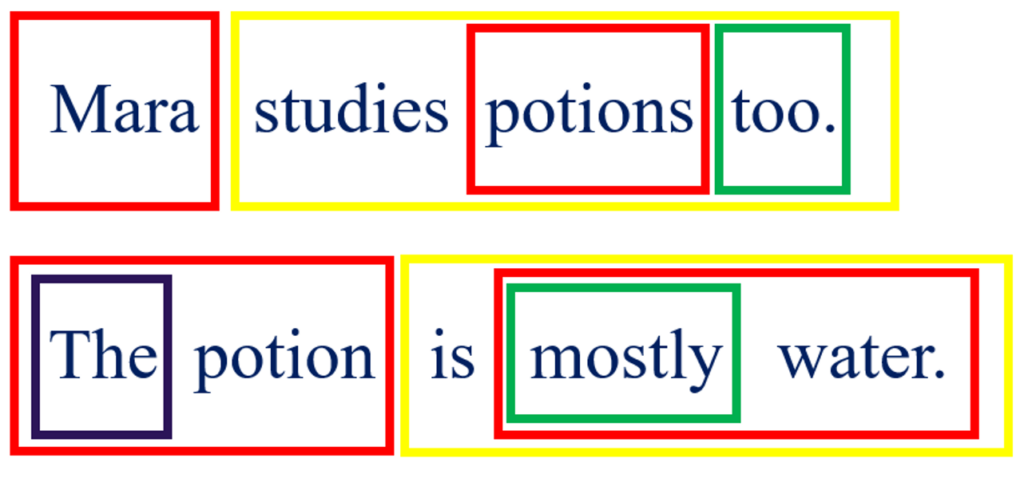
Boxing in Phrases
Place a green box around the adverb phrase.
Words of Wisdom
“Where you place your focus shapes what you understand.”