
A sentence requires a subject and a predicate. The subject is the who or what the sentence is about, and the predicate is the verb phrase that tells you about the subject’s action or state of being.
The type of sentence you will practice is a declarative sentence. A declarative sentence makes a statement—it shares a thought, an idea, or a truth.
Tense and Aspect
In English, we write in three tenses, and each tense has four aspects. Every tense and aspect follows its own set of spelling patterns, which means structure and form always matter.
Tenses: Past, Present, Future
Aspects: Simple, Continuous/Progressive, Perfect, Perfect Continuous
Simple Present: A Timeless Statement
The simple present tense gives your statement a “timeless” quality. It does not tell us when something begins or ends—it simply is.
You will use the simple present when you are expressing:
- facts
- habits and customs
- assertions or generalizations about groups or ideas
This is the tense of steady truths—the kind of statements that stand without needing a timeline.
Simple Present Conjugation
| Simple Present | ||
| Singular | Plural | |
| 1st person | I run. | We run. |
| 2nd person | You run. | You run. |
| 3rd person | He runs. | They run. |
Subject-Verb Agreement
In the simple present tense, third-person singular subjects require the verb to change form.
This is where English begins to show its patterns:
- Most subjects use the bare infinitive: run, walk, speak
- But a third-person singular subject—he, she, it, or a singular noun phrase—requires something extra.
Examples:
- The wizard runs.
- A cat sleeps.
- The computer works.
Third-person singular subjects take –s or –es.
This slight change carries a big grammatical signal.
Spelling Rules
1 Most vers add –s
- run → runs
2. Verbs ending in ss, sh, ch, z, or x add –es
- watch → watches
3. Verbs ending in a consonant + y, change y to i and add –es
- try → tries
4. Verbs ending in a vowel + o add –es
- go → goes
5. Verbs ending in a vowel + o simply add –s
- radio → radios
- canoe → canoes
Note: In the word canoe, the word already ends in e; therefore, the final spelling looks like “-es,” but only “-s” was added.
These are not random rules—they are patterns that help the language stay pronounceable.
Building the Sentence
We will begin breaking sentences into two main parts:
- Noun Phrase (NP)
- Verb Phrase (VP)
This is where grammar shifts from memorizing rules to seeing structure.
Note: Phrases are one or more words working together to perform a function: noun, adjective, adverb, verb, and so on.
Noun Phrase (NP)
A noun phrase is one or more words working together to function as a subject or object.
A simple pattern looks like this:
- Noun phrase → Determiner + Noun
A pronoun can replace a noun phrase because pronouns perform the same function.
Verb Phrase (VP)
A verb phrase is one or more words working together as the verb.
It can take two forms:
- Transitive: Verb + Noun Phrase (Direct Object)
- Intransitive: Verb
Understanding Verbs
Not all verbs behave the same way.
- Transitive verbs carry an action to the receiver, called the direct object.
- Intransitive verbs do not carry an action to a receiver.
- Dynamic verbs (action verbs) show the action of the subject. Dynamic verbs can be either transitive or intransitive.
- Stative verbs (state verbs) show a state of being or condition rather than an action. They are often intransitive, but some stative verbs can take direct objects.
Infinitives
- Infinitive: to + base verb → to swim
- Bare infinitive: base verb alone → swim
In the simple present tense, we usually use the bare infinitive, except with third-person singular subjects, where the verb changes form.
Completing the Meaning
Verb complements complete the meaning of the verb. There are several different types of verb complements. One common type is the direct object, which receives the action from the verb.
Seeing the Structure
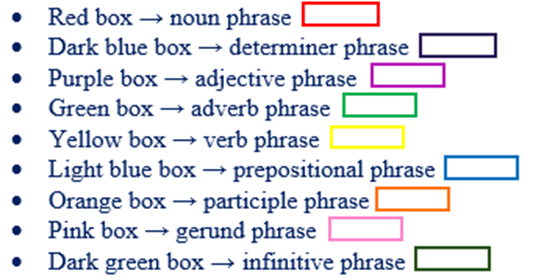
From this point forward, we will begin placing boxes around the phrases in our sentences. When you can see the structure, you begin to understand the sentence—not just read it.
Words of Wisdom
“Powerful words have the ability to move through time—across decades and centuries.”