
The grammar potions we have been working with are mostly declarative sentences, but the intent of your words changes the type of sentence.
Punctuation also gives the reader important clues. It shows whether a sentence is making a statement, giving a command, expressing strong emotion, or asking a question.
In other words, punctuation does not leave much to the imagination. It waves a tiny grammar flag and says, “Read me this way!”
Four Types of Sentences
There are four main types of sentences:
- A declarative sentence makes a statement and ends with a period.
- An imperative sentence gives a command, instruction, request, or invitation. It ends with a period or an exclamation mark and tells someone to do something.
- An exclamatory sentence expresses strong emotion and ends with an exclamation point.
- An interrogative sentence asks a question and ends with a question mark.
Examples:
| Sentence Type | Example | Punctuation |
| Declarative | Jace is kind. | Period |
| Imperative | Wash the dishes. | Period |
| Exclamatory | What a beautiful day! | Exclamation point |
| Interrogative | Is Jace kind? | Question mark |
Interrogative sentences will be explored in depth in later lessons.
Imperative Sentence Features
- Tense: Imperative sentences are written in the simple present form.
- Subject: The subject is omitted because it is understood to be “you.”
Examples:
- (You) wash the dishes! → Wash the dishes!
- (You) eat the pizza! → Eat the pizza!
Punctuation:
- Exclamation mark (!) → shows force or urgency
- Period (.) → makes the sentence sound calmer, more polite, or more suggestive
Think of it this way: Your mom is staring at you and says:
- “Pick up the dog poo!”
You know she means you. The subject is not said or written, but it is definitely understood. Very understood. Painfully understood.
Direct Speech in Creative Writing
Creative writing is one of the best ways to practice sentence structure. Stories such as Harry Potter, The Chronicles ofNarnia, and Percy Jackson are great examples of imaginative worlds where characters speak, ask questions, shout warnings, and give commands.
When a character’s exact words are written inside quotation marks, this is called direct speech or quoted speech.
Example:
- Marcy says, “The dragon ate the thief.”
Direct Speech Sentences Show Us That
Parts of the Sentence:
- The subject is the speaker.
- The verb tells how the words are spoken.
- The exact words spoken can function as the complement of the reporting verb.
- The subject does not always begin the sentence.
- A clause can function as a complement.
Examples of reporting verbs include:
- says
- asks
- shouts
- whispers
- replies
- yells
Clause Structure
A clause has a subject and a verb phrase.
A clause may:
- stand alone as a sentence
- function as part of a sentence
In direct speech, the whole quoted clause can function as a complement to the reporting verb.
Construction of Direct Speech
In direct speech, the exact words are placed in quotation marks.
If the quoted words are interrogative, imperative, or exclamatory, their punctuation remains the same, even when the reporting clause comes after the quotation.
Examples:
- “What is that?” asks Mark.
- “Run!” shouts Mark.
- “What a surprise!” says Mark.
The quoted words keep their question mark or exclamation point.
Speaker Position in Direct Speech
The speaker, or subject, can be in three positions:
- At the beginning
- In the middle
- At the end
1. At the Beginning
Example:
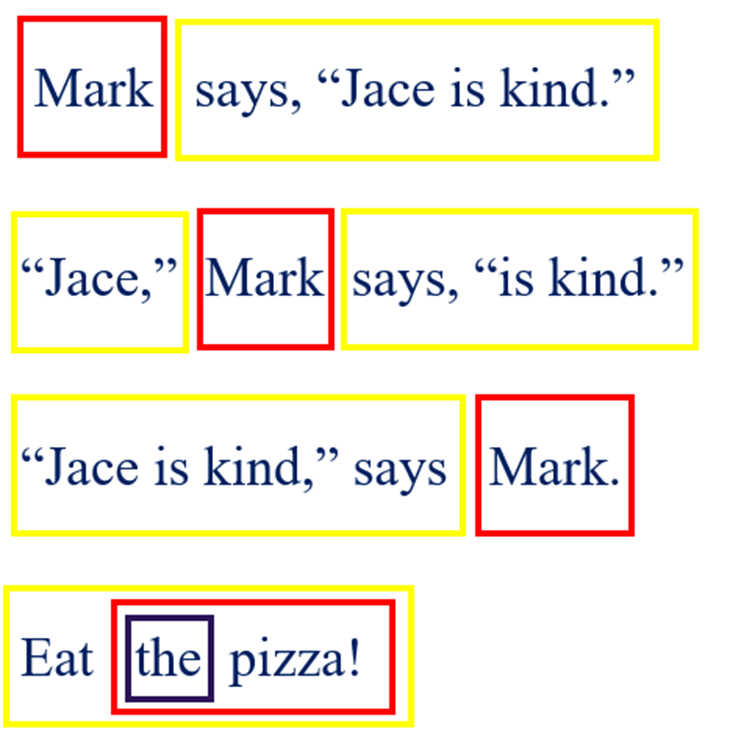
- Mark says, “Jace is kind.”
Rules:
- A comma goes after the reporting verb.
- Capitalize the first word inside the quotation marks.
- Punctuation goes inside the quotation marks.
2. In the Middle
This is called an interrupting reporting clause because the speaker interrupts the quoted sentence.
Example:
- “Jace,” Mark says, “is kind.”
Rules:
- The first comma separates the first part of the quote from the reporting clause.
- The first comma goes inside the quotation marks.
- The second comma separates the reporting clause from the rest of the quote.
- Quotation marks surround all the spoken words and their punctuation.
- Do not capitalize the second part of the interrupted quote unless it begins a new sentence.
3. The End
Examples:
- “Jace is kind,” says Mark.
- “Run!” says Mark.
- “What is that?” asks Mark.
Rules:
- A comma replaces a period before the reporting clause.
- Do not replace an exclamation point or question mark.
- A final period ends the full sentence after the reporting clause.
Key Idea
The quoted words determine whether the direct speech is declarative, imperative, exclamatory, or interrogative.
A short creative writing activity each day is a wonderful way to practice sentence structure.
Boxing in Phrases
When boxing direct speech, only box the subject and the verb phrase of the sentence for now!
Words of Wisdom
“One might be able to improve one’s life when no one knows.”