
A single pinch of language magic can make two small words act as one powerful ingredient. In grammar potions, compound adjectives and compound nouns are two-word (or multiword) combinations that fuse into a single meaning. For compound adjectives used before a noun (the attributive position), use a hyphen to keep the meaning clear—like sealing a vial with wax—so readers do not mix the wrong ingredients. For compound nouns, there are several structural possibilities, and over time many open or hyphenated forms become closed compounds.
Compound adjectives comprise two or more words that function together to describe a noun. They often use a hyphen to prevent ambiguity and to show the words form a single modifier. Compound adjectives can appear before a noun (attributive) or after a linking verb (predicative), but hyphenation is most important when the compound directly precedes the noun.
In an adjective-adjective compound, the first adjective modifies the meaning of the second; together they form one descriptive unit. Think of it as a miniature phrase; the second adjective is the head (the main category), while the first adjective narrows, shades, or changes the meaning of that head. This head/modifier relationship is why a hyphen often makes the intended meaning clear.
Hyphen Rules
- In attributive position, use a hyphen for clarity of meaning.
- In the predicate position as a predicate adjective, hyphenation is less required but still acceptable when the compound is a fixed expression.
Example: bluish-green
The bluish-green pixie flew into the woods.
The pixie is bluish green.
Combination of Compound Adjectives
Compound adjectives have many structure combinations:
1. adjective + adjective
- bluish-green (the bluish-green pixie)
2. adjective + noun
- full-length (a full-length cloak)
3. noun + participle (present or past)
- world-famous (the world-famous spell book)
4. noun + adjective
- blood-red (the blood-red gem)
5. noun + noun
- ice-cold (the ice-cold water)
6. adverb + present/past participle
- never-ending (a never-ending night)
7. noun-adjunct + present participle
- mouth-watering (a mouth-watering pie)
- heart-breaking (a heart-breaking story)
Concept Break: Noun Adjuncts
A noun adjunct is a noun that functions as a modifier of another noun (also called attributive noun). It typically comes before the noun it modifies and explains the type, purpose, or association (running shoes, crystal wand). Noun-adjuncts also appear inside participle compound affects—or example in mouth-watering the noun “mouth” specified what is being made to water; the –ing participle is the semantic head. Lesson 47 and 48 will explore participles and verbals in depth; for now, treat these participial compounds as single adjectival units (hyphenate before the noun).
Cross-reference back to Lesson 10, Purposes (adjective order item 11)
- What is the item used for: sleeping bag, running shoes
Notes:
- The adjective order naturally accommodates noun adjuncts (these can be simple nouns or participial forms). One common function is to name the purpose or intended action of an item (running shoes = shoes for running).
- This shows how critical thinking and careful rephrasing simpler concepts or ideas into more complex grammatical structures. When reference guides or textbooks seem to disagree, tracing phrases back to these basic functions (type, material, purpose) helps students resolve apparent conflicts.
8. quantifiers + noun → (used for length, age, weight, currency. Etc.)
- Length:
- three-foot (a three-foot wand)
- Age:
- 11-year-old (an 11-year-old apprentice)
- Currency:
- five-thousand-dollar (the five-thousand-dollar potion kit)
- numerals and currency sign (the $5,000 potion kit)
Note: In a hyphenated measurement compound the unit is singular: three-foot, five-thousand-dollar, 11-year-old. You are naming a single measure that describes the noun. Prefer $ + numerals for currency when concise ($5,000).
More examples:
- full-length movie
- last-minute decision
- twentieth-century writer
- middle-class writer
Intro to Participles
In lessons 47 and 48, we will explore many functions of participles. This is a brief, introductory explanation because participles are often used as adjectives and form many common compound adjectives, so we must discuss them now.
Present participles (-ing):
- Present participles used as adjectives describe an ongoing action or a continuing state and often convey motion or process.
- Examples:
- The flowing river sparkled in the sunlight.
- The ever-flowing waterfall cascades down the rocks.
- Note: In these examples, “flowing” describes the continuous motion; the participle functions adjectivally.
Past participle (-ed, -en, -t, etc.):
- Past participles as adjectives usually describe a state resulting from prior action. The base verb names the action; the past participle expresses the resulting state.
- Example: The shattered vase was an expensive decoration.
- Event: The vase shattered.
- Resulting state: The vase is now in a shattered condition.
- Example: The sweet, freshly baked cookies filled the kitchen with a sweet aroma.
- Event: The cookies were baked.
- Resulting state: The cookies are now baked.
Hyphenation Rule
- Do not hyphenate –ly adverb/particle + participle combinations: a beautifully made robe (not beautifully-made robe). Writers still treat –ly adverb + participle combination as multiword modifiers, but do not hyphenate them (a beautifully made robe).
- Hyphenated non –ly adverb + participle compounds for clarity: a well-written article; a fast-moving train.
Noun Phrase and Adjective Phrase Structure
Noun Phrase Structure → (Determiner Phrase) + (Adjective Phrase) + (Adjectival Compound Participle) + Noun
- Do not split or reorder a hyphenated compound; adverbs ending in –ly remain unhyphenated and stay adjacent to the adjective they modify.
- Adjectival compound participles follow the standard order by coming after descriptive adjectives, but coordinating adjective structure allows the flexibility to shift the order.
- If a compound participle adjective and another descriptive adjective belong to the same semantic category in the adjective order, treat them as coordinate adjectives and apply the comma or and.
- Examples:
- The bright, fast-moving train rushed past the station.
- His insightful, well-written article won an award.
- The sweet, freshly baked cookies taste good. (a comma was added for clarity)
- If the compound adjective does not have any participle, you follow the adjective order.
Note: The standard adjective order reduces confusion and is a useful default, but English is flexible—semantic meaning, emphasis, and clarity are ultimate guides. Sometimes compound participle will be placed within the descriptive adjective order to emphasize opinion, size, or another quality. See Lesson 10 for adjective order chart and Lesson 20 for coordinating and cumulative adjectives.
Adjective Phrase Structure → (Adverb) + Adjective* + (Adjectival Compound Participle)
- A compound adjective without a participle still follows the standard adjective order in English.
Example: She wore a twentieth-century handmade silk dress.
Advanced Concept—Deep Thinker
Example: The shattered vase was an expensive decoration.
Subject definiteness ≠ complement definiteness.
- The subject can be definite (the shattered vase) because the vase is already identified in the conversation or text.
- The predicate nominative (the noun that renames the subject) has its own reference requirement: if it is a count noun, it still needs a determiner (a/an/the). Which determiner you choose depends on whether you are classifying, identifying, or contrasting—not simply on the subject’s definiteness.
- Predicate nominative that classifies normally use an indefinite article: you are saying the subject is one instance of that noun class (The shattered vase was an expensive decoration = classification).
- “Decoration” is a broad class name that refers to many possible objects, while “vase” names a specific kind of object. When a definite subject (the shattered vase) is paired with a general class term as the predicate nominative (…was a decoration, readers naturally hear classification: you are assigning that specific vase to the larger category of decorations (one decoration among many).
- If you intended a pure adjectival description (no renaming), use a predicate adjective instead: The shattered vase was expensive.
Postmodifiers shift how you read a predicate nominative (classification → identification)
Example (Prepositional Phrase): The shattered vase was the expensive decoration on the mantel.
Example (Appositives): The shattered vase was the expensive decoration, the one from Aunt Mira.
- The predicate nominative is uniquely identifiable because the sentence or discourse provides extra information (postmodifier, prior mention, situation uniqueness, apposition, contrast). When identification is supplied, use “the.”
- A postmodifier removes the ambiguity of classification by supplying identifying content; without such identifying content, the predicate nominative (PN) normally reads as classificatory and takes “a” or “an.”
Compound Nouns
Compound nouns are made up of two words that come together to create a new noun with a different meaning than the individual words.
Compound Nouns Written Forms
Open compound: a space between the two words (ice cream, high school)
Hyphenated compound: hyphen in between the two words (father-in-law, self-esteem)
Closed compound: the words written together (bluebird, skateboard)
Reminder: Over time many open or hyphenated forms become closed compounds. The lexicalization pathway: they may start as an open phrase, become hyphenated as they cohere, and finally close into a single word as the language accepts the new lexical item.
Compound nouns have many structure combinations:
1. noun + noun
- bluebird
- seafood
- snowball
2. adjective + noun
- sweetheart
- high school
3. noun + verb (noun derived from verb)
- dishwasher
- skateboarder
4. Verb + particle (phrasal verb lexicalized as noun)
- check-out
- cave-in
- Note: as verbs these are two words, check out and cave in, as nouns may be hyphenated or closed.
5. noun + preposition
- mother-in-law
- editor-in-chief
6. preposition/ adverb + noun (often closed)
- upstream
- downfall
Some compound nouns may have more than one option either be opened, hyphenated, or closed. This is often noticed when looking at different grammar guides. The newest dictionary will be the best guide to consult.
Keep in mind, adjust wording to fit your style and lesson flow.
Boxing in Phrases
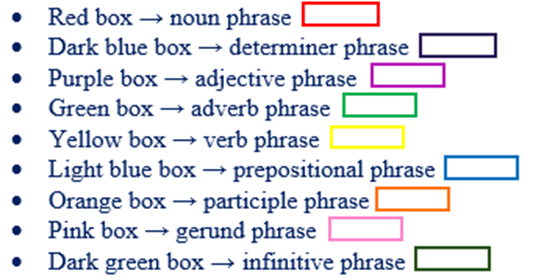
For now, place compound participle adjectives or noun adjuncts, inside the adjective phrase. When we dive deep into verbals and noun adjuncts, we will break them into their own phrase boxes. The goal is to show how grammar concepts advance from simple to complex.

A compound turns multiple small words into a single, potent ingredient.
Words of Wisdom
“An amazing friend encourages and celebrates another person’s success, even while facin personal struggles.”