
Welcome back, potion makers of language!
So far, your grammar potions have named people, places, things, and ideas; replaced noun phrases with pronouns; added color with adjectives; and shaped actions through tense and aspect. Now we add a shimmering ingredient that lets your sentence move through time: adverbs of time.
Adverbs of time inform your reader about when an action occurs, its duration, or if it is still expected, already finished, or not yet concluded. They are the tiny clock charms of the sentence. A single word like now, yesterday, still, or yet can change the time flavor of the entire verb phrase.
Compare:
- The wizard studies.
- The wizard studies tonight.
- The wizard still studies.
- The wizard has not studied yet.
Each sentence contains a different time spell.
In lesson 9, we studied adverbs of frequency, which tell how often something happens. In this lesson, we widen the cauldron and study adverbs of time, the larger category that includes words and phrases that answer When?, How long?, and How soon?
As you work through this lesson, remember that adverbs are flexible ingredients. They can appear at the beginning, middle, or end of a sentence, depending on meaning, emphasis, and structure. The key is not just knowing the word but placing it correctly so the potion does not bubble over.
Review: What Adverbs Do
Adverbs modify or alter the meaning of verbs, adjectives, other adverbs, and sometimes entire clauses by indicating the time frame, place, manner, reason, frequency, degree, focus, viewpoint, or evaluation.
Adverbs help answer the following questions:
- Where?
- When?
- How?
- Why?
- To what extent?
Reference Note: In Lesson 9, we introduced adverbs of frequency. In Lessons 14, 17, and 19, we saw how adverbs interact with progressive verb phrases. In this lesson, we focus specifically on adverbs of time.
Forming Adverbs from Adjectives
Many regular adverbs are formed by adding “-ly” to the end of an adjective. However, several spelling rules apply depending on the ending of the adjective.
1. Most adjectives form adverbs by adding “-ly” to the adjective
- quick → quickly
- slow → slowly
2. Adjective ending in “-ic” usually add “-ally”
- basic → basically
- dramatic → dramatically
3. Adjective ending in “-y” change -y to -i and add “-ly”
- happy → happily
- angry → angrily
4. Adjective ending in “-le” usually drop “e” and add “-y”
- gentle → gently
- simple → simply
5. Adjectives already ending in “-ly” usually use a phrase instead of forming another -ly word.
- friendly → in a friendly manner
- lively → in a lively way
6. Irregular adverbs do not follow standard spelling rules.
- good → well
The time has come to work on how you want to keep these spelling patterns in your long-term memory.
Adverbs of Time
Adverbs of time answer the questions When?, How long?, or How soon? They tell when something happens or for how long it occurs.
Common adverbs of time include:
- Now, tomorrow, yesterday, still, yet, later, tonight, next week, early, then, before, soon, already, recently, eventually, shortly, briefly
Examples:
- She studies now.
- The dragon arrived yesterday.
- We will practice tomorrow.
- The potion is still bubbling.
- He has not finished yet.
Subcategory: Adverbs of Frequency
Adverbs of frequency are a type of adverb of time. They describe how often something happens.
Definite adverbs of frequency indicate a specific or exact frequency.
- Examples: daily, weekly, monthly, yearly, hourly, twice, every morning, once a week
Indefinite adverbs of frequency indicate a general or unspecific frequency.
- Examples: always, usually, often, sometimes, rarely, seldom, never
Reference Note: In Lesson 9, we learned that adverbs of frequency typically modify verbs and sometimes adjectives.
Placement of Adverbs of Time
Adverbs of time primarily modify verbs and may appear in various places within a sentence. Their position often depends on sentence structure, emphasis, and the specific adverb being used.
Common positions include:
1. End position
2. Introductory position
3. Middle position
4. Special placement, depending on words such as still, yet, and already
In the diagrams, elements in parentheses () indicate that the element is optional because not all sentences have the same structure.
The verb complement may be an indirect object, a direct object, a predicate nominative, a predicate adjective, or an adverbial complement.
Reference Note
- Lesson 11 introduced predicate nominatives, predicate adjectives, and adverbial complements.
- Lesson 12 introduced indirect objects.
- Lesson 14 introduced auxiliary verbs in the present progressive tense.
- Lesson 18 introduced the modal auxiliary verb will.
- Lesson 58 will contain a more detailed chart showing how different adverbial phrases interact with each other. When other adverbial phrases (prepositional, infinitive, participle) are present, placement may shift.
Modifying Verbs
1. End Position
- Adverbs of time are most often placed at the end of a sentence.
- She watches the kids tomorrow.
- She will watch the kids tomorrow.
Structure: NP subject + VP → (Auxiliary Verbs) + Verb + (Verb Complements) + (Adverb)
Note: In Lesson 8, we studied the simple present tense. Although the simple present often expresses habits or general truths, it can also describe scheduled future events. In Lesson 18, we learned that will can also express future time.
2. Introductory Position for Emphasis
- For emphasis, place the adverb of time at the beginning of the sentence. Introductory adverbs or adverbial phrases are often followed by a comma.
- Tomorrow, she watches the kids.
- Tonight, the wizard studies.
- Next week, we will review the spell.
Structure: (Adverb), NP subject + VP → (Auxiliary Verbs) + Verb + (Verb Complements)
3. “Later”
- The adverb “later” often appears at the end of the sentence.
- She speaks to the mayor later.
- We will finish the potion later.
- It can also appear after the main verb in a formal or marked structure.
- She speaks later to the mayor.
Structure: NP subject + VP → (Auxiliary Verbs) + Verb + (Adverb “later”) + (Verb Complements)
4. Special Time Adverb: “Yet”
Some adverbs of time follow special placement patterns. Two important examples are yet and still.
- With the word “yet” commonly used in negative sentences or questions. It often suggests that something is expected but has not happened.
- “Yet” appears at end of a negative sentence.
- Mike has not done his homework yet.
Structure: NP subject + VP → (Auxiliary Verbs) + Verb + (Verb Complements) + (Adverb “yet”)
- In more formal writing, “yet” may appear after “not” and before the main verb.
- I have not yet driven the car.
Structure: NP subject + VP → (Auxiliary Verbs) + (Adverb “not” “yet”) + Verb + (Verb Complements)
- When “yet” means something like “still possible,” it can appear between a modal auxiliary verb and the main verb.
- I might yet write a book.
Structure: NP subject + VP → (Auxiliary Verbs) + (Adverb “yet”) + Verb + (Verb Complements)
Reference Note: In Lesson 18, we studied the modal auxiliary verb “will.” Later lessons will examine other modal auxiliaries such as might, may, can, and could.
5. Special Time Adverb: “Still”
The adverb “still” describes something that continues to be true or continues to happen.
- In a yes-or-no questions, “still” usually appears after the subject and before the main verb.
- Are you still doing homework?
Structure: Auxiliary Verbs + NP subject + (Adverb “still”) + Verb + (Verb Complements)?
- In negative sentences, “still” often appears before the auxiliary verb or before the negative verb phrase.
- She still does not swim.
- She still will not swim.
- She will still not swim tomorrow.
- The dragon still will not leave the cave.
Structure: NP subject + VP → (Adverb “still”) + (Auxiliary Verbs) + (Adverb “not”) + Verb + (Verb Complements)
Structure: NP subject + VP → (Auxiliary Verbs) + (Adverb “still”) + (Adverb “not”) + Verb + (Verb Complements)
Potion Note: When “still” comes before “will,” it often emphasizes that the subject continues to refuse or continues in the same state. When still comes after will, it often emphasizes that the situation will continue into the future.
- In a positive sentence, when a sentence has an auxiliary verb, “still” usually appears after the auxiliary verb and before the main verb.
- She is still swimming.
Structure: NP subject + VP → (Auxiliary Verbs) + (Adverb “still”) + Verb + (Verb Complements)
- With modal auxiliary verbs such as may, might, can, and could, “still” often appears before the modal auxiliary verb, especially when emphasizing continuing possibility.
- She still might change her mind.
Structure: NP subject + VP → (Adverb “still”) + (Auxiliary Verbs) + Verb + (Verb Complements)
Later in this course, we will explore other modal auxiliaries and techniques for forming questions. For now, these structures can rest quietly in your notes, waiting for the lesson where we examine them more deeply. They are included here as helpful reference points for moments when you are specifically looking for how to use them.
Adverb Complements
Adverbs of time are the clock charms of grammar. They tell your reader whether the spell happened yesterday, is happening now, will happen tomorrow, or has not happened yet. As you continue brewing stronger sentences, pay attention not only to which adverb you choose, but also where you place it. In grammar, time is not just measured—it is arranged.
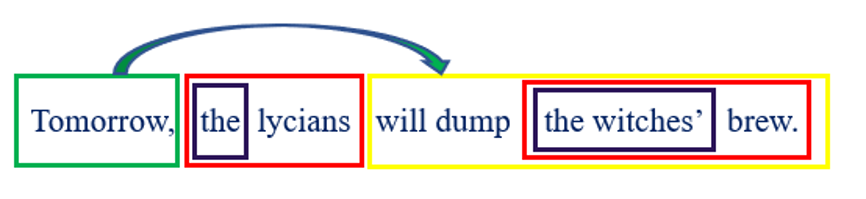
Boxing in Phrases
If you like, place an arrow and point what is modifying, but it is not necessary.

Words of Wisdom
“Time seems unlimited until you have no more.”