
Welcome back, grammar potion brewer!
In Lesson 34, we used adverbs of time to place actions on the clock. In Lesson 35, we used adverbs of place to guide actions through space. In Lesson 36, we used adverbs of manner to alter how an action was performed. Now we add a measuring ingredient: the adverb of degree.
Adverbs of degree tell us how much, how little, how strongly, or to what extent something is true. They can turn a small flame into a very bright flame, a hard spell into a slightly difficult spell, or a finished task into an almost finished task.
Compare:
- The potion is hot.
- The potion is slightly hot.
- The potion is very hot.
- The potion is too hot.
- The potion is completely ruined.
Each adverb changes the strength of the description. Some degree adverbs soften meaning. Others intensify it. A few announce that the cauldron has gone past the safe bubbling stage and entered “everyone step back” territory.
Adverbs of degree are the measuring drops of grammar. Use too little, and the meaning may feel weak. Use too much, and the sentence may overflow.
Adverbs of Degree
Adverbs of degree show the intensity, degree, or extent of the verb, adjective, or adverb.
They answer questions such as:
- To what extent?
- How much?
- How strongly?
- How completely?
Examples:
- The spell is slightly dangerous.
- The dragon very sleepy.
- She speaks quite softly.
- He almost fell.
- The potion is completely ruined.
Adverbs of degree can modify:
- verbs
- adjectives
- adverbs
Placement of Adverbs of Degree: Modifying Verbs
1. Before the Main Verb
- Some adverbs of degree can modify verbs. When they do, they often appear before the main verb.
- I almost forgot the spell.
- She nearly dropped the wand.
Structure: NP subject + VP → (Auxiliary Verbs) + (Adverb) + Verb + (Verb Complements)
2. After the Verb Complement with “Somewhat”
- The adverb “somewhat” can also appear after the verb complement, though this may sound more formal or marked.
- I am studying history somewhat.
- She knows the answer somewhat.
Structure: NP subject + VP → (Auxiliary Verbs) + Verb + (Verb Complements) + (Adverb “somewhat”)
Potion Note: Not every adverb of degree can modify a verb directly. For example, “very” and “too” usually modify adjectives or adverbs, not verbs.
Correct:
- She is very brave.
- She works very carefully.
Not:
- She very studies.
Placement of Adverbs of Degree: Modifying Adjectives
- Most adverbs of degree appear before the adjective they modify.
- The slightly bluish paint covers the large desk.
- The remarkably brave child faced the monster.
Structure: Noun Phrase → (Determiner Phrase) + [Adjective Phrase → (Adverb) + Adjective] + (Noun Adjunct) + Noun
Placement of Adverbs of Degree: Modifying Adverbs
- Adverbs of degree always appear before the adverb it modifies.
- She speaks very softly.
- The apprentice worked quite carefully.
Placement of Adverbs of Degree: Special Cases: “Enough,” “Too,” and “Very
1. “Enough”
- Enough meaning to the necessary degree.
- Unlike most adverbs of degree, “enough” usually appears after the adjective or adverb it modifies.
- She studies hard enough.
- The potion is warm enough.
- The apprentice is brave enough.
Structure: Adverb Phrase → Adverb + (Adverb “enough”)
Structure: Noun Phrase → (Determiner Phrase) + [Adjective Phrase → + Adjective + (Adverb “enough”)] + (Noun Adjunct) + Noun
Potion Note: When “enough” modifies a noun, it works differently.
- Example: We have enough candles.
- In this sentence, “enough” modifies the noun candles, so it is functioning as a determiner or quantifier, not as an adverb of degree.
2. “Too”
- “Too” means excessively, or more than is useful, safe, or necessary.
- It appears before adjectives and adverbs.
- The hot chocolate is too hot.
- The dragon roared too loudly.
Structure: Adverb Phrase → (Adverb “too”) + Adverb
Structure: Noun Phrase → (Determiner Phrase) + [Adjective Phrase → (Adverb “too”) + Adjective] + (Noun Adjunct) + Noun
Potion Note: Think of “too” as the “overkill” charm. It tells the reader that something has gone beyond a helpful amount.
3. “Very”
- “Very” means to a high degree. It intensifies adjectives and adverbs
- She works very hard.
- The potion bubbled very quietly.
Structure: Adverb Phrase → (Adverb “very”) + Adverb
Structure: Noun Phrase → (Determiner Phrase) + [Adjective Phrase → (Adverb “very”) + Adjective] + (Noun Adjunct) + Noun
Potion Warning: “Very” usually does not modify verbs directly.
- Correct: The apprentice works very carefully.
- Not standard: The apprentice very works.
Degrees of Intensity
Adverbs of degree can describe intensity at four levels:
- Mild: slightly, somewhat, fairly, mildly, marginally, relatively
- Medium: quite, reasonably, moderately, pretty, rather, essentially, mostly, comparatively
- Strong: very, extremely, incredibly, remarkably, awfully, highly, exceedingly, tremendously
- Absolute: absolutely, completely, totally, entirely, perfectly, utterly, thoroughly, wholly, decidedly
Potion Note: Some adverbs can shift level depending on context, tone, and dialect. For example, “quite” can mean “somewhat” or “completely” depending on how it is used.
Subcategories of Adverbs of Degree
1. Mitigators reduce their intensity, making them seem less extreme or powerful.
Examples:
- slightly, somewhat, fairly, a bit, mildly, rather
Example sentences:
- She is a bit difficult.
- The potion is slightly warm.
- He was somewhat confused.
- The spell was fairly simple.
Mitigators are typically mild and medium in strength.
2. Intensifiers increase intensity. They make the meaning stronger.
Examples:
- very, remarkably, extremely, amazingly, incredibly, completely, exceptionally, super, really
Example sentences:
- He is incredibly happy.
- The dragon is extremely loud.
- The answer is completely wrong.
- She was remarkably calm.
Intensifiers are usually strong or absolute.
Gradable vs Non-Gradable Words
Not all adjectives and adverbs can be modified in the same way.
1. Gradable Adjectives
Gradable adjectives describe qualities that can exist in degrees. Something can be a little, somewhat, very, or extremely this quality.
Examples:
- Small, cold, hot, difficult, slow, fast, quick, light, heavy, young, old, new, warm, narrow, wide, deep, shallow, calm, tricky
Example Sentences:
- The room is slightly cold.
- The test was very difficult.
- The road is extremely narrow.
2. Non-gradable Adjectives
Non-gradable adjectives describe meanings that are usually absolute, complete, or not easily measured by degree.
Examples:
- impossible, freezing, unique, perfect, dead, infinite, impossible, empty, full, first, last
Example sentences:
- The task is completely impossible.
- The room is totally empty.
- The answer is absolutely prefect.
Potion Note: In everyday speech, people sometimes use degree adverbs with non-gradable adjectives for emphasis.
Examples:
- Very unique
- Almost perfect
- Completely full
Formal grammar may treat some of these carefully, but writers use them for style, emphasis, or conversational tone.
3. Gradable Adverbs
Gradable adverbs describe actions in ways that can exist in degrees.
Examples:
- quickly, easily, carefully, slowly, always, frequently, seldom, rarely, soon, here, there, certainly
Example Sentences:
- She speaks very softly.
- He ran extremely quickly.
- The apprentice worked fairly carefully.
4. Non-grading Adverbs
Non-grading adverbs do not naturally accept many degree modifiers because their meanings already point to a fixed time, place, frequency, or certainty.
Examples:
- Yesterday, tomorrow, here, there, never, once, already, definitely, undoubtedly
However, some of these words can still appear with special modifiers in specific contexts.
Examples:
- Almost never
- Not quite there
- Nearly always
Potion Note: English loves exceptions. The goal is not to memorize every possible combination; the goal is to notice whether the meaning can logically increase, decrease, or become more complete.
Making Connections
1. Gradable adjectives can be modified by degree adverbs.
- Example: She is very tall.
“Tall” is gradable because height can exist in degrees.
2. Non-grading adjectives are often modified by absolute intensifiers.
- Example: The battle is completely impossible.
“Impossible” is usually non-gradable because something is either possible or impossible.
3. Some adverbs work with both gradable and non-gradable adjectives.
Words such as “really” and “quite” can appear with both gradable and non-gradable adjectives, though their meaning may shift.
Example Sentences:
- She is really tall.
- That answer is really impossible.
- The spell is quite difficult.
- The room is quite empty.
Careful Note: Words such as “fairly” and “pretty” usually sound more natural with gradable adjectives.
Natural:
- Pretty good
- Fairly easy
- Pretty tall
Less natural:
- Fairly impossible
- Fairly dead
- Pretty infinite
Creative Writing: Present-Time Narration
In Lesson 36, we learned that writers choose one main time frame and stay consistent unless they have a clear reason to shift. Tense is the time spell of a story, and aspect shapes how the action unfolds inside that time.
In this creative writing section, we will focus on present-time narration.
A writer may choose the present time frame to make a scene feel immediate, vivid, or alive in the moment.
Simple Present
The simple present can make a scene feel immediate, dramatic, or timeless.
Example:
- Mara opens the gate.
- She steps quietly inside.
- The dragon watches from the tower.
This narration feels as if the reader is watching the scene happen right now. The simple present tense often propels the action forward.
Present Progressive
The present progressive shows an action happening right now or unfolding in progress.
Example:
- Mara is opening the gate.
- She is stepping quietly inside.
- The dragon is watching from the tower.
This narration slows the moment down and shows the action as ongoing.
Shifting Aspects Inside the Present Time Frame
A present-time story can shift between simple present and present progressive without leaving the present time frame.
Example:
- Mara opens the gate. Rain is falling over the courtyard. The dragon watches from the tower while the torches are flickering in the wind.
This paragraph stays in the present time frame.
Verbs forms:
- opens = simple present
- is falling = present progressive
- watches = simple present
- are flickering = present progressive
Potion Note: When narrating in the present, the simple present tense is frequently used to move the scene forward, while the present progressive tense depicts ongoing actions or events happening at that time.
Same Scene with Adverbs of Degree
Adverbs of degree can help control the intensity of a scene.
Without adverbs of degree:
- Mara opens the gate. The room is dark. The dragon watches quietly.
With adverbs of degree:
- Mara opens the gate. The room is almost dark. The dragon watches very quietly.
Another version:
- Mara opens the gate. The room is completely dark. The dragon watches too quietly.
A single measuring charm can make a scene softer, stronger, or more dangerous.
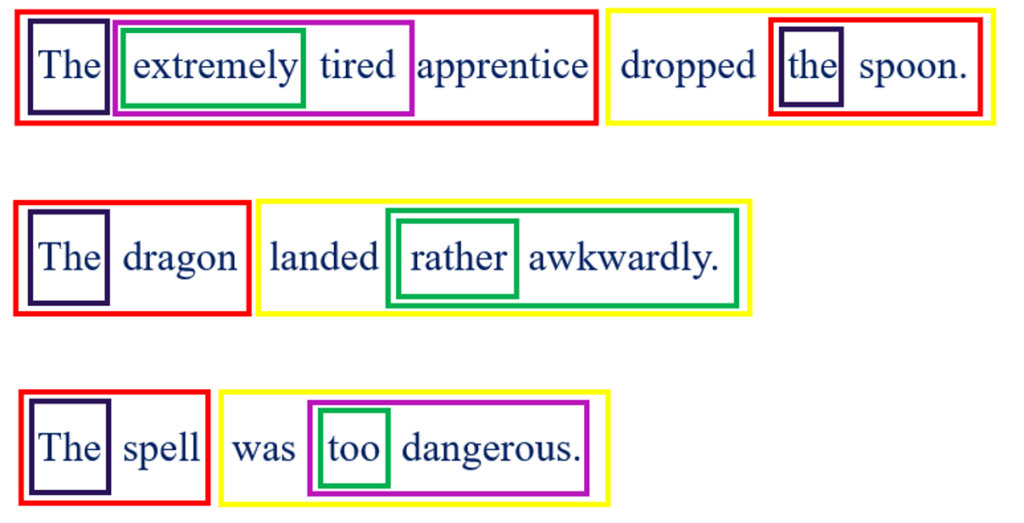
Boxing in Phrases
Place a green box around the adverb phrase.
Words of Wisdom
“Do not let another person’s words pull your eyes from the goal.”