
Welcome back, grammar potion brewer!
In our recent adverb lessons, we have learned to place actions in time, guide them through space, alter how actions happen, measure their intensity, and focus the reader’s attention. Now we add an adverb that does something even more personal: it reveals the speaker’s mind.
Evaluative adverbs are comment charms/ingredients. They allow the speaker or writer to comment on an entire statement by showing certainty, attitude, or judgment.
Compare:
- You lost the dog.
- Clearly, you lost the dog.
- Fortunately, you found the dog.
- Foolishly, you blamed the cat.
The basic event changes very little, but the speaker’s view becomes visible. “Clearly” shows certainty. “Fortunately” shows attitude. “Foolishly” judges the action. Evaluative adverbs do not merely decorate a sentence; they reveal how the speaker interprets the sentence.
Use them carefully. A single evaluative adverb can make a sentence sound confident, doubtful, grateful, annoyed, amused, or deeply suspicious of the cat.
Evaluative Adverbs
Evaluative adverbs comment on a clause by showing the speaker’s opinion, attitude, judgment, or level of certainty about the statement.
They often modify the entire clause, not just a single word.
Examples:
- Obviously, the potion failed.
- Luckily, no one drank it.
- Foolishly, the apprentice stirred it again.
- Probably, the cauldron needs cleaning.
The part of the sentence affected by the adverb is called its scope. When an evaluative adverb modifies the whole clause, its scope is the entire statement.
Example:
- Fortunately, the dragon was asleep.
Here, “fortunately” comments on the whole idea: The dragon was asleep.
Types of Evaluative Adverbs
Evaluative adverbs can be grouped by the kind of comment they make.
1. Certainty Adverbs
Certainty adverbs show how sure the speaker is about the statement.
Examples:
- apparently
- clearly
- definitely
- doubtfully
- doubtlessly
- evidently
- obviously
- probably
- presumably
- supposedly
Example Sentences:
- Clearly, you lost the dog.
- Apparently, the spell worked.
- Probably, the dragon is sleeping.
- Obviously, the potion exploded.
2. Attitude Adverbs
Attitude adverbs show how the speaker feels about the situation.
Examples:
- astonishingly
- fortunately
- frankly
- hopefully
- interestingly
- luckily
- amazingly
- curiously
- mercifully
- miraculously
- oddly
- predictably
- regrettably
- sadly
- strangely
- surprisingly
- unfortunately
Example Sentence:
- Fortunately, she survived.
- Interestingly, the spell worked backward.
- Oddly, the cat refused the fish.
- Predictably, the goblin blamed someone else.
3. Judgment Adverbs
Judgment adverbs show the speaker’s judgment about an action, behavior, or decision.
Examples:
- bravely
- carelessly
- foolishly
- generously
- kindly
- rightly
- shamefully
- unfairly
- wisely
- wrongly
Examples Sentences:
- Foolishly, the gods considered execution.
- Bravely, the knight faced the monster.
- Generously, Mara shared her last candle.
- Unfairly, the council blamed the apprentice.
Potion Note: Some adverbs can shift categories based on their usage. For example, “honestly” can comment on the whole statement, but it can also describe how someone speaks or acts.
Shifting Adverbs: Same Word, Different Job
Some adverbs can change category depending on sentence position and meaning.
1. “Honestly”
Evaluative Adverb:
- Honestly, I forgot the spell.
- Here, “honestly” comments on the speaker’s attitude toward the whole statement. It suggests frankness or sincerity.
Adverb of Manner:
- She answered honestly.
- Here, “honestly” tells how she answered.
2. “Bravely”
Evaluative Adverb:
- Bravely, the knight faced the monster.
- Here, “bravely” comments on the knight’s action as brave.
Adverb of Manner:
- The knight fought bravely.
- Here, “bravely” describes how the knight fought.
3. “Frankly”
Evaluative Adverb:
- Frankly, I disagree.
- Here, “frankly” comments on the speaker’s directness.
Adverb of Manner:
- She spoke frankly.
- Here, “frankly” tells how she spoke.
Potion Note: Commas influence the interpretation of an adverb. An introductory adverb may still describe how an action happens: Carefully, she carried the potion. However, when certain adverbs appear at the end of a sentence and a comma sets them off, they often comment on the whole clause: She answered, honestly. Some ambiguity of meaning is unavoidable, but careful placement helps guide the reader.
Placement of Evaluation Adverbs: Attitude and Certainty
1. Introductory Position
- Evaluative adverbs of attitude or certainty often appear at the beginning of a sentence. A comma usually follows them.
- Clearly, you lost the dog.
- Fortunately, the dog came home.
- Apparently, the spell worked.
- Honestly, I forgot the instructions.
Structure: (Adverb), NP subject + VP → (Auxiliary Verbs) + Verb + (Verb Complements)
In this position, the evaluative adverb usually comments on the whole clause.
2. End Position
- Evaluative adverbs can also appear at the end of the sentence. A comma often precedes them.
- You lost the dog, clearly.
- The spell failed, unfortunately.
Structure: NP subject + VP → (Auxiliary Verbs) + Verb + (Verb Complements), (Adverb)
The end-position can sound conversational, reflective, or afterthought-like.
3. After the Subject
- Some evaluative adverbs, especially adverbs of certainty, can appear after the subject and before the main verb.
- Mark probably gave her the pizza.
- The dragon apparently left the cave.
- She definitely knows the answer.
Structure: NP subject + VP → (Adverb) + (Auxiliary Verbs) + Verb + (Verb Complements)
4. With the Verb “To Be”
- Words such as “probably” and “definitely” often appear after the verb “to be”.
- I am definitely beautiful.
- The answer is probably correct.
- The potion is clearly dangerous.
Structure: NP subject + VP → Verb “to be” + (Adverb) + Verb Complement
Potion Note: In a sentence like I am definitely beautiful, the adverb “definitely” sits before the predicate adjective “beautiful,” but it usually expresses certainty about the whole statement I am beautiful. It does not describe the type of beauty.
Compare:
- I am very beautiful.
- “Very” modifies beautiful as an adverb of degree.
- I am definitely beautiful.
- “Definitely” comments on the certainty of the whole claim.
Treat “definitely” as an evaluative adverb in the verb phrase rather than as part of the adjective phrase.
Placement of Evaluation Adverbs: Judgment
1. After the Subject or After an Auxiliary Verb
- When expressing judgment, the adverb often appears after the subject and before the main verb. If there is an auxiliary verb, it often appears between the auxiliary verb and the main verb.
- The kids unfairly played soccer.
- The council foolishly blamed the apprentice.
- The gods have foolishly ignored the warning.
Structure: NP subject + VP → (Auxiliary Verbs) + (Adverb) + Verb + (Verb Complements)
In these sentences, the adverb judges the action or behavior.
Potion Note: Judgment adverbs often appear near the verb, but they may judge the whole event. In The council foolishly blamed the apprentice, “foolishly” evaluates the decision to blame the apprentice, not merely the manner of blaming.
2. Introductory Position for Emphasis
- For emphasis, place the judgment adverb at the beginning of the sentence and follow it with a comma.
- Foolishly, the gods consider execution.
- Bravely, the knight faced the monster.
- Carelessly, the apprentice dropped the crystal.
- Wisely, the queen waited for more evidence.
Structure: (Adverb), NP subject + VP → (Auxiliary Verbs) + Verb + (Verb Complements)
Introductory placement makes the speaker’s judgment clear before the action unfolds.
3. End-Position
- End-position is possible, but it can sound awkward, conversational, or like an afterthought.
- The council blamed the apprentice, unfairly.
- The knight faced the monster, bravely.
- The plan failed, honestly.
Structure: NP subject + VP → (Auxiliary Verbs) + Verb + (Verb Complements), (Adverb)
Potion Note: Speakers often sound like they are adding a final comment after they have already brewed the sentence when they use end-position evaluative adverbs.
Manner adverbs explain the way someone performs an action. Judgment adverbs evaluate the action, the decision, or the behavior.
Creative Writing: Future-Time Narration
In Lesson 36, we learned writers choose one main time frame and stay consistent unless they have a logical reason shift. In Lesson 37, we practiced present-time narration. In Lesson 38, we practiced past-time narration. Now we look forward to what has not happened yet: future-time narration.
A writer may choose the future time frame to create prophecy, warning, planning, promise, suspense, or expectation.
Simple Future
The simple future tense presents actions that will happen later.
Example:
- Mara will open the gate.
- She will step quietly inside.
- The dragon will watch from the tower.
This narration feels predicated, planned, or promised. It points toward events that have not happened yet.
Future Progressive
The future progressive tense shows that an action will be happening at a future time.
Example:
- Mara will be opening the gate at midnight.
- Rain will be falling over the courtyard.
- The dragon will be watching from the tower.
This narration makes the future feel active and unfolding.
Shifting Aspects within the Future Time Frame
A future-time story can shift between the simple future and the future progressive without leaving the future time frame.
Example:
- At midnight, Mara will open the gate. Rain will be falling over the courtyard. The dragon will watch from the tower while the torches will be flickering in the wind.
This paragraph stays in the future time frame.
Verb forms:
- will open = simple future
- will be falling = future progressive
- will watch = simple future
- will be flickering = future progressive
Potion Note: In future-time narration, the simple future often tells what will happen, while the future progressive shows what will be happening at a future moment.
Same Scene with Evaluative Adverbs
Evaluative adverbs help a narrator reveal attitude, certainty, or judgement.
Without evaluative adverbs:
- Mara will open the gate. The dragon will watch from the tower. The spell will fail.
With evaluative adverbs:
- Probably, Mara will open the gate. Ominously, the dragon will watch from the tower. Unfortunately, the spell will fail.
Notice how the evaluative adverbs change the narrator’s voice:
- “Probably” shows uncertainty.
- “Ominously” creates a threatening mood.
- “Unfortunately” shows the narrator’s attitude about the failure.
Evaluative adverbs do not merely tell what happens. They reveal how the narrator interprets what happens.
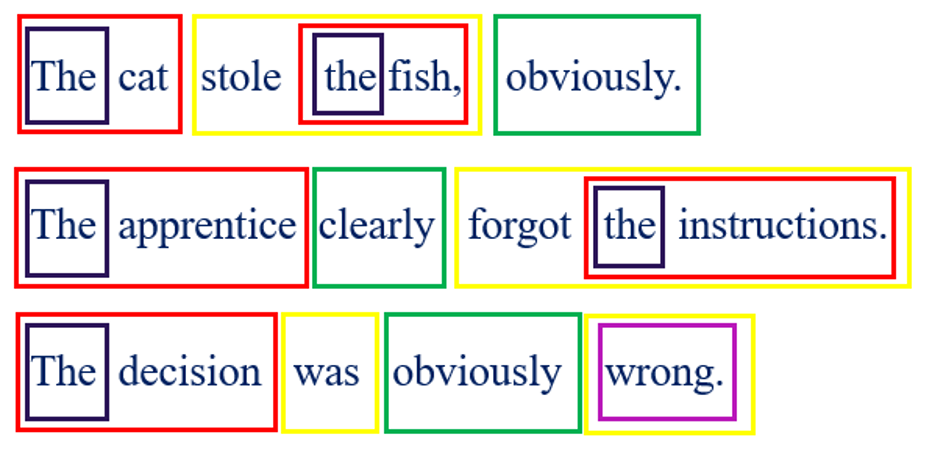
Boxing in Phrase
Place a green box around the evaluative adverb. Since an evaluative adverb modify the entire clause, do not place them inside the verb phrase. Think of the evaluative adverb as an interruption: it may appear at the beginning, middle, or end of the sentence, but its meaning often reaches over the whole clause.
Words of Wisdom
“A wise person separates what happened from how they feel about it.”