
Young wizard of words, we journey to explore the mystical art of distributive determiners. These magical words help us refer to individual members of a group, either collectively or separately.
The Enchanted Members
Both: two items make a pair
- Example: Both cakes taste delicious.
- “Both” must be followed by a plural noun.
Each: refers to a single individual in a group, considered separately, each fulfilling the same condition.
- Example: Each tree needs water.
- Use “each” with a singular noun.
Every: refers to all individual members of a group, considered one by one.
- Example: Every member drives a school bus.
- Use “every” before a singular noun.
Either: refers to one of two options that can satisfy requirement, or condition.
- Example: Either kid can wash the dishes daily.
- Use “either” before a singular noun.
Neither: the two options you have will not be able to follow the action or condition
- Example: Neither kid washes the dishes.
- Use “neither” before a singular noun.
Determiner Phrase Rules

Rule 1: Cardinal Adjective and Distributive Determiners.
- Distributive determiners do not normally combine directly with a cardinal number when both independently count the same noun. However, they may occur together when the number belongs to a measurement, compound modifier, interval, or subgroup expression.
- Example: each two-hour session
- Example: every three days
- Example: either five-page version
- Example: both two-bedroom apartments
- Example: both five-page reports
Rule 2: Ordinal Adjective and Distributive Determiners.
- Distributive may come in front of ordinal adjective.
- Example: Each first muffin gets to be tasted.
- Example: Both first place winner and second place winner won the jackpot.
- Example: Every first prize winner signs a business contract.
- Example: Either the first option or the second option is acceptable.
- Example: Neither the first nor the second book was good.
Rule 3: Articles and Distributive Determiners.
- “A” and “an” are not used with distributive determiners.
- Use “the” with “neither” and “either” when paired with ordinals.
- Example: Neither the first nor the second book was good.
- Example: Either the first option or the second option is acceptable.
Rule 4: Multipliers and Distributive Determiners.
- Structurally, multipliers occupy the predeterminer position, and distributive determiners occupy the central determiner position, so the two categories can combine within the same determiner phrase.
- Whether this combination sounds natural depends heavily on which multiplier is used and how familiar that usage is to the listener. Multipliers like “twice” function primarily as adverbs of frequency in everyday speech, so placing them before a distributive determiner can sound formal or unusual, but it remains grammatical.
- Example: Twice every wizard’s usual effort may improve the results.
- Multipliers like “double” and “triple, however, have very strong competing identities as verbs, adjectives, and nouns. Because of this, placing them directly before a distributive determiner often reads as ungrammatical or confusing, even though nothing in the determiner phrase structure technically forbids it.
- Awkward: Double every wizard’s effort will improve the results. (reads as a verb command, not a modified noun phrase)
- Clearer alternatives:
- Doubling every wizard’s effort may improve the results. (gerund)
- Twice every wizard’s usual effort may improve the results. (adverb-style multiplier)
Potion Rule: Grammatical possibility and natural usage are not the same thing. While the rules of determiner phrases technically allow a structure, native speakers may still find it unfamiliar or awkward. When a multiplier’s competing function (verb, adjective, noun, adverb) is stronger than its predeterminer function, writers often rephrase rather than force the combination.
Coordinating Conjunction
Coordinating conjunctions can beautifully connect the nouns modified by distributive determiners, whether through choice or exclusion. They define noun phrases based on these magical relationships:
- And combines equal phrases, clauses, and words.
- Nor connects to negative clauses, phrases together, and words.
- Or presents a choice between statements or options.
Look at the two compared examples to notice the flexibility of English.
1. Either/Or: Indicates only one subject in action.
- Example: Either kid can wash the dishes daily.
- Example: Either the first option or the second option is acceptable.
- Explanation: “Either” and “or” indicate a choice, meaning only one subject is active. Singular agreement follows, as it applies to one option at a time.
2. Neither/Nor: Denotes absence of action for both subjects.
- Example: Neither kid washes the dishes.
- Example: Neither the first book nor the second book was good.
- Explanation: “Neither” and “nor” denote an absence for two distinct subjects. While considered, singular agreement is used because no action occurs within either option.
3. Both/And: Plural subject agreement showcasing joint action.
- Example: Both winners won the jackpot.
- Example: Both first place winner and second place winner won the jackpot.
- Explanation: “Both” and “and” combine subjects into a plural noun phrase, showcasing joint action.
Parallel Construction
Parallel construction ensures that elements in a series or comparison share the same grammatical structure, enhancing fluency and coherence.
When parallel construction begins, all non-parallel elements are considered shared.
Example: Neither the first book nor the second book was good.
- Explanation: Initiated by the distributive determiner “Neither,” the parallel structure includes “definite article + ordinal adjective + noun.”
Example: Neither the first book nor second book was good.
- Explanation: The parallel structure starts with the “ordinal adjective + noun,” as “the” shared between the elements.
Example: Neither the first nor second book was good.
- Explanation: In this case, both “neither,” “the” and “book” are shared, while the parallel structure focuses on the “ordinal adjective,” to differentiate the elements. This works because the context makes it clear that both references are to “books,” and the primary distinction is their sequence. The shared elements ensure clarity and preserve the intended meaning, emphasizing the order as the differentiating factor.
Insight for Thought
Adjective phrases describe imagery or qualities of a noun. Determiner phrases provide definiteness, quantity, and possession, working together as a unit.
Boxing in Phrases
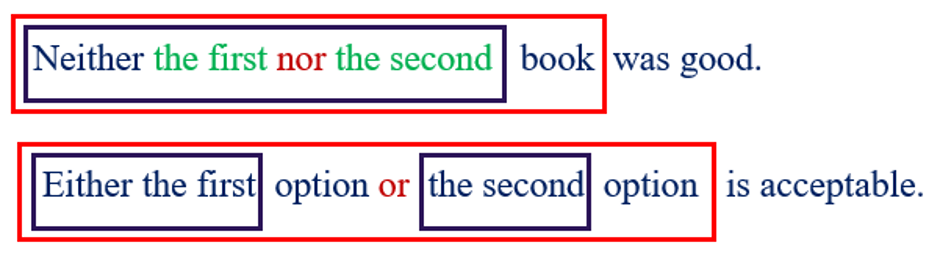
The distributive and coordinating conjunctions work together to create a single, cohesive noun phrase. The conjunction connects elements, ensuring they function as one grammatical unit rather than separate phrases.
Words of Wisdom
“Every hero chooses to live for something or die for something.”