
oung wizard of words, today we dive into the mystical art of possessive determiners and possessive nouns found within the language ingredient cabinet. These magical elements reveal ownership and define relationships, adding precision and clarity to your linguistic spells. To enchant your expression further, we will also expand the pronoun ingredient list, offering another way to convey possession.
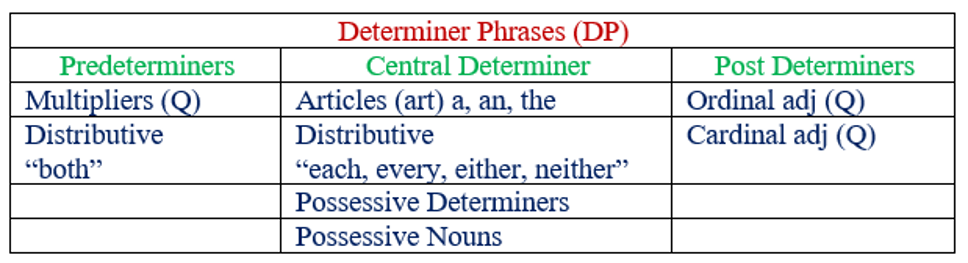
The determiner phrase is a syntactic unit in English grammar that introduces and modifies nouns. Within the DP, determiners can be classified into three main categories:
Possessive Nouns
Possessive nouns indicate ownership or a part-whole relationship. Possessive nouns function as determiners. The rules vary depending on the number and form of the noun:
1. Show Ownership
- Singular Nouns: Add an apostrophe + s
- Example: The boy’s house
- Singular Nouns ending in -s: Add an apostrophe + s or, following some style guides, just an apostrophe
- Example: James’s truck
- Example: James’ truck
- Regular Plural Nouns (ending in -s): Add an apostrophe
- Example: The boys’ clothes
- Irregular Plural Nouns: Add an apostrophe + s
- Example: The children’s toys
2. Part-Whole Relationship
Possessive nouns can indicate not just ownership but also part-whole relationships:
- Concrete Nouns: Can use apostrophe + s for tangible parts, or “of” prepositional phrase
- Example: The desk’s drawer
- Abstract Concepts: Prefer “of” construction which is the “of” prepositional phrase
- Example: The knowledge of science
Multiple and Compound Possessive Nouns
Nested Possession: It is grammatically correct to have a possessive noun possessing another possessive noun.
- Example: Adam’s wife’s name is Heather.
Articles and Possessive Nouns: Articles are not used with proper possessive nouns but may accompany common possessive nouns for clarity
- Example: The parents’ kids look extremely upset.
Shared Possession: When two or more nouns share possession, only the last noun takes the possessive form.
- Example: Chris and Perry’s boat
Separate Possession: Each noun takes the possessive form to indicate separate ownership.
- Example: Kieran’s and Elena’s mothers are doctors.
Compound Nouns: The possessive is added to the end of the compound.
- Example: My brother-in-law’s car
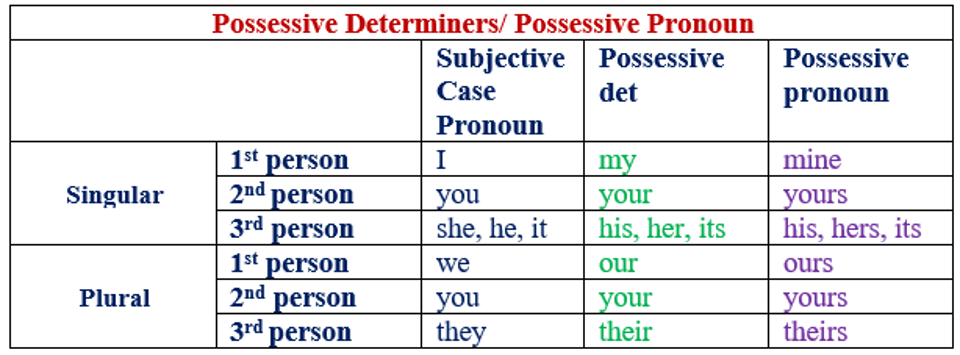
Possessive Determiners vs. Possessive Pronouns
Possessive determiners are traditionally called possessive adjectives. This curriculum primarily treats them as determiners because they identify the possessor and occupy the determiner position before a noun.
- Examples:
- My daughter’s name is Gabrielle.
- My daughter’s husband’s name is Tom.
Possessive pronouns: These replace the entire noun phrase (NP), performing two roles: indicating ownership and functioning as a pronoun.
- Examples:
- Mine works well.
- Use hers.
Possessive pronouns can replace the subject, direct object, and object of the preposition.
Key Differences
Understanding the difference between possessive determiners and possessive pronouns helps in crafting sentences that are more precise and elegant.
- Function: Determiners modify nouns; pronouns replace noun phrases.
- Placement: Determiners precede nouns; pronouns stand alone.
- Articles: Articles cannot precede possessive determiners of proper possessive nouns.
Determiner Phrase
Rule 1: Possessive Nouns or Possessive Determiners with Distributive Determiners
- Distributive determiners precede a possessive determiner or possessive noun.
- Example: Each student’s car has valid parking.
- Example: Both your cars have valid parking.
Rule 2: Possessive Nouns or Possessive Determiners with Articles
- Possessive determiners cannot precede articles.
- Example: Her book report was excellent.
- Ungrammatical: The her book report was excellent.
- Articles are not used with proper possessive nouns but may accompany common possessive nouns for clarity or emphasis.
- Example: The student’s car has valid parking.
- Meaning: A specific, already-identified student.
- Example: A student’s question interrupted the lecture.
- Meaning: Some unspecified, unidentified student
- Example: Mark’s question interrupted the lecture.
- Ungrammatical: The Mark’s question interrupted the lecture.
- Example: The student’s car has valid parking.
Potion Note: Articles must not only agree with the noun’s meaning, but they also cannot interfere with a determiner meaning already supplied elsewhere. A proper possessive noun such as “Mark’s” already identifies a specific possessor, so the writer does not need to use an article. A common possessive noun such as “student’s” does not carry that built-in specificity, so an article is needed to clarify whether the possessor is definite (the student’s) or indefinite (a student’s).
Rule 3: Possessive Nouns or Possessive Determiner with Multipliers
- Multipliers come before possessive nouns or possessive determiners.
- Example: Triple the students’ cars parked in the street.
- Example: Triple her savings will help her buy a car.
- These constructions are grammatical, but they can sound stiff or awkward in natural speech. Consider rephrasing for clarity:
- Example: The street had three times as many students’ cars parked.
- Example: Tripling her savings will help her buy a car.
Potion Note: Multipliers rely heavily on context to sound natural and clear. Multipliers only work when there is a shared understanding of the “normal” amount being multiplied. For example, “Triple the cars parked on the street” only makes sense if both speaker and listener already know how many cars there are usually. If the street normally has three cars but today has nine, the multiplier “triple” accurately describes the change, but only because the baseline of three is known or implied. Without that shared baseline, the sentence becomes vague or confusing.
Rule 4: Possessive Nouns or Possessive Determiners with Ordinal Adjectives
- The position of an ordinal number relative to a possessive noun depends on the meaning.
- Example: The second student’s car rolled down the hill.
- Meaning: The car belonging to the second student (ranking among students).
- Example: The second student’s car rolled down the hill.
- Example: The student’s second car rolled down the hill.
- Meaning: The second car belonging to that student (ranking among the student’s cars).
Potion Note: Word order changes the meaning here. Ask yourself: is the ordinal number ranking the possessor (student) or the possession (car)?
- Possessive determiners cannot shift position the way possessive nouns can. Since a possessive determiner entirely replaces the possessor’s name instead of modifying a noun phrase, you cannot separate it from the noun to create a “ranking the possessor” meaning.
- Example: Her second car rolled down the hill.
- Ungrammatical: Second her car rolled down the hill.
Rule 5: Possessive Nouns or Possessive Determiners with Cardinal Adjectives.
- Possessive nouns can appear before or after cardinal adjectives, depending on focus.
- Focus on Quantity: The six students’ cars have valid parking.
- Focus on Ownership: The students’ six cars have valid parking.
- Possessive determiners always come before cardinal adjectives.
- Example: Her six cars have valid parking.
- Not: Six her cars have valid parking.
Rule 6: Possessive Nouns with Inanimate Nouns
There is a debate among grammar authorities about using possessive forms with inanimate nouns. The most conservative view restricts possessives to animate nouns (people, animals), while modern usage often allows inanimate possessives.
- Traditional: The foot of the mountain (not the mountain’s foot)
- Modern/Permissible: The car’s engine
Alternative: A noun adjunct modifies another noun and can sometime replace a possessive construction.
- Example: hotel room (instead of the “hotel’s room”)
- Example: office lobby
To create diversity in writing, the mastery of possessive determiners, possessive nouns, and possessive pronouns is not merely a matter of memorizing forms but understanding their logic, function, and interaction within the determiner phrase. The distinctions between these forms, their syntactic placement, and their compatibility with other determiners are crucial for grammatical accuracy and stylistic elegance.
Advanced Concept
The word possessive is the familiar school term. It works well when the noun truly owns something: the wizard’s wand.
In more advanced grammar, this form is called the genitive case. A genitive noun is noun marked with ‘s or s’ that functions like a determiner before another noun.
The genitive does not only show ownership. It can show relationship, source, time, measure, association, authorship, or part-whole connection.
Every possessive noun is genitive, but not every genitive noun shows true possession.
| Genitive Meaning | Example | Meaning |
| Ownership | the wizard’s wand | the wand belongs to the wizard |
| Relationship | Adam’s wife | Adam is related to the person |
| Part-whole | the car’s engine | the engine is part of the car |
| Origin/source | the dragon’s roar | the roar comes from the dragon |
| Authorship/creation | the student’s essay | the student wrote the essay |
| Association | the city’s mayor | the mayor is connected to the city |
| Time/measure | a day’s work | work measured by one day |
| Classification | children’s books | books intended for children |
Many words traditionally called possessive nouns are better understood as genitive nouns because they show more than ownership.
Potion Rule: Possession is one genitive spell, but genitive cauldron holds many relationships.
Boxing in Phrases
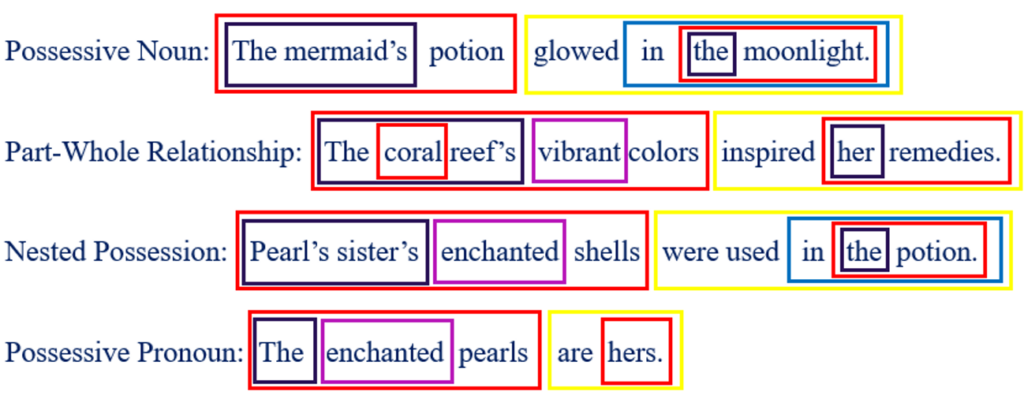
Note: “Coral reef’s” demonstrates a whole-to-part relationship. The reef is modified by “coral,” functioning as a noun adjunct. This highlights how possessive nouns retain the ability to be modified by noun adjuncts.
Words of Wisdom
“You will be a villain in someone’s life and the hero in someone else’s life.”