
In the magical realm of language, demonstrative determiners bring clarity to our expressions by highlighting the object, its distance, and its number. These magical words—this, that, these, those—guide us on our journey through sentences.
Understanding Demonstrative Determiners
Demonstrative determiners modify nouns by identifying the noun, showing its proximity to the speaker, and if the noun is singular or plural. Demonstrative determiners always come before the noun.
- Examples:
- This toy is amazing.
- These toys are amazing.
Additionally, the archaic demonstratives yon and yonder traditionally used to indicate object not near the speaker.
Determiner Phrase (DP)
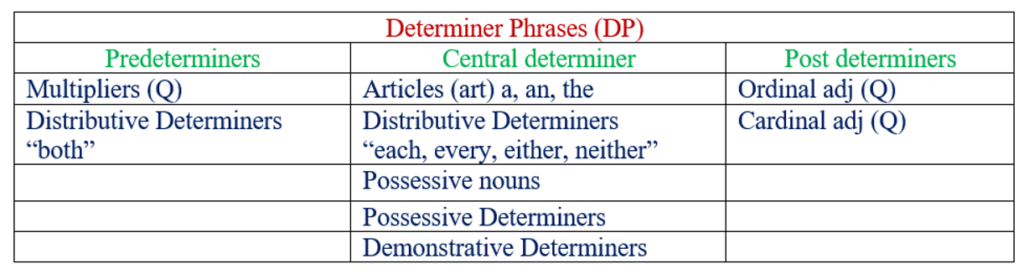
Rules for Demonstrative Determiners
Rule 1: Demonstrative Determiners with Multipliers
- Demonstrative determiners and multipliers cannot coexist in the same determiner phrase.
- Ungrammatical: Twice this toy is amazing.
Rule 2: Demonstrative Determiners with Distributive Determiners
- Demonstrative determiners and distributive determiners cannot coexist in the same determiner phrase.
- Ungrammatical: Each this toy is amazing.
Rule 3: Demonstrative Determiners with Articles
- Demonstrative determiners and articles cannot coexist in the same determiner phrase.
- Ungrammatical: The this toy is amazing.
Rule 4: Demonstrative Determiners with Possessive Determiners
- Demonstrative determiners and possessive determiners cannot coexist in the same determiner phrase.
- Ungrammatical: This his toy is amazing.
- Grammatical: This toy of his is amazing.
Potion Note: The structure “toy of his” is called a double genitive (or post-genitive). It lets a posssessive meaning follow the noun instead of competing for the determiner position before it.
Rule 5: Demonstrative Determiners with Possessive Nouns
- Demonstrative determiners and possessive nouns cannot coexist in the same determiner phrase.
- Ungrammatical: This Mark’s toy is amazing.
- Grammatical: This toy of Mark’s is amazing.
Potion Note: Like Rule 4, this uses the double genitive structure to resolve the conflich between the demonstrative and the possessive noun.
Rule 6: Demonstrative Determiners with Ordinal Adjectives
- Demonstrative determiners can pair with ordinal adjectives.
- Example: This second toy is amazing.
Rule 7: Demonstrative Determiners with Cardinal Adjectives
- Demonstrative determiners can also pair with cardinal adjectives.
- Example: These eight toys are amazing.
Boxing in Phrases
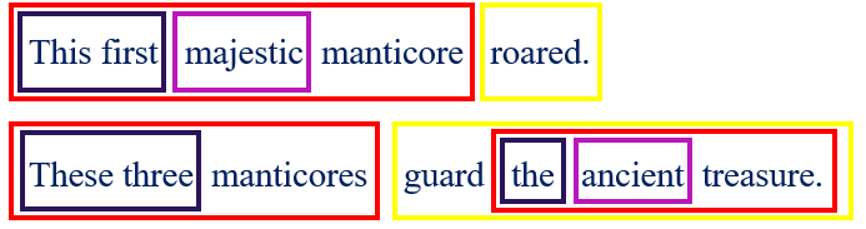
Creative Writing
The Unnamed Hero of the Stone City
The modern world grew from the bones of buildings constructed long before technology glowed in everyone’s hands. In this town, the man who lay on the stone street, resting against ancient walls, had nothing but time to ponder the men who built these structures.
For years, this hungry, dirty, and homeless man watched most people pass him by—a city buzzing with movement and technology had little use for a broken-bodied veteran. Yet he found solace in eavesdropping on conversations about political and military powers. He knew that a man with a country’s resources could change a city without notice.
Today, war visited this historic city. The sky exploded, and the building across from him began to crumble. The man, whose name was not known but whose face was familiar to many, shuffled to hold a door open, ensuring it didn’t get stuck.
He realized he wouldn’t move fast enough if the building continued to fall. With his body, he propped the door open, allowing the first group of people to escape.
“Go! Get to safety!” he urged, his voice raspy from years of silence.
As more people hurried past, his strength waned. Yet he held firm, driven by a sense of purpose rooted deep in his soul.
Finally, with the last person out, the door snapped shut. The city would remember his sacrifice, even if his name was forgotten.
Proverb: “A name is forgotten, but a deed is eternal.”
A proverb shares a universal truth to convey wisdom.
How to Break Up Scene Paragraphs
1 New Idea or Action: Start a new paragraph when the scene shifts to a new idea or action.
- Example: If a character moves from sitting to running, start a new paragraph.
2. Dialogue: Each time a different character speaks, use a new paragraph.
- Example:
- “Run!” shouted Alex.
- “I can’t!” replied Jamie.
3. Setting Change: When the location or time changes, begin a new paragraph to reflect this shift.
- Example:
- As the sun set, the shadows grew longer.
- Meanwhile, inside the cottage…
4. Character Focus: If you switch focus to a different character’s thoughts or actions, start a new paragraph.
- Example:
- Lily felt hopeful.
- Nearby, Jake worried about the journey ahead.
5. Pacing and Emphasis: Use shorter paragraphs for fast-paced action or to emphasize a dramatic moment.
- Example:
- The door slammed shut.
- Silence followed.
Previous Lessons
The following previous lessons will help you if you need to refresh on previous creative writing instructions:
- Lesson 13: Breaking up Dialogue
- Lesson 23: Creating Direct Speech
Words of Wisdom
“When you are the devil in someone’s story, leaving can be the most generous thing you can do for repentance.”