
Greetings, young alchemists of language!
Today, we return to the cauldron to explore a curious truth about English: some determiners can step out of their usual role and function pronominally. A word that normally stands before a noun may sometimes stand in for a noun phrase instead.
We will also examine how determiners interact with collective adjectives and other nominal adjectives, such as words naming nationalities and shared traits.
Prepare your linguistic ingredients, and let’s explore the secrets of these magical transformations.
Understanding Determiners as Pronouns
Some determiners can function pronominally by replacing a noun phrase that someone has already mentioned or that the context makes clear.
The noun phrase being replaced is called the antecedent.
Example
Each receives a test.
You can understand this sentence in two ways.
1. Elliptical construction
- Someone omits a noun because they understand it from context.
- Understood meaning: Each student receives a test.
2. Determiners function as pronouns.
- The determiner “each” functions pronominally by referring to the noun phrase “each student.”
Either way, the key idea is the same: the word refers to a noun that is known or understood.
Vocabulary
Elliptical construction: A word or phrase is omitted but understood from context.
Antecedent: The noun that is replaced by a pronoun.
Author’s Point of View
Some determiners can function as pronouns, or some pronouns can function as determiners.
Traditional grammar instruction taught me to expect a written subject in every sentence, except in imperative sentences where we imply an understood you. For that reason, I do not find the elliptical construction explanation entirely convincing in every case.Linguistic and grammar educators continue to debate how best to describe words that do not fit neatly into a single category. This is a reminder that many words can serve more than one function/job, and their meaning may shift depending on context.
Determiner Phrase (DP)
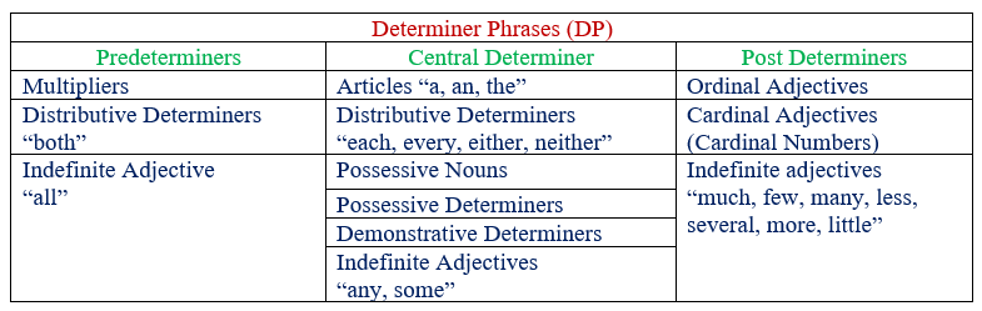
Words That Rarely Function as Pronouns
This usually strikes people as ungrammatical, but apparently, there might be times when it is used in creative writing.
- Multipliers
- Articles: a, an, the
- Ordinal Adjectives
- Possessive Determiners
Determiners as Pronouns
1. Some distributive determiners can function as pronouns: “each,” “either,” “neither,” “every,” and “both.”
- Determiner example: Each student received an apple.
- Pronoun example: Each received an apple.
An of-prepositional phrase (“of” construction) may follow when it is functioning pronominally and may help identify the antecedent.
- “Of” example: Each of the students received an apple.
If you remove “of,” you must also remove the article “the.” “The” and “each” cannot co-exist in the same determiner phrase.
2. Some indefinite adjectives can function as pronouns: “all,” “some,” “none,” “few,” “many,” and “several.”
- Determiner example: Some students were absent.
- Pronoun example: Some were absent.
- “Of” example: Some of the students were absent.
3. If we know the noun, possessive nouns can function as pronouns.
- Possessive nouns used as pronouns occur in informal writing (stories, novels…) or informal speech.
- Determiner example: John’s computer works fine.
- Pronoun example: John’s works fine.
- An of-prepositional phrase cannot modify a possessive noun functioning as a pronoun.
4. Demonstrative determiners can function as demonstrative pronouns: “this,” “that,” “these,” and “those.”
- Lesson 32 covers this.
Cardinal Adjectives Can Function in Several Ways
Depending on their usage in a sentence, cardinal adjectives, also called cardinal numbers or cardinal numerals, can function in several ways. Because of this, grammar books do not always agree on whether to classify them as adjectives, determiners, or pronominal.
1. Cardinal numbers can function pronominally.
- Example: I had four.
- Understood meaning: I had four cookies.
Author’s Point of View—Food for Thought 🍽️
One reason grammar resources and teachers often prefer the terms cardinal number or cardinal numeral is that these forms can perform more than one grammatical job.
When a cardinal number appears before a noun, it functions as a cardinal determiner. Some grammar resources may still label it broadly as a cardinal adjective, just as I did in Lesson 26.
When it stands alone and replaces an understood noun phrase, it functions pronominally or as part of an elliptical construction.
The concept of elliptical construction aims to maintain a sentence’s function by clarifying that we understand a word is missing because of the context. The writer omits the original noun, but the rest of the phrase still interprets it as present.
- Example: Six [ _________ ] passed the test. (“Six” is a cardinal determiner.)
Remember, cardinal numbers can function as predicate complements after linking verbs.
- Example: There are six.
Pronominals
When determiners function like pronouns, they function pronominally. Labels identify some forms as pronouns and others as functioning pronominally.
Forms with established pronoun names:
- Distributive determiners ↔ distributive pronouns.
- Indefinite determiners/adjectives ↔ indefinite pronouns.
- Demonstrative determiners ↔ demonstrative pronouns.
Forms without a fixed pronoun label:
- Cardinal numbers.
- Possessive nouns.
- These may be described as genitive nouns used pronominally.
Nominal Adjectives and Determiners
As discussed in Lesson 22 and Lesson 23, some adjectives function as nouns, especially when referencing nationalities or shared traits. These are called nominal adjectives. People often use “the” before nominal adjectives, but they can replace “the” or coexist with another determiner.
Can You Replace “the” or Coexist With Another Determiner?
1. Collective Adjective
- Distributive Determiners: No! Collective adjectives emphasize a characteristic of a group, while distributive adjectives break up a group or refer to an individual out of a group.
- Multipliers: No! Quantifying a collective trait does not align with the meaning of a collective adjective.
- Indefinite Adjectives: No! Not directly; use an of-prepositional phrase.
- Example: Many of the poor want help.
- Demonstrative Determiners: Yes! (rare) We will remove “the” and replace it with the demonstrative determiner.
- Example: Those poor need help.
- Possessive Determiners: No!
- Possessive Nouns: Yes! With a proper possessive noun, eliminate “the.” With a common possessive noun, the possessive noun follows “the.”
- Example: The city’s poor need help.
- Example: Denver’s poor need help.
- Ordinal Adjectives: No!
- Cardinal Adjectives: No! Cardinal numbers change the meaning of the collective group.
2. Nationalities
- Multipliers: No!
- Distributive Determiners: No!
- Indefinite Adjectives: No! Not directly; use an of-prepositional phrase.
- Example: Many of the Japanese celebrate the New Year!
- Demonstrative Determiners: Yes!
- Example: Those Japanese arrived early.
- Possessive Determiners: Yes! (rare)
- Example: Their Japanese are here.
- Possessive Nouns: Yes!
- Example: Japan’s Japanese are skilled.
- Ordinal Adjectives: Yes! A prepositional phrase usually follows to explain the cardinal number grouping, and “the” remains in place. History texts often contain sentences with this structure.
- Example: The first Japanese to arrive mined gold.
- Cardinal Adjectives: No!
Note: Collective nouns in American English are treated as singular-subject-verb-agreement. Collective adjectives, like “the rich,” always take a plural verb because they inherently refer to multiple people sharing a characteristic.
Boxing in Phrases
When a determiner functions as a pronoun and replaces a noun phrase, place it in a red box.

Words of Wisdom
“If you control thought and ideas, you can control a population.”