In English, grammatical choices are determined by meaning and structure, not by what merely “sounds right.”

Category: Uncategorized

  • Lesson 31: Determiners as Pronouns/ Determiners with Collective Adjectives

    Greetings, young alchemists of language!

    Today, we return to the cauldron to explore a curious truth about English: some determiners can step out of their usual role and function pronominally. A word that normally stands before a noun may sometimes stand in for a noun phrase instead.

    We will also examine how determiners interact with collective adjectives and other nominal adjectives, such as words naming nationalities and shared traits.

    Prepare your linguistic ingredients, and let’s explore the secrets of these magical transformations.

    Understanding Determiners as Pronouns

    Some determiners can function pronominally by replacing a noun phrase that someone has already mentioned or that the context makes clear.

    The noun phrase being replaced is called the antecedent.

    Example

    Each receives a test.

    You can understand this sentence in two ways.

    1. Elliptical construction

    • Someone omits a noun because they understand it from context.
    • Understood meaning: Each student receives a test.

    2. Determiners function as pronouns.

    • The determiner “each” functions pronominally by referring to the noun phrase “each student.”

    Either way, the key idea is the same: the word refers to a noun that is known or understood.

    Vocabulary

    Elliptical construction: A word or phrase is omitted but understood from context.

    Antecedent: The noun that is replaced by a pronoun. 


    Author’s Point of View

    Some determiners can function as pronouns, or some pronouns can function as determiners.

    Traditional grammar instruction taught me to expect a written subject in every sentence, except in imperative sentences where we imply an understood you. For that reason, I do not find the elliptical construction explanation entirely convincing in every case.Linguistic and grammar educators continue to debate how best to describe words that do not fit neatly into a single category. This is a reminder that many words can serve more than one function/job, and their meaning may shift depending on context.


    Determiner Phrase (DP)
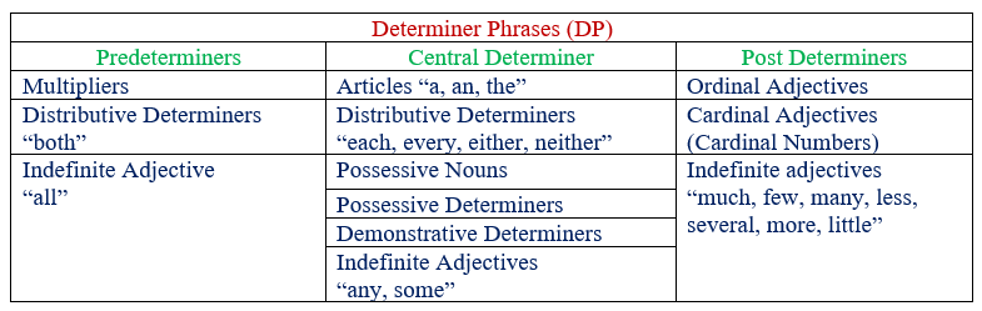
    Words That Rarely Function as Pronouns

    This usually strikes people as ungrammatical, but apparently, there might be times when it is used in creative writing.

    1. Multipliers
    2. Articles: a, an, the
    3. Ordinal Adjectives
    4. Possessive Determiners

    Determiners as Pronouns

    1. Some distributive determiners can function as pronouns: “each,” “either,” “neither,” “every,” and “both.

    • Determiner example: Each student received an apple.
    • Pronoun example: Each received an apple.

    An of-prepositional phrase (“of” construction) may follow when it is functioning pronominally and may help identify the antecedent.

    • “Of” example: Each of the students received an apple.

    If you remove “of,” you must also remove the article “the.” “The” and “each” cannot co-exist in the same determiner phrase.

    2. Some indefinite adjectives can function as pronouns: “all,” “some,” “none,” “few,” “many,” and “several.”

    • Determiner example: Some students were absent.
    • Pronoun example: Some were absent.
    • “Of” example: Some of the students were absent.

    3. If we know the noun, possessive nouns can function as pronouns.

    • Possessive nouns used as pronouns occur in informal writing (stories, novels…) or informal speech.
    • Determiner example: John’s computer works fine.
    • Pronoun example: John’s works fine.
    • An of-prepositional phrase cannot modify a possessive noun functioning as a pronoun.

    4. Demonstrative determiners can function as demonstrative pronouns: “this,” “that,” “these,” and “those.”

    • Lesson 32 covers this.

    Cardinal Adjectives Can Function in Several Ways

    Depending on their usage in a sentence, cardinal adjectives, also called cardinal numbers or cardinal numerals, can function in several ways. Because of this, grammar books do not always agree on whether to classify them as adjectives, determiners, or pronominal.

    1. Cardinal numbers can function pronominally.

    • Example: I had four.
    • Understood meaning: I had four cookies.

    Author’s Point of View—Food for Thought 🍽️

    One reason grammar resources and teachers often prefer the terms cardinal number or cardinal numeral is that these forms can perform more than one grammatical job.

    When a cardinal number appears before a noun, it functions as a cardinal determiner. Some grammar resources may still label it broadly as a cardinal adjective, just as I did in Lesson 26.

    When it stands alone and replaces an understood noun phrase, it functions pronominally or as part of an elliptical construction.

    The concept of elliptical construction aims to maintain a sentence’s function by clarifying that we understand a word is missing because of the context. The writer omits the original noun, but the rest of the phrase still interprets it as present.

    • Example: Six [ _________ ] passed the test. (“Six” is a cardinal determiner.)

    Remember, cardinal numbers can function as predicate complements after linking verbs.

    • Example: There are six.

    Pronominals

    When determiners function like pronouns, they function pronominally. Labels identify some forms as pronouns and others as functioning pronominally.

    Forms with established pronoun names:

    • Distributive determiners ↔ distributive pronouns.
    • Indefinite determiners/adjectives ↔ indefinite pronouns.
    • Demonstrative determiners ↔ demonstrative pronouns.

    Forms without a fixed pronoun label:

    • Cardinal numbers.
    • Possessive nouns.
      • These may be described as genitive nouns used pronominally.  

    Nominal Adjectives and Determiners

    As discussed in Lesson 22 and Lesson 23, some adjectives function as nouns, especially when referencing nationalities or shared traits. These are called nominal adjectives. People often use “the” before nominal adjectives, but they can replace “the” or coexist with another determiner.

    Can You Replace “the” or Coexist With Another Determiner?

    1. Collective Adjective

    • Distributive Determiners: No! Collective adjectives emphasize a characteristic of a group, while distributive adjectives break up a group or refer to an individual out of a group.
    • Multipliers: No! Quantifying a collective trait does not align with the meaning of a collective adjective.
    • Indefinite Adjectives: No! Not directly; use an of-prepositional phrase.
      • Example: Many of the poor want help.
    • Demonstrative Determiners: Yes! (rare) We will remove “the” and replace it with the demonstrative determiner.
      • Example: Those poor need help.
    • Possessive Determiners: No!
    • Possessive Nouns: Yes! With a proper possessive noun, eliminate “the.” With a common possessive noun, the possessive noun follows “the.”
      • Example: The city’s poor need help.
      • Example: Denver’s poor need help.
    • Ordinal Adjectives: No!
    • Cardinal Adjectives: No! Cardinal numbers change the meaning of the collective group.

    2. Nationalities

    • Multipliers: No!
    • Distributive Determiners: No!
    • Indefinite Adjectives: No! Not directly; use an of-prepositional phrase.
      • Example:  Many of the Japanese celebrate the New Year!
    • Demonstrative Determiners: Yes!
      • Example: Those Japanese arrived early.
    • Possessive Determiners: Yes! (rare)
      • Example: Their Japanese are here.
    • Possessive Nouns: Yes!
      • Example: Japan’s Japanese are skilled.
    • Ordinal Adjectives: Yes! A prepositional phrase usually follows to explain the cardinal number grouping, and “the” remains in place. History texts often contain sentences with this structure.
      • Example: The first Japanese to arrive mined gold.
    • Cardinal Adjectives: No!

    Note: Collective nouns in American English are treated as singular-subject-verb-agreement. Collective adjectives, like “the rich,” always take a plural verb because they inherently refer to multiple people sharing a characteristic.

    Boxing in Phrases

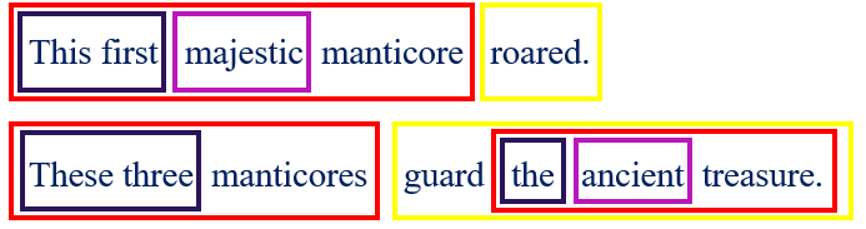
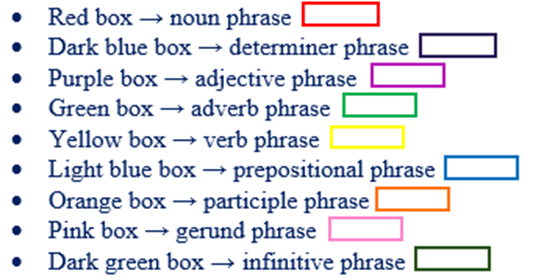
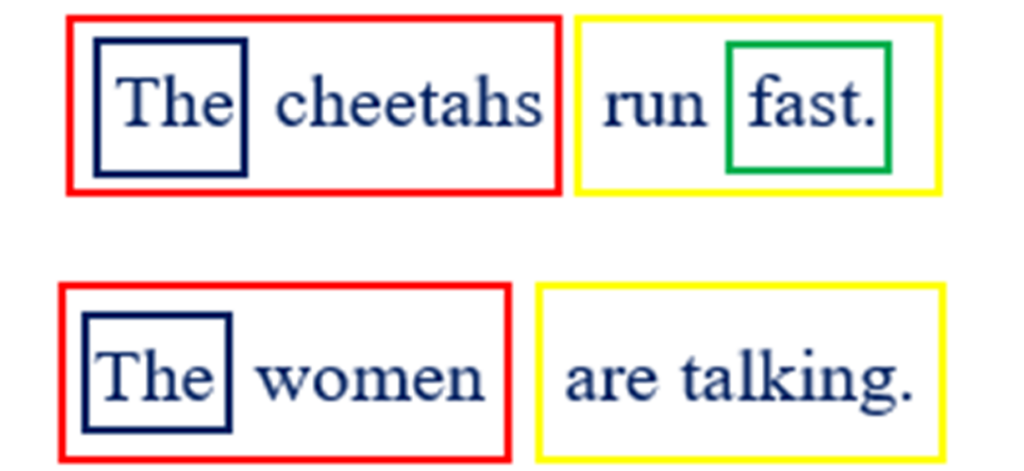
    When a determiner functions as a pronoun and replaces a noun phrase, place it in a red box.

    Words of Wisdom

    “If you control thought and ideas, you can control a population.”

  • Lesson 30: Indefinite Determiners (Indefinite Adjectives)

    Welcome, budding wizards of words, to the enchanting world of indefinite determiners! Like magical ingredients in a potion, these words—such as “all,” “some,” “many,” and “few”—help us express quantity, weaving precision and mystery into our sentences. As you master these linguistic spells, you’ll learn to conjure with countable and uncountable nouns, crafting expressive and nuanced language without specifying exact numbers. Prepare your cauldron and let magic of words guide you!

    Indefinite determiners (or indefinite adjectives) give a general indication of quantity without specifying an exact number or amount. They are essential in expressing quantities for countable and uncountable nouns.

    Common Indefinite Adjectives

    Indefinite adjectives can indicate different quantities for countable nouns, uncountable nouns, or both; speakers can also use some indefinite adjectives in questions.

    Large Quantity

    • Countable Nouns: many, several, more
      • Example: She read many books.
      • Example: Several people learned French.
      • Example: More men joined the cause.
    • Uncountable Nouns: much
      • Example: She drank much water. (This is grammatically correct, and formal, which is not used in everyday conversation.)
    • Countable or Uncountable Nouns: most, a lot of
      • Example: Most people enjoy pizza.
      • Example: She drank a lot of water.

    Small Quantity

    • Countable Nouns: a few, less (occasionally, with referring to a lower number or reduced frequency)
      • Example: He eats a few cookies.
    • Uncountable Nouns: a little, a bit, less
      • Example: A little tea calms my nerves.
    • Countable or Uncountable Nouns: few, little
      • Example: Few people attended the party.

    Quantity Unknown

    • Countable or Uncountable Nouns: Some, any, all
      • Example: Some dwarfs dwell in that mountain.

    Questions

    • Countable Nouns: many
      • Example: How many stickers do you have?
    • Uncountable Nouns: much
      • Example: How much flour do you need?
    • Countable or Uncountable Nouns: any
      • Example: Do you have any questions?

    Note: We will explore the “of” prepositional phrase in the next lesson, focusing on instances where the indefinite determiner acts as a pronoun. In Lesson 26, collective nouns (like group, class, number, team) become the noun followed by an “of” prepositional phrase may also correct some examples below.

    Pre-determiners: all

    Rule 1: Indefinite Determiner with Multiplier

    • Cannot use a multiplier in the same determiner phrase.
      • Incorrect: All twice the kids ran.

    Rule 2: Indefinite Determiner with Distributive Determiner

    • Cannot use a distributive determiner in the same determiner phrase.
      • Incorrect: All both kids ran.

    Rule 3: Indefinite Determiner with Article

    • Can use a definite article “the,” but not with indefinite articles “a” and “an.”
      • Example: All the kids ran.

    Rule 4: Indefinite Determiner with Possessive Noun

    • Can use possessive nouns in the same determiner phrase.
      • Example: All Jim’s kids ran.
      • Improved: All of Jim’s kids ran. (Preferred for clarity and structure.)

    Rule 5: Indefinite Determiner with Possessive Determiner

    • Can use a possessive determiner in the same determiner phrase.
      • Example: All his kids ran.

    Rule 6: Indefinite Determiner with Demonstrative Determiner

    • Can use a demonstrative determiner in the same determiner phrase, accepted in spoken and informal writing. Formal writing often recommends “all of those/these.”
      • Incorrect: All those kids ran.
      • Improved: All of those kids ran. (“All” functions as a pronoun.)

    Rule 7: Indefinite Determiner with Ordinal Adjective

    • Can use an ordinal adjective in the same determiner phrase, while this is grammatically correct but awkward, “of” prepositional phrase structure provides clarity.
      • Example: All the third kids ran.
      • Improved: The third student of all the teams ran.

    Rule 8: Indefinite Determiner with Cardinal Adjective

    • Can use a cardinal adjective in the same determiner phrase.
      • Example: All six kids ran.

    Central Determiners: any, some

    Rule 1: Indefinite Determiner with Multiplier

    • Cannot use a multiplier in the same determiner phrase.
      • Incorrect: Any twice the students finished the book.
      • Incorrect: Some triple the soldiers showed up.

    Rule 2: Indefinite Determiner with Distributive Determiner

    • Cannot use a distributive determiner in the same determiner phrase.
      • Incorrect: Any both students attended the meeting.
      • Incorrect: Some each soccer players left.

    Rule 3: Indefinite Determiner with Article

    • Cannot use an article in the same determiner phrase.
      • Incorrect: Some the students passed mid-term test.
      • Incorrect: Any a student could answer the question.

    Rule 4: Indefinite Determiner with Possessive Noun

    • Cannot use possessive nouns in the same determiner phrase.
      • Incorrect: Any John’s writing is on the table.
      • Incorrect: Some John’s ideas are interesting.

    Rule 5: Indefinite Determiner with Possessive Determiner

    • Cannot use a possessive determiner in the same determiner phrase.
      • Incorrect: Any my friend could come. 
      • Incorrect: Some my gifts were exchanged.

    Rule 6: Indefinite Determiner with Demonstrative Determiner

    • Cannot use a demonstrative determiner in the same determiner phrase.
      • Incorrect: Any those apples are red.
      • Incorrect: Some these apples are sweet.

    Rule 7: Indefinite Determiner with Ordinal Adjective

    • Can use an ordinal adjective in the same determiner phrase.
      • Example: Some first-place winners won money.
      • Example: Any third customer won a free meal.

    Rule 8: Indefinite Determiner with Cardinal Adjective

    • Can use a cardinal adjective in the same determiner phrase to refer to a subset or a known or implied group. Grammatically acceptable but uncommon outside informal or idiomatic use.
      • Example: Any three monsters ate the bird.
      • Example: Some three monsters ate the bird.
      • Improved: Three of the monsters ate the birds.

    Post determiners: much, few, many, less, several, more, little

    Rule 1: Indefinite Determiner with Multiplier

    • Cannot use a multiplier in the same determiner phrase.
      • Incorrect: Many twice the students finished the test.

    Rule 2: Indefinite Determiner with Distributive Determiner

    • Cannot use distributive determiners in the same determiner phrase.
      • Incorrect: Several each book was read.

    Rule 3: Indefinite Determiner with Article

    • Cannot use articles in the same determiner phrase.
      • Incorrect: Few the students were absent.

    Rule 4: Indefinite Determiner with Possessive Noun

    • Cannot use possessive noun in the same determiner phrase, even though this occurs in spoken English.
      • Incorrect: Few Jim’s friends arrived. 
      • Improved: Few of Jim’s friends arrived.

    Rule 5: Indefinite Determiner with Possessive Determiner

    • Cannot use possessive determiner in the same determiner phrase.
      • Incorrect: Few his friends arrived.
      • Correct: A few of his friends arrived. (“Few” changes to “a few.”)

    Rule 6: Indefinite Determiner with Demonstrative Determiner

    • Cannot use demonstrative determiner in the same determiner phrase.
      • Incorrect: Many those students finished early.

    Rule 7: Indefinite Determiner with Ordinal Adjective

    • Cannot use ordinal adjectives in the same determiner phrase.
      • Incorrect: Few first student finished.

    Rule 8: Indefinite Determiner with Cardinal Adjective

    • Cannot use cardinal adjectives in the same determiner phrase.
      • Incorrect: Many three students passed.

    Post Determiner Phrasal determiners: a few, a little, a lot of

    • These are post-determiners. Even when the determiner word order is adjusted, they cannot appear with central or pre-determiners in the same determiner phrase.
    • To combine them with other determiners, use an “of” prepositional phrase, but note: when used this way, the phrasal determiner functions as a pronoun, not as part of the determiner phrase.

    Rule 1: Phrasal Determiner with Multiplier

    • Cannot use a multiplier in the same determiner phrase. Their sematic meaning conflict.
      • Incorrect: A few twice the students finished the test.
      • Improved: Twice as many students finished the test.
      • Improved: A few of the students finished the test. (“ A few” functions as a pronoun.)

    Rule 2: Phrasal Determiner with Distributive Determiner

    • Cannot use a distributive determiner in the same determiner phrase. These forms are semantically and structurally incompatible. 
      • Incorrect: A little each book read.
      • Improved: Each of the books was damaged. (“each” functions as a pronoun.)
      • Improved: A little damage was done to each book.

    Rule 3: Phrasal Determiner with Article

    • Cannot: The phrasal determiner already includes an article to create a meaning together. Combine an article with another article following a phrasal determiner by using an “of” prepositional phrase to make the correction. 
      • Correct: A few textbooks lay on the floor.
      • Correct: A few of the textbooks lay on the floor.
      • Incorrect: A few the textbooks lay on the floor.
      • Correct: A lot of the students were absent. (“A lot” functions as a pronoun.)
      • Incorrect: A lot the students were absent.
      • Correct: A little piece lays on the floor.

    Rule 4: Phrasal Determiner with Possessive Noun

    • Cannot use directly with a possessive noun in the same determiner phrase. Use an “of” prepositional phrase to correct the structure.
      • Incorrect: A few Jim’s friends arrived. (“A few” functions as a pronoun.)
      • Correct: A few of Jim’s friends arrived.

    Rule 5: Phrasal Determiner with Possessive Determiner

    • Cannot use directly with a possessive determiner in the same determiner phrase. Fix with an “of” prepositional phrase.
      • Incorrect: A lot my friend arrived.
      • Correct: A lot of my friends arrived. (“A lot” functions as a pronoun.)

    Rule 6: Phrasal Determiner with Demonstrative Determiner

    • Cannot use directly with a demonstrative determiner in the same determiner phrase. Fix with an “of” prepositional phrase.
      • Incorrect: A few those students finished early.
      • Correct: A few of those students finished early. (“A few” functions as a pronoun.)

    Rule 7: Phrasal Determiner with Ordinal Adjective

    • Cannot use an ordinal adjective in the same determiner phrase. Use and “of” structure to separate the ideas. 
      • Incorrect: A little first student finished the puzzle.
      • Correct: A first student of a little group finished the puzzle.

    Rule 8: Phrasal Determiner with Cardinal Adjective

    • Cannot use directly with cardinal adjectives in the same determiner phrase. Their meanings must be separated or restructured.
      • Incorrect: A lot of three students passed.
      • Correct: A few of the three students passed.
      • Correct: A group of three students passed

    Misfit Determiners 

    Indefinite adjectives like “such,” “another,” and “various” don’t conform to the standard definition of determiners. “Such” even shares some qualities with demonstrative determiners. The irregular behavior of these words and the lack of agreement among linguists on how to classify them lead to individual instruction.

    As much as I dislike oversimplification, I teach them as indefinite adjectives—even though I don’t find that entirely accurate.

    • Another adds one more to that it is modifying.
      • Example: Another cup of coffee to go.
      • Nouns: countable singular or plural (sometimes used with plural in informal contexts: another three days)
    • Such emphasizes the nature or quality of a noun.
      • Example: You grew such a great garden.
      • Nouns: countable or uncountable, usually paired with adjectives or noun phrase (such a mess, such kindness)
    • Various denotes a variety of different types of the noun.
      • Example: We saw various dogs. 
      • Nouns: Countable plural

    Misfit: Another, Various, Such

    Rule 1: Indefinite Determiner with Multiplier

    • Cannot use multipliers in the same determiner phrase.
      • Incorrect: Another twice the students finished the book.

    Rule 2: Indefinite Determiner with Distributive Determiner

    • Cannot use distributive determiners in the same determiner phrase.
      • Incorrect: Various each book was read.

    Rule 3: Indefinite Determiner with Article

    • Cannot use “another,” “such,” and “various” with articles in the same determiner phrase.
      • Incorrect: The another book was read. 
    • Cannot use articles with “such” as a determiner. “Such” can also function as an intensifier when this occurs an article may follow. (She is having such a beautiful day.)
      • Incorrect: Such a students came late.
      • Correct: Such behavior is unacceptable.

    Rule 4: Indefinite Determiner with Possessive Noun

    • Cannot use possessive nouns in the same determiner phrase. You can use a collective noun and “of” prepositional phrase to correct this combination. 
      • Example: Various John’s books were read.
      • Improved: Various books of John’s were read. (Possessive nouns can function as a pronoun.)

    Rule 5: Indefinite Determiner with Possessive Determiner

    • Cannot use possessive determiners in the same determiner phrase.
      • Incorrect: Another my friend arrived.

    Rule 6: Indefinite Determiner with Demonstrative Determiner

    • Cannot use demonstrative determiners in the same determiner phrase.
      • Incorrect: Various those students finished early.

    Rule 7: Indefinite Determiner with Ordinal Adjective

    • Can use ordinal adjectives in the same determiner phrase.
      • Example: Another first-place winner won the prize.

    Rule 8: Indefinite Determiner with Cardinal Adjective

    • Can use cardinal adjectives in the same determiner phrase.
      • Example: Another three students passed.

    Boxing in Phrases

    Words of Wisdom

    “Wars start because you represent opposing ideology, moral, or control something valuable, or you are the value they want to possess.”

  • Lesson 29: Demonstrative Determiners (Demonstrative Adjectives)

    In the magical realm of language, demonstrative determiners bring clarity to our expressions by highlighting the object, its distance, and its number. These magical words—this, that, these, those—guide us on our journey through sentences.

    Understanding Demonstrative Determiners

    Demonstrative determiners modify nouns by identifying the noun, showing its proximity to the speaker, and if the noun is singular or plural. Demonstrative determiners always come before the noun.

    • Examples:
      • This toy is amazing.
      • These toys are amazing.

    Additionally, the archaic demonstratives yon and yonder traditionally used to indicate object not near the speaker.

    Determiner Phrase (DP)

    Rules for Demonstrative Determiners

    Rule 1: Demonstrative Determiners with Multipliers

    • Demonstrative determiners and multipliers cannot coexist in the same determiner phrase.
    • Not: Twice this toy is amazing.

    Rule 2: Demonstrative Determiners with Distributive Determiners

    • Demonstrative determiners and distributive determiners cannot coexist in the same determiner phrase.
    • Not: Each this toy is amazing.

    Rule 3: Demonstrative Determiners with Articles

    • Demonstrative determiners and articles cannot coexist in the same determiner phrase.
    • Not: The this toy is amazing.

    Rule 4: Demonstrative Determiners with Possessive Determiners

    • Demonstrative determiners and possessive determiners cannot coexist in the same determiner phrase.
    • Not: This his toy is amazing.

    Rule 5: Demonstrative Determiners with Possessive Nouns

    • Demonstrative determiners and possessive nouns cannot coexist in the same determiner phrase.
    • Not: This Mark’s toy is amazing.

    Rule 6: Demonstrative Determiners with Ordinal Adjectives

    • Demonstrative determiners can pair with ordinal adjectives.
    • Example: This second toy is amazing.

    Rule 7: Demonstrative Determiners with Cardinal Adjectives

    • Demonstrative determiners can also pair with cardinal adjectives.  
    • Example: These eight toys are amazing.

    Boxing in Phrases

    Creative Writing

    The Unnamed Hero of the Stone City

    The modern world grew from the bones of building when technology did not glow from everyone’s hands. In this town, the man who lay on the stone street, resting against ancient walls, had nothing but time to ponder the men who built these structures.

    For years, this hungry, dirty, and homeless man watched most people pass him by—a city buzzing with movement and technology had little use for a broken-bodied veteran. Yet, he found solace in eavesdropping on conversations about political and military powers. He knew that a man with a country’s resources could change a city without notice.

    Today, war visited this historic city. The sky exploded, and the building across from him began to crumble. The man, whose name was not known but whose face was familiar to many, shuffled to hold a door open, ensuring it didn’t get stuck.

    He realized he wouldn’t move fast enough if the building continued to fall. With his body, he propped the door open, allowing the first group of people to escape.

    “Go! Get to safety!” he urged, his voice raspy from years of silence.

    As more people hurried past, his strength waned. Yet he held firm, driven by a sense of purpose rooted deep in his soul.

    Finally, with the last person out, the door snapped shut. The city would remember his sacrifice, even if his name was forgotten.

    Proverb: “A name is forgotten, but a deed is eternal.”

    A proverb shares a universal truth to convey wisdom.

    How to Break Up Scene Paragraphs

    1  New Idea or Action: Start a new paragraph when the scene shifts to a new idea or action.

    • Example: If a character moves from sitting to running, start a new paragraph.

    2. Dialogue: Each time a different character speaks, use a new paragraph.

    • Example:
      • “Run!” shouted Alex.
      • “I can’t!” replied Jamie.

    3. Setting Change: When the location or time changes, begin a new paragraph to reflect this shift.

    • Example:
      • As the sun set, the shadows grew longer.
      • Meanwhile, inside the cottage…

    4. Character Focus: If you switch focus to a different character’s thoughts or actions, start a new paragraph.

    • Example:
      • Lily felt hopeful.
      • Nearby, Jake worried about the journey ahead.

    5. Pacing and Emphasis: Use shorter paragraphs for fast-paced action or to emphasize a dramatic moment.

    • Example:
      • The door slammed shut.
      • Silence followed.

    Previous Lessons

    The following previous lessons will help you if you need to refresh on previous creative writing instructions:

    • Lesson 13: Breaking up Dialogue
    • Lesson 23: Creating Direct Speech

    Words of Wisdom

    “When you are the devil in someone’s story, leaving can be the most generous thing you can do for repentance.”

  • Lesson 28: Possessive Determiners, Possessive Nouns, Possessive Pronouns

    oung wizard of words, today we dive into the mystical art of possessive determiners and possessive nouns found within the language ingredient cabinet. These magical elements reveal ownership and define relationships, adding precision and clarity to your linguistic spells. To enchant your expression further, we will also expand the pronoun ingredient list, offering another way to convey possession.

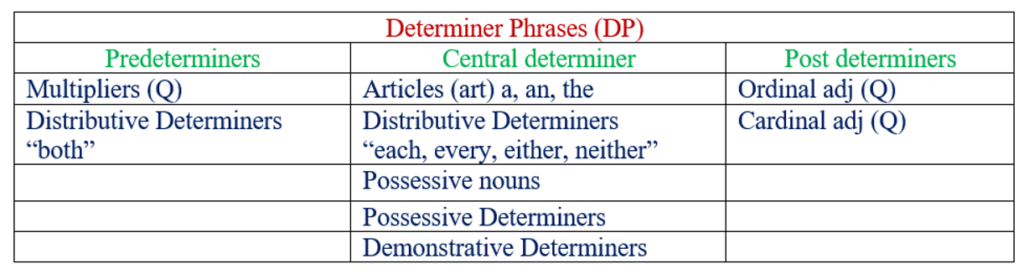
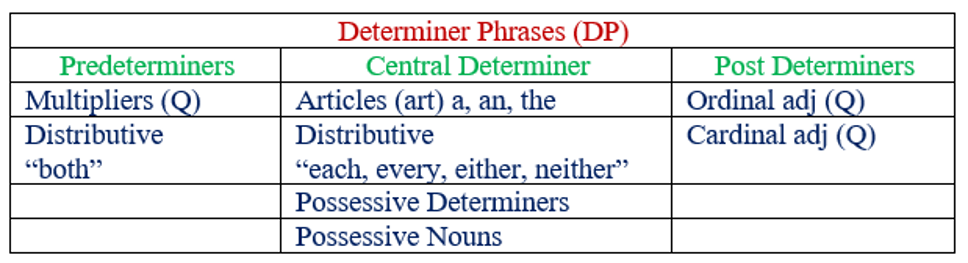
    The determiner phrase is a syntactic unit in English grammar that introduces and modifies nouns. Within the DP, determiners can be classified into three main categories:

    Possessive Nouns

    Possessive nouns indicate ownership or a part-whole relationship. Possessive nouns function as determiners. The rules vary depending on the number and form of the noun:

    1. Show Ownership

    • Singular Nouns: Add an apostrophe + s
      • Example: The boy’s house
    • Singular Nouns ending in -s: Add an apostrophe + s or, following some style guides, just an apostrophe
      • Example: James’s truck
      • Example: James’ truck
    • Regular Plural Nouns (ending in -s): Add an apostrophe
      • Example: The boys’ clothes
    • Irregular Plural Nouns: Add an apostrophe + s
      • Example: The children’s toys

    2. Part-Whole Relationship

    Possessive nouns can indicate not just ownership but also part-whole relationships:

    • Concrete Nouns: Can use apostrophe + s for tangible parts, or “of” prepositional phrase
      • Example: The desk’s drawer
    • Abstract Concepts: Prefer “of” construction which is the “of” prepositional phrase
      • Example: The knowledge of science

    Multiple and Compound Possessive Nouns

    Nested Possession: It is grammatically correct to have a possessive noun possessing another possessive noun.

    • Example: Adam’s wife’s name is Heather.

    Articles and Possessive Nouns: Articles are not used with proper possessive nouns but may accompany common possessive nouns for clarity

    • Example: The parents’ kids look extremely upset.

    Shared Possession: When two or more nouns share possession, only the last noun takes the possessive form.

    • Example: Chris and Perry’s boat

    Separate Possession: Each noun takes the possessive form to indicate separate ownership.

    • Example: Kieran’s and Elena’s mothers are doctors.

    Compound Nouns: The possessive is added to the end of the compound.

    • Example: My brother-in-law’s car

    Possessive Determiners vs. Possessive Pronouns

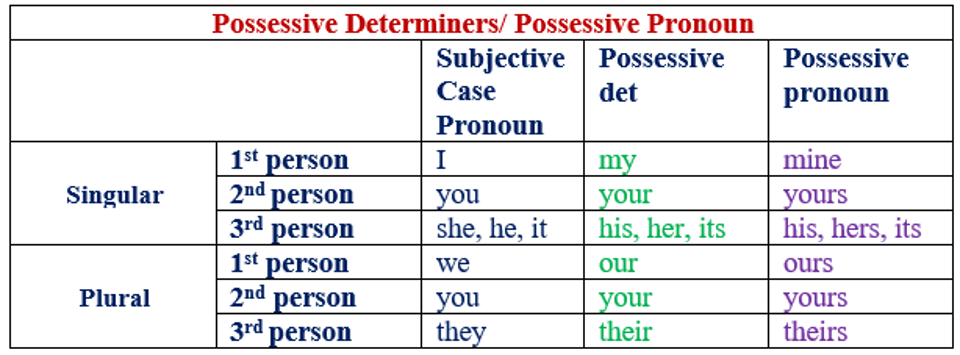
    Possessive determiners, also known as possessive adjectives: These function like adjectives. They modify a noun to indicate ownership, clarifying to whom the noun belongs.

    • Examples:
    • My daughter’s name is Gabrielle.
    • My daughter’s husband’s name is Tom.

    Possessive pronouns: These replace the entire noun phrase (NP), performing two roles: indicating ownership and functioning as a pronoun.

    • Examples:
    • Mine works well.
    • Use hers.

    Possessive pronouns can replace the subject, direct object, and object of the preposition.

    Key Differences

    Understanding the difference between possessive determiners and possessive pronouns helps in crafting sentences that are more precise and elegant.

    • Function: Determiners modify nouns; pronouns replace noun phrases.
    • Placement: Determiners precede nouns; pronouns stand alone.
    • Articles: Articles cannot precede possessive determiners of proper possessive nouns.

    Determiner Phrase

    Rule 1: Possessive Nouns or Possessive Determiners with Distributive Determiners

    • Distributive determiners precede a possessive determiner or possessive noun.
      • Example: Each student’s car has valid parking.
      • Example: Both your cars have valid parking.

    Rule 2: Possessive Nouns or Possessive Determiners with Articles

    • Possessive determiners cannot precede articles.
      • Example: Her book report was excellent.
      • NOT: The her book report was excellent.
    • Articles are not used with proper possessive nouns but may accompany common possessive nouns for clarity or emphasis.
      • Example: The student’s car has valid parking.
      • Example: A student’s question interrupted the lecture.

    Rule 3: Possessive Nouns or Possessive Determiner with Multipliers

    • Multipliers come before possessive nouns or possessive determiners.
      • Example: Triple the students’ cars parked in the street.
      • Example: Triple her savings will help her buy a car. 

    Rule 4: Possessive Nouns or Possessive Determiners with Ordinal Adjectives

    • Ordinal adjectives switch with possessive nouns.
      • Example: The second student’s car rolled down the hill.
    • Possessive determiners precede ordinal adjectives.
      • Example: Her second car rolled down the hill.

    Rule 5: Possessive Nouns or Possessive Determiners with Cardinal Adjectives.

    • Possessive nouns can appear before or after cardinal adjectives, depending on focus.
      • Focus on Quantity: The six students’ cars have valid parking.
      • Focus on Ownership: The students’ six cars have valid parking.
    • Possessive determiners always come before cardinal adjectives.
      • Example: Her six cars have valid parking.
      • Not: Six her cars have valid parking.

    Rule 6: Possessive Nouns with Inanimate Nouns

    There is a debate among grammar authorities about using possessive forms with inanimate nouns. The most conservative view restricts possessives to animate nouns (people, animals), while modern usage often allows inanimate possessives.

    • Traditional: The foot of the mountain (not the mountain’s foot)
    • Modern/Permissible: The car’s engine

    Alternative: A noun adjunct modifies another noun and can sometime replace a possessive construction.

    • Example: hotel room (instead of the “hotel’s room”)
    • Example: office lobby

    To create diversity in writing, the mastery of possessive determiners, possessive nouns, and possessive pronouns is not merely a matter of memorizing forms but understanding their logic, function, and interaction within the determiner phrase. The distinctions between these forms, their syntactic placement, and their compatibility with other determiners are crucial for grammatical accuracy and stylistic elegance.

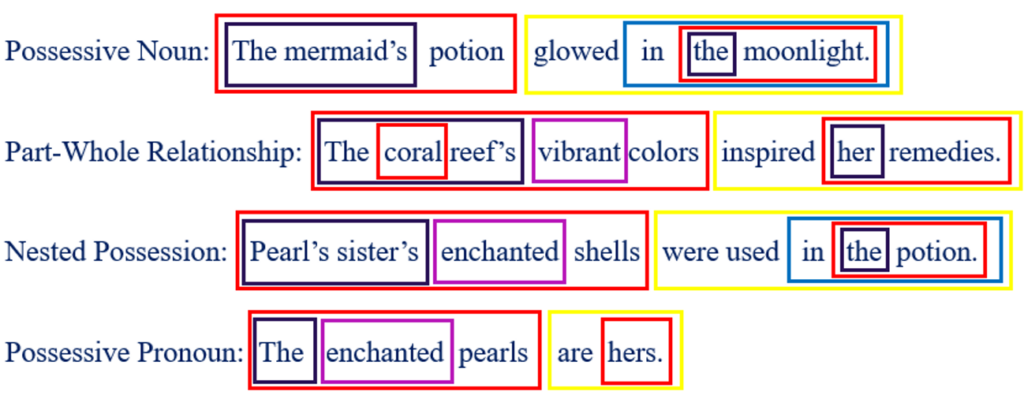
    Boxing in Phrases

    Note: “Coral reef’s” demonstrates a whole-to-part relationship. The reef is modified by “coral,” functioning as a noun adjunct. This highlights how possessive nouns retain the ability to be modified by noun adjuncts.  

    Words of Wisdom

    “You will be a villain in someone’s life and the hero in someone else’s life.”

  • Lesson 27: Distributive Determiners (Definite Determiners)

    Young wizard of words, we journey to explore the mystical art of distributive determiners. These magical words help us refer to individual members of a group, either collectively or separately.

    The Enchanted Members

    Both: two items make a pair

    • Example: Both cakes taste delicious.
    • “Both” must be followed by a plural noun.

    Each: refers to a single individual in a group, considered separately, each fulfilling the same condition. 

    • Example: Each tree needs water.
    • Use “each” with a singular noun.

    Every: refers to all individual members of a group, considered one by one. 

    • Example: Every member drives a school bus.
    • Use “every” before a singular noun.

    Either: refers to one of two options that can satisfy requirement, or condition.

    • Example: Either kid can wash the dishes daily.
    • Use “either” before a singular noun.

    Neither: the two options you have will not be able to follow the action or condition

    • Example: Neither kid washes the dishes.
    • Use “neither” before a singular noun.

    Determiner Phrase Rules

    Rule 1: Cardinal Adjective and Distributive Determiners.

    • Do not use “both,” “each,” “every,” “either,” or “neither” with cardinal adjectives.

    Rule 2: Ordinal Adjective and Distributive Determiners.

    • Distributive may come in front of ordinal adjective.
    • Example: Each first muffin gets to be tasted.
    • Example: Both first place winner and second place winner won the jackpot.
    • Example: Every first prize winner signs a business contract.
    • Example: Either the first option or the second option is acceptable.
    • Example: Neither the first nor the second book was good.

    Rule 3: Articles and Distributive Determiners.

    • “A” and “an” are not used with distributive determiners.
    • Use “the” with “neither” and “either” when paired with ordinals.
    • Example: Neither the first nor the second book was good.
    • Example: Either the first option or the second option is acceptable.

    Rule 4: Multipliers and Distributive Determiners.

    • Position multipliers before distributive determiners.
    • Example: Double every wizard’s effort will improve the results.
      • The word “double” modifies “every,” indicating the effort of each student.
    • When using “both,” place the multiplier afterward.
    • Example: Both twice the number of students and the teachers attended the event.

    Coordinating Conjunction

    Coordinating conjunctions can beautifully connect the nouns modified by distributive determiners, whether through choice or exclusion. They define noun phrases based on these magical relationships:

    • And combines equal phrases, clauses, and words. 
    • Nor connects to negative clauses, phrases together, and words.
    • Or presents a choice between statements or options.

    Look at the two compared examples to notice the flexibility of English.

    1. Either/Or: Indicates only one subject in action.

    • Example: Either kid can wash the dishes daily.
    • Example: Either the first option or the second option is acceptable.
    • Explanation: “Either” and “or” indicate a choice, meaning only one subject is active. Singular agreement follows, as it applies to one option at a time.

    2. Neither/Nor: Denotes absence of action for both subjects.

    • Example: Neither kid washes the dishes.
    • Example: Neither the first book nor the second book was good.
    • Explanation: “Neither” and “nor” denote an absence for two distinct subjects. While considered, singular agreement is used because no action occurs within either option.

    3. Both/And: Plural subject agreement showcasing joint action.

    • Example: Both winners won the jackpot.
    • Example: Both first place winner and second place winner won the jackpot.
    • Explanation: “Both” and “and” combine subjects into a plural noun phrase, showcasing joint action.

    Parallel Construction

    Parallel construction ensures that elements in a series or comparison share the same grammatical structure, enhancing fluency and coherence.

    When parallel construction begins, all non-parallel elements are considered shared.

    Example: Neither the first book nor the second book was good.

    • Explanation: Initiated by the distributive determiner “Neither,” the parallel structure includes “definite article + ordinal adjective + noun.”

    Example: Neither the first book nor second book was good.

    • Explanation: The parallel structure starts with the “ordinal adjective + noun,” as “the” shared between the elements.

    Example: Neither the first nor second book was good.

    • Explanation: In this case, both “neither,” “the” and “book” are shared, while the parallel structure focuses on the “ordinal adjective,” to differentiate the elements. This works because the context makes it clear that both references are to “books,” and the primary distinction is their sequence. The shared elements ensure clarity and preserve the intended meaning, emphasizing the order as the differentiating factor.

    Insight for Thought

    Adjective phrases describe imagery or qualities of a noun. Determiner phrases provide definiteness, quantity, and possession, working together as a unit.

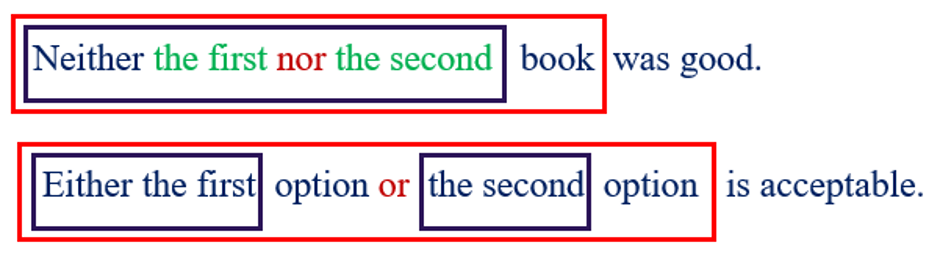
    Boxing in Phrases

    The distributive and coordinating conjunctions work together to create a single, cohesive noun phrase. The conjunction connects elements, ensuring they function as one grammatical unit rather than separate phrases.

    Words of Wisdom

    “Every hero chooses to live for something or die for something.”

  • Lesson 26: Cardinal Adjectives and Ordinal Adjectives

    Greetings, young wizards of words! Today, we embark on a mystical journey into the realm of cardinal adjectives and ordinal adjectives. These magical elements will bring clarity and precision to your sentences like a well-cast spell.

    Cardinal Adjectives: Masters of Quantity

    With a wave of your grammatical wand, use cardinal adjectives to summon the precise number of items you desire. When the number is more than one, the noun magically is plural.

    Cardinal adjectives indicate quantity by specifying a numerical amount. When a cardinal adjective is greater than one, the noun it modifies is plural.

    Cardinal Adjectives: one, two, three, four, five, six, seven

    • Example: One duck swam.
    • Example: The five yellow baby ducks swam.

    Ordinal Adjectives: Guardians of Order

    These adjectives stand as sentinels, marking the positions of nouns, whether they march alone or in armies.

    Ordinal adjectives show the position or order of the noun. The nouns they modify can be either singular or plural, depending on the context.

    • Ordinal Adjectives: first, second, third, fourth, fifth, sixth, seventh
    • Example: The sixth boy ate the sandwich. (“Sixth” modifies the singular noun “boy.”)

    Determiner Phrase: The Mystical Arrangement

    To make variety of sentence structures, you need to know how to add determiner ingredients together.

    Rule 1: Cardinal adjectives typically come after articles in standard sentence structure.

    Rule 2: You can include both cardinal and ordinal adjectives in the same determiner phrase, if they perform distinct roles:

    • The ordinal adjective identifies the position of the group.
    • The cardinal adjective tells how many items are in that group.
    • In such cases, the ordinal adjective precedes the cardinal adjective.

    Example 1: The second eight ducks cross the road.

    • This phrase refers to the second group of eight ducks.
    • Enhanced Clarity: The second group of eight ducks crossed the road.
      • A collective ambiguous noun, “group,” followed be an “of” adjectival prepositional phrase behind the noun clarifies the group structure.
      • The “of” preposition (“of eight ducks”) states what the group consist of. (The phrase “second group of eight ducks” clarifies that “second” refers to a grouping, not modifying “eight” directly.)

    Grammar Deep Dive

    Of” prepositional phrase, of eight ducks, function as a partitive. This partitive magic clarifies what the group consists of, ensuring that every feathered friend is accounted for.

    The partitive phrase not only defines the group but also casts away ambiguity, letting our enchanted ducks waddle across the road with clarity and purpose.


    Example 2: The second eight-boy team won the race.           

    • The teams have eight members, and the second group won the race.
    • Hyphen Heroics: Hyphenating “eight-boy” creates a temporary compound adjective, which is a common practice to clarify meaning.
    • Enhanced Clarity: The second team of eight boys won the race.
      • Here, using “of” provides even clearer structure, ensuring the magic of understanding is never lost.

    Note: Some grammar resources claim that you cannot include both cardinal and ordinal adjectives in the same determiner phrase. While this is a common simplification, it does not reflect the full flexibility of English grammar. This is a perfect example of why we must adjust what we consider absolute rules as we learn more.

    Rule 3: Multipliers and cardinal adjectives generally do not occur together in the same determiner phrase unless the multiplier is quantifying the cardinal adjective as a unit (a set or group size.)

    • The multiplier precedes both the article and the cardinal adjective.
    • This structure can be rare and often ambiguous without context.
    • The multiplier + cardinal adjective forms a conceptual unit referring to multiple sets.

    Example: The double eight cupcakes tasted great.

    • Interpretation: Two sets of eight cupcakes = 16.
    • Improved: A double set of eight cupcakes tasted great.

    Rule 4: In the grammar cosmos, multipliers and ordinal adjectives often dwell in separate realms due to their distinct powers:

    • Multipliers: These enchantments enhance quantity.
    • Ordinal Adjectives: Guardians of order and sequence.

    Though their paths rarely cross, they can unite under special circumstances where:

    • The multiplier empowers the entire noun or event.
    • The ordinal steadfastly maintains the sequence.

    Example 1: The triple second race was competitive.

    • Magic at Work: “Triple” enhances “race,” suggesting three races for second place. “Second” describes the race’s rank.
    • Improved Clarity: There were three second-place races.
    • Alternative: The triple series of second-place races was competitive.

    Example 2: She won the triple first three-minute race.

    • This grammar spell is potent but ambiguous. It could mean:
      • She claimed three first-place victories in a three-minute series.
      • She triumphed in the same three-minute race run thrice.
    • Improved: She won three first-place titles in the three-minute race series.
    • Alternative: She won first place in three three-minute races.

    Compound Adjectives (Bonus Potion Ingredients)

    These are generally fixed in form and meaning are best learned as compound adjective expressions.

    • First-class
    • Second-rate
    • Third-world
    • First-degree (murder)
    • Second-hand
    • Fourth-generation (technology)
    • First-rate

    Mastering Clarity

    When weaving theses spells, ensure clarity reigns supreme. Use supportive nouns or “of” prepositional phrases to guide your readers through your enchanted narrative.

    Conclusion

    While some grammar texts promote strict rules about determiners, real-world-usage and advanced grammar show that determiner phrases can contain multiple layers of meaning. When analyzing grammar, it’s important to consider both the technical structure and the intended meaning, especially when dealing with complex noun phrases.

    Boxing in Phrases

    Words of Wisdom

    “Truth can not only be constructive but destructive at the same time; the truth does not always set you free but sets reality into words.”

  • Lesson 25: Multipliers

    A single pinch of language magic can make numbers and measures behave like little spells. Determiners tell us about the noun’s role in the sentence—whether it’s specific or general, near or far, singular or plural, the quantity of the item, and ownership. Unlike descriptive adjectives (which paint a visual picture), determiners set the structure and reference: they tell readers which thing we mean and how many of them there are.   

    Quick Review: Articles

    • “The” marks a specific noun that can be singular or plural.
    • “A” or “an” mark a general noun that is singular.

    There are two major categories: definite determiners and quantifiers.

    Quantifiers provide numeric quantity, rough estimation of quantity, the change in quantity or intensity, and the position/order of the noun. Types of quantifiers:

    • Indefinite adjectives (some, many) give an estimate/ general exclamation of amount.
    • Multipliers (double, triple, twice) specify a multiple of a quantity, either by increasing or intensifying it.
    • Cardinal adjectives (one, two, five) provide the quantity with a numeric value.
    • Ordinal adjectives (first, second) place the noun in an ordered position.

    Definite determiners tell the audience you know the specific noun. Types of definite determiners:

    • Definite article (the)
    • Demonstrative determiners (this, those)
    • Distributive determiners (each, every)
    • Possessives (my, our)

    Classifications

    Grammar books teach quantifiers differently based on grammatical linguistic perspectives or definitions, classifying them as adjectives, determiners, or separate parts of speech. One characteristic many determiners share is that they can also function as pronouns.

    Even the linguists cannot agree on how to classify quantifiers. Some linguists consider quantifiers adjectives because they are gradable and can function as predicate adjectives. Others classify quantifiers as determiners because their placement is within the determiner phrase, and they don’t visually describe or give a subjective impression. Regardless of classification, quantifiers can function in multiple roles, appearing as different parts of speech depending on their function.

    Determiner Phrase Structure

    Pre-determiners, central determiners, and post-determiners are names of the position in the determiner phrase. In certain grammatical conditions, the position may change, which we will discover today. The chart shows the standard position of the determiner phrases (DP). Let’s examine multipliers, a specific type of quantifier, and how they function within determiner phrases.

    Multipliers

    Multipliers are a subcategory of quantifiers. Multipliers (also known as multiplication adjectives) multiply the original amount or intensify quantity or frequency. 

    Multipliers Function

    They can act as determiners, adjectives, or adverbs, depending on their function.

    1. Multipliers as Determiners

    Multipliers can function as determiners to show a quantity or magnitude related to a noun.

    • Examples: single, double, triple, quadruple, twice, five times
      • Triple bacon = three times the usual amount of bacon
      • Double ice creams = 2 scoops/servings
      • Two double ice creams = two servings of ice cream, each with two scoops
    • When the word functions as a determiner, the word belongs in the determiner phrase.
      • Uncountable nouns with multipliers remain singular.
      • Countable nouns are plural with a multiplier.
    • Examples:
      • He won triple the amount. (The amount of money is normally ten but won 30.)
      • Completing the project required double the effort. 

    An article precedes the multiplier when introducing a new noun, a general concept for the first time, or when referring to a noun in a general sense.

    • Example: She took a double helping. (Interpretation: The heap of food seems extremely large for a normal size serving.)

    2. Multipliers with Dual Meaning (Determiner/ Adjective)

    Sometimes, multipliers not only show quantity but also serve as descriptive adjectives.

    When a multiplier has dual meaning as a descriptor and a multiplier, place it in the adjective phrase. When a multiplier has any adjectival meaning, it falls into the measurement category of the descriptive adjective order.  

    • Examples: double espresso, triple crown, double entendre, double agent, double burger, triple scoop, double take, triple threat, double feature, triple bypass
    • Example: The double order goes to table 8.
      • Double as Adjective: a double order is a type of order
      • Doubele as Determiner: quantify the amount.

    When using multipliers with uncountable nouns, the noun remains singular. The multipliers quantify the intensity or amount, but they do not make the noun plural.

    • People had triple the fun at the summer solicits.

    3. Multipliers as Descriptive Adjectives

    Multipliers can sometimes stop counting and simply describe a type of quality. When a multiplier functions as an adjective, it falls into the measurement category of descriptive adjectives.  

    • Examples: double doors, double-sided (sword), double-breasted (chest armor), triple-bypass, triple-decker (bus or sandwich), double-sided (tape), triple axel (skating), double-jeopardy, triple-threat.
      • Often these are compound adjectives with a hyphen.
      • Note: Some paired items (double doors) conventionally remain plural.
    • When considering pairs as a unit, the noun is usually singular, except for conventional plural forms like “double doors.”

    4. Multipliers as Adverbs

    Many multipliers can also function as adverbs. The structure of the sentence changes when the word functions as an adverb; as an adverb, it tells you how many times the action happens. We discussed adverbs of frequency, and multipliers serve as adverbs of frequency, specifically definite adverbs of frequency. This seems to be more natural for most people.

    • Example: She called me twice. (Adverb)

    Recap Descriptive Adjective Order

    When multipliers take on a descriptive function, they follow the established adjective order in English.

    • Example: The greasy double burger slides down his belly.
    • Example: The greasy, double-meaty burger slides down his belly.

    1. Determiners (Limiting Adjectives)

    • The Determiner Phrase: Pre-determiners, central determiners, and post-determiners

    2. Opinion / quality / observation

    3. Measurement (big, small, tall) no numerical value

    4. Shape

    5. Condition

    6. Age (old, new, young, adolescent, ancient) non-numeral value

    7. Color (pink, yellow)

    8. Pattern

    9. Origin

    10. Material

    11. Purpose

    Boxing in Phrases

    When a multiplier is a determiner, place it in the determiner phrase.

    When a multiplier is a dual determiner and adjective, place it in the adjective phrase.

    “Eight” functions as a postnominal identifier/ label, not a determiner that counts multiple items.

    Cardinal numerals (often called cardinal adjectives when they appear before a noun) can also appear postnominal as nominals /identifiers to name or label a particular instance, for example, table eight, chapter three, page 10, or room 12. In this post-modifier position, the numeral is not counting “how many” but answering “which one?” and functions like a label or part of the name. When a cardinal answers “which one?” behind the noun, it is called a postnominal numeral or numeral identifier.

    When a multiplier is functioning as an adjective, place it in the adjective phrase.

    A multiplier is functioning as an adverb of definite frequency.

    “Every morning” can be seen as a definite adverb of frequency phrase or a prepositional phrase of time.

    Words of Wisdom

    “Difficult times only test morals and principles.”

  • Lesson 24: Compound Adjectives and Compound Nouns

    A single pinch of language magic can make two small words act as one powerful ingredient. In grammar potions, compound adjectives and compound nouns are two-word (or multiword) combinations that fuse into a single meaning. For compound adjectives used before a noun (the attributive position), use a hyphen to keep the meaning clear—like sealing a vial with wax—so readers do not mix the wrong ingredients. For compound nouns, there are several structural possibilities, and over time many open or hyphenated forms become closed compounds.

    Compound adjectives comprise two or more words that function together to describe a noun. They often use a hyphen to prevent ambiguity and to show the words form a single modifier. Compound adjectives can appear before a noun (attributive) or after a linking verb (predicative), but hyphenation is most important when the compound directly precedes the noun.  

    In an adjective-adjective compound, the first adjective modifies the meaning of the second; together they form one descriptive unit. Think of it as a miniature phrase; the second adjective is the head (the main category), while the first adjective narrows, shades, or changes the meaning of that head. This head/modifier relationship is why a hyphen often makes the intended meaning clear.

    Hyphen Rules

    • In attributive position, use a hyphen for clarity of meaning.
    • In the predicate position as a predicate adjective, hyphenation is less required but still acceptable when the compound is a fixed expression.

    Example: bluish-green

    The bluish-green pixie flew into the woods.

    The pixie is bluish green.

    Combination of Compound Adjectives

    Compound adjectives have many structure combinations:

    1. adjective + adjective

    • bluish-green (the bluish-green pixie)

    2. adjective + noun

    • full-length (a full-length cloak)

    3. noun + participle (present or past)

    • world-famous (the world-famous spell book)

    4. noun + adjective

    • blood-red (the blood-red gem)

    5. noun + noun

    • ice-cold (the ice-cold water)

    6. adverb + present/past participle

    • never-ending (a never-ending night)

    7. noun-adjunct + present participle

    • mouth-watering (a mouth-watering pie)
    • heart-breaking (a heart-breaking story)

    Concept Break: Noun Adjuncts

    A noun adjunct is a noun that functions as a modifier of another noun (also called attributive noun). It typically comes before the noun it modifies and explains its type, purpose, or association (running shoes, crystal wand). Noun-adjuncts also appear inside participle compound affects—or example in mouth-watering the noun “mouth” specified what is being made to water; the –ing participle is the semantic head. Lesson 47 and 48 will explore participles and verbals in depth; for now, treat these participial compounds as single adjectival units (hyphenate before the noun).

    Cross-reference back to Lesson 10, Purposes (adjective order item 11)

    • What is the item used for: sleeping bag, running shoes

    Notes:

    • The adjective order naturally accommodates noun adjuncts (these can be simple nouns or participial forms). One common function is to name the purpose or intended action of an item (running shoes = shoes for running).
    • This shows how critical thinking and careful rephrasing simpler concepts or ideas into more complex grammatical structures. When reference guides or textbooks seem to disagree, tracing phrases back to these basic functions (type, material, purpose) helps students resolve apparent conflicts.

    8. quantifiers + noun → (used for length, age, weight, currency. Etc.)

    • Length:
      • three-foot (a three-foot wand)
    • Age:
      • 11-year-old (an 11-year-old apprentice)
    • Currency:
      • five-thousand-dollar (the five-thousand-dollar potion kit)
      • numerals and currency sign (the $5,000 potion kit)

    Note: In a hyphenated measurement compound the unit is singular: three-foot, five-thousand-dollar, 11-year-old. You are naming a single measure that describes the noun. Prefer $ + numerals for currency when concise ($5,000).  

    More examples:

    • full-length movie
    • last-minute decision
    • twentieth-century writer
    • middle-class writer

    Intro to Participles

    In lessons 47 and 48, we will explore many functions of participles. This is a brief, introductory explanation because participles are often used as adjectives and form many common compound adjectives, so we must discuss them now.

    Present participles (-ing):

    • Present participles used as adjectives describe an ongoing action or a continuing state and often convey motion or process.
    • Examples:
      • The flowing river sparkled in the sunlight. 
      • The ever-flowing waterfall cascades down the rocks.
      • Note: In these examples, “flowing” describes the continuous motion; the participle functions adjectivally.

    Past participle (-ed, -en, -t, etc.):

    • Past participles as adjectives usually describe a state resulting from prior action. The base verb names the action; the past participle expresses the resulting state.
    • Example: The shattered vase was an expensive decoration.
      • Event: The vase shattered.
      • Resulting state: The vase is now in a shattered condition.
    • Example: The sweet, freshly baked cookies filled the kitchen with a sweet aroma.
      • Event: The cookies were baked.
      • Resulting state: The cookies are now baked.

    Hyphenation Rule

    • Do not hyphenate –ly adverb/particle + participle combinations: a beautifully made robe (not beautifully-made robe). Writers still treat –ly adverb + participle combination as multiword modifiers, but do not hyphenate them (a beautifully made robe).
    • Hyphenated non –ly adverb + participle compounds for clarity: a well-written article; a fast-moving train.

    Noun Phrase and Adjective Phrase Structure

    Noun Phrase Structure → (Determiner Phrase) + (Adjective Phrase) + (Adjectival Compound Participle) + Noun

    • Do not split or reorder a hyphenated compound; adverbs ending in –ly remain unhyphenated and stay adjacent to the adjective they modify.
    • Adjectival compound participles follow the standard order by coming after descriptive adjectives, but coordinating adjective structure allows the flexibility to shift the order.
    • If a compound participle adjective and another descriptive adjective belong to the same semantic category in the adjective order, treat them as coordinate adjectives and apply the comma or and.
    • Examples:
      • The bright, fast-moving train rushed past the station.
      • His insightful, well-written article won an award. 
      • The sweet, freshly baked cookies taste good. (a comma was added for clarity)
    • If the compound adjective does not have any participle, you follow the adjective order.

    Note: The standard adjective order reduces confusion and is a useful default, but English is flexible—semantic meaning, emphasis, and clarity are ultimate guides. Sometimes compound participle will be placed within the descriptive adjective order to emphasize opinion, size, or another quality. See Lesson 10 for adjective order chart and Lesson 20 for coordinating and cumulative adjectives.

    Adjective Phrase Structure → (Adverb) + Adjective* + (Adjectival Compound Participle)

    • A compound adjective without a participle still follows the standard adjective order in English.

    Example: She wore a twentieth-century handmade silk dress.


    Advanced Concept—Deep Thinker

    Example: The shattered vase was an expensive decoration.

    Subject definiteness ≠ complement definiteness.

    • The subject can be definite (the shattered vase) because the vase is already identified in the conversation or text.
    • The predicate nominative (the noun that renames the subject) has its own reference requirement: if it is a count noun, it still needs a determiner (a/an/the). Which determiner you choose depends on whether you are classifying, identifying, or contrasting—not simply on the subject’s definiteness.
    • Predicate nominative that classifies normally use an indefinite article: you are saying the subject is one instance of that noun class (The shattered vase was an expensive decoration = classification).
    • “Decoration” is a broad class name that refers to many possible objects, while “vase” names a specific kind of object. When a definite subject (the shattered vase) is paired with a general class term as the predicate nominative (…was a decoration, readers naturally hear classification: you are assigning that specific vase to the larger category of decorations (one decoration among many).
    • If you intended a pure adjectival description (no renaming), use a predicate adjective instead: The shattered vase was expensive.

    Postmodifiers shift how you read a predicate nominative (classification → identification)

    Example (Prepositional Phrase): The shattered vase was the expensive decoration on the mantel.

    Example (Appositives): The shattered vase was the expensive decoration, the one from Aunt Mira.

    • The predicate nominative is uniquely identifiable because the sentence or discourse provides extra information (postmodifier, prior mention, situation uniqueness, apposition, contrast). When identification is supplied, use “the.”
    • A postmodifier removes the ambiguity of classification by supplying identifying content; without such identifying content, the predicate nominative (PN) normally reads as classificatory and takes “a” or “an.”

    Compound Nouns

    Compound nouns are made up of two words that come together to create a new noun with a different meaning than the individual words.

    Compound Nouns Written Forms

    Open compound: a space between the two words (ice cream, high school)

    Hyphenated compound: hyphen in between the two words (father-in-law, self-esteem)

    Closed compound: the words written together (bluebird, skateboard)

    Reminder: Over time many open or hyphenated forms become closed compounds. The lexicalization pathway: they may start as an open phrase, become hyphenated as they cohere, and finally close into a single word as the language accepts the new lexical item.

    Compound nouns have many structure combinations:

    1. noun + noun

    • bluebird
    • seafood
    • snowball

    2. adjective + noun

    • sweetheart
    • high school

    3. noun + verb (noun derived from verb)

    • dishwasher
    • skateboarder

    4. Verb + particle (phrasal verb lexicalized as noun)

    • check-out
    • cave-in
    • Note: as verbs these are two words, check out and cave in, as nouns may be hyphenated or closed.            

    5. noun + preposition

    • mother-in-law
    • editor-in-chief             

    6. preposition/ adverb + noun (often closed)

    • upstream
    • downfall

    Some compound nouns may have more than one option either be opened, hyphenated, or closed. This is often noticed when looking at different grammar guides. The newest dictionary will be the best guide to consult.

    Keep in mind, adjust wording to fit your style and lesson flow.

    Boxing in Phrases

    For now, place compound participle adjectives or noun adjuncts, inside the adjective phrase. When we dive deep into verbals and noun adjuncts, we will break them into their own phrase boxes. The goal is to show how grammar concepts advance from simple to complex.

    A compound turns multiple small words into a single, potent ingredient.

    Words of Wisdom

    “An amazing friend encourages and celebrates other’s success, even when they are stumbling.”

  • Lesson 23: Nominal Adjectives

    A nominal adjective is an adjective that functions as a noun. Nominalization occurs when a word from another part of speech takes on the job of a noun.

    Types of Nominal Adjectives:

    • Collective Adjectives
    • Superlative Adjectives
    • Comparative Adjectives

    This lesson emphasizes collective adjectives, a common type of nominal adjective.

    The definite article “the” usually precedes nominal adjectives. Nominal adjectives can perform any noun function, including:

    • subject
    • direct object
    • indirect object
    • object of the preposition

    People often nominalize adjectives of condition or quality.

    Examples:

    • the poor
    • the brave
    • the young

    Nominal adjectives do not refer to a single person. Instead, they refer to a group, class, or category of people.

    • Example: The brave deserve honor.

    We will talk about superlative adjectives and comparative adjectives in a later lesson.


    Creative Writing

    Creating a fictional world is a great way to practice grammar without limiting yourself. In Lesson 13, we discussed quotation marks for direct speech.

    Core Dialogue Rule

    Always start a new paragraph each time the speaker changes.

    When setting up dialogue, indent each new paragraph.

    If another speaker cuts off a speaker, use an em dash before the closing quotation mark. Then begin the interrupter’s line in a new paragraph.   

    Example:

                “A frog?” Jory scoffed. “Please. I’ll turn you into a goose and you’ll honk all the way to the grocery store.”

                “Goose?” Mara barked a short laugh. “You mean the kind that eats all the marshmallows in one sitting?”

                Jory leaned closer, eyes bright. “Exactly. And I’ll make you lay eggs for a week.”

                “Lay eggs?” Mara’s voice dropped to a dangerous whisper. I’ll—”

                “That’s enough!” Their mother’s voice cut across the yard. “Get off my car this instant!”


    Word of Wisdom

    “Lying about a flaw does not make it go away.”

  • Lesson 22: Collective Adjectives—The Coven of Collective Names

    Welcome back, Potion Maker. Today we brew a small but powerful charm: the collective adjective. Add a drop of “the,” stir with plural agreement, and watch an adjective become a whole coven. This is nominalization—an adjective slips into a noun’s robe and leads a group. Like a potion that binds many herbs into one elixir, a collective adjective transforms many people into one plural subject. Keep your quill ready and our verbs plural.

    Overview collective adjectives, also known as collective adjectival nouns, name groups of people who share a trait. When you place the definite article “the” before an adjective, the adjective becomes a noun phrase referring to that group. Because these phrases refer to many people, they take plural verb agreement.

    Two Types of Collective Adjectives

    1 . Nationalities

      • Some nationalities have distinct collective forms: the French, the Japanese.
      • When a country does not have a special nationality adjective, pluralize the country name to mean its people: the Americans, the Canadians.

      2 . Groups Defined by a Trait

      • Adjectives describing a shared physical or non-physical trait become collective groups:
        • the elderly
        • the wealthy
        • the wounded
        • the brave

      Forming Collective Adjectives

      • Place the definite article “the,” before the adjective.
      • In later lessons we will learn how other determiners can replace “the.”
        • Example: The elderly weave baskets by the river.

      Agreement and Usage Facts

      • Treat collective adjectival nouns as plural subjects:
        • Correct: The elderly are wise.
        • Incorrect: The wealthy is generous.
      • Collective adjectives are not modified by attributive adjectives placed directly before them. Instead, use a predicate adjective or postmodifier (relative clause, prepositional phrase):
        • Correct: The elderly are wise.
        • Incorrect: The wise elderly collect rare herbs.

      Advanced Concepts

      Collective adjectives may be modified by various structures that follow the noun. These postmodifiers refine the collective adjectives, coven—like charms sewn onto a robe. We will explore some of these in depth and introduce others more briefly.

      • Relative Clauses (Adjective Clauses):
        • Example: The elderly who are wise collect rare herbs.
      • Prepositional Phrases:
        • Example: The elderly in the city grow a large garden.
      • Verbals (Participle Phrases or Infinitive Phrases):
        • Example: The elderly tending the garden are skilled.
      • Appositives Phrase:
        • Example: The elderly, a group known for their wisdom, enjoy storytelling.
      • Determiners and Quantifiers:
        • Example: All the elderly attended the meetings.
      • Comparative and Superlative Modifiers:
        • Example: The eldest of the elderly shared stories.

      Boxing in Phrases

      Since the collective adjective is functioning as a noun, it is placed in a red box.

      Brew this into your daily practice: consult other grammar resources and dip into your memory bank of earlier lessons to expand these grammar potions into richer, more elaborate sentences. Investigate questions and add those answers to your pages. Let curiosity and mistakes guide you—the best grammar potions are those you refine by testing, reading, and borrowing small magics from other texts.

      Word of Wisdom

      “Some people sell you poison with a smile on their face.”

    1. Lesson 21: Proper Adjectives

      Today we’ll add a gleaming new ingredient to the adjective phrase: proper adjectives. Like a single, magical herb that tells you exactly where a potion ingredient comes from, proper adjectives name origin (geographic location), cultural background, or historical connection. Handle proper adjectives with care—capitalize them—so your grammar potion keeps its sparkle.

      Proper adjectives can also express opinions related to these origins.

      What are Proper Adjectives?

      • Proper adjectives are adjectives formed from proper nouns. They tell the reader where something or someone originates, or they connect the noun to a notable individual, place (cities, countries, regions), culture, religions, brands, or historical period.
      • Always capitalize proper adjectives because they come from proper nouns.
      • Demonyms (also called gentilic forms) identify people by their place of origin: country, region, or city.

      Examples

      • The horrible, vicious, unknown monster devoured the small American girl.
      • The brave Mexican explorer climbed the mountain.

      How Proper Adjectives Are Formed

      1. Direct Forms (no change)

      • City or region names often stay the same:
        • New York → New York actors
        • Tokyo → Tokyo cuisine
      • Brands and Institutions
        • Harvard → Harvard student
        • Sony → Sony headphones
      • Religions and cultures
        • Christian → Christian music
        • Hindu → Hindu festival
        • Islamic → Islamic art

      2. Suffix for Creating Proper Adjectives

      • Nationalities and origins often take specific suffixes, such as: 
      • -ian, -an, -ean, -ic, -ese, -ish, -i.
      • Examples: Italian, Iranian, Greenlandic, British, Chinese, Spanish, Israeli

      3. Unique Forms

      • Some cities, states, or provinces have special adjective forms:
      • Alaska → Alaskan
      • France → French
      • New York → New Yorker or New York
      • Some countries have unique words for people from that place:
      • The Netherlands → Dutch
      • Greece → Greek

      4. From People and Thinkers

      • Proper adjectives can derive from individuals (often capitalized):
      • Darwin → Darwinian
      • Newton → Newtonian
      • Shakespeare → Shakespearean

      Hyphens and Prefixes

      • Use a hyphen when attaching a prefix to a proper adjective.
      • anti-Chinese
      • pre-Shakespearean
      • If the prefix itself includes a proper-name element, capitalize both parts:
      • Austro-Hungarian
      • Anglo-American
      • Afro-Caribbean

      Adjective Order

      • Proper adjectives can be in the attributive position.
      • When a proper adjective appears in a cumulative adjective sequence, follow the adjective order in Lesson 10.
      • When proper adjectives are coordinate, separate with a comma, use “and,” or use both a comma and “and.” (Lesson 20 covers the rules.)
      • They can also appear in predicate position with linking verbs.
      • Example: The author is Irish.

      Articles with Proper Adjectives

      • Remember: articles “a,” “an,” and “the” modify the noun, not the adjective. When a proper noun is used adjectivally, article rules apply to the noun in the phrase.
      • Example: The American wizard studies at Harvard.
      • She is a French artist.
      • This means that the article “the” or “a” specifies the noun “wizard” or “artist” while the proper adjective gives origin information.

      This lesson can be printed or written on paper; when you add your own examples later, feel free to adjust wording as you learn more. May your grammar potions expand past these lessons, inspired by other wise grammar-potion makers.

      Words of Wisdom

      “Tend the well that nurtures you.”

    2. Lesson 20: Coordinate Adjectives and Cumulative Adjectives

      Adjectives help create a descriptive picture. They can show a noun’s physical characteristics, such as size, color, and shape, or they can express subjective qualities, such as beauty, scariness, or kindness.

      In this lesson, we will study two important adjective patterns:

      • Coordinate adjectives = adjectives that are equal.
      • Cumulative adjectives = adjectives that build meaning step by step.

      A comma, “and,” or a change in adjective order can show that two adjectives are equal ingredients in the same descriptive potion.

      Review: Adjectives and Noun Phrases

      Lesson 10 introduced adjectives, adjective phrases, and adjective order. Now we will expand our understanding of the noun phrase.

      A noun phrase may include a determiner phrase, an adjective phrase, and a noun.

      Before we look at the phrase formulas, remember these symbols:

      • The parentheses around a phrase mean that not all noun phrases need or have that phrase.
      • The asterisk * indicates that more than one adjective may appear in the adjective phrase.
      • The arrow → shows how the phrase breaks down into individual parts, or individual ingredients.

      Noun phrase → (determiner phrase) + (adjective phrase) + noun

      • Example: The old man
      • Example: The old, fragile man

      Adjective phrase → (adverb) + adjective*

      • Example: very sad

      In very sad, very is an adverb.

      • Example: tiny yellow

      Coordinating Conjunctions

      Before we talk about coordinating adjectives, we need to talk about coordinating conjunctions. The coordinating conjunctions are:

      • for, and, nor, but, or, yet, so

      A helpful memory trick is FANBOYS.

      In this lesson, the focus is on “and.” “And” means “in addition to.” It joins equal elements together, such as coordinate adjectives.

      Are Coordinate Adjectives in One Adjective Phrase?

      A question that may bubble up is: Is “and” connecting two individual adjective phrases, or are coordinate adjectives inside the same adjective phrase?

      In these lessons, we will treat coordinate adjectives as adjectives inside the same adjective phrase, just like cumulative adjectives. The difference is not whether the adjectives are in the phrase. The difference is how the adjectives work together.

      • Coordinate adjectives work equally.
      • Cumulative adjectives build meaning layer by layer.

      Coordinate Adjectives

      Coordinate adjectives are equal adjectives that modify the same noun at the same level of importance. Coordinate adjectives can be joined by:

      • a comma
      • “and”
      • commas plus “and”

      Think of coordinate adjectives as equal ingredients in the descriptive potion. 

      Rules for Attributive Coordinate Adjectives

      Rule 1:  For two coordinate adjectives, use a comma or “and.”

      • The slender, sickly lady shuffled her feet.
      • The slender and sickly lady shuffled her feet.
      • My sister wants a small, black dog.

      In the sentence My sister wants a small, black dog, the writer treats small and black as equally important. However, without the comma, small black dog could also be read as cumulative. That would simply describe a type of dog: a small black dog.

      So punctuation helps show the writer’s intended meaning.

      Rule 2: For three or more coordinate adjectives, use commas or commas with “and.”

      • The slender, sickly, delicate lady shuffled by.
        • The slender, sickly, and delicate lady shuffled by.

      Both versions are correct. The second version uses “and” before the final adjective.

      Rules for Predicate Coordinate Adjectives

      A predicate adjective comes after a linking verb and describes the subject.

      Rule 1: For two predicate adjectives, connect the adjectives with “and.”

      • The dogs are mischievous and smart.

      Rule 2: For three or more adjectives, use commas and “and.”

      • My dog is mischievous, dirty, and sleepy.

      Adjective Order for Attributive Cumulative Adjectives

      Cumulative adjectives in the attributive position usually follow the established adjective order. Each adjective adds a layer to the noun’s description and makes the noun more specific.

      • Example: The enormous old yellow cheese tastes sour.

      Rule: When cumulative adjectives come before a noun, do not separate them with commas or “and.”

      Lesson 10 has an adjective order list. Don’t be shy—flip back or scroll back.

      Adjective Order for Attributive Coordinate Adjectives

      Writers may change the usual adjective order to make coordinate adjectives stand out more clearly.

      • Example: The black, scary monster ate my grandma!
      • Example: The scary, black monster ate my grandma!

      In both sentences, the comma shows that black and scary are being treated as equal descriptions.

      Comparing Predicate Position for Coordinate and Cumulative Adjectives

      If there are two predicate adjectives, use “and” to separate them, whether they are interpreted as cumulative or coordinate.

      • Example: She is intelligent and young.

      This sentence can be interpreted as either cumulative or coordinate.

      • Example: She is young and intelligent.

      Changing the order can shift the emphasis, but predicate adjectives are usually joined with “and.”

      When there are more than two predicate adjectives, separate them with commas and “and.”

      • Example: She is young, intelligent, and spirited.

      Ambiguity: When Meaning Depends on the Writer

      Sometimes it is difficult to decide whether adjectives are coordinate or cumulative because interpretation is subjective and context-dependent. When editing, ask the writer for the intended meaning.

      Example:

      • The scary black monster ate my grandma. (cumulative adjectives)

      This sentence gives you a visual of a monster without emphasizing its features equally. 

      • The black, scary monster ate my grandma! (coordinate adjectives)

      To clarify the intended meaning, an author may deliberately invert the typical adjective order to emphasize that both adjectives are equal. 

      Potion Insight

      Memory trick:

      • Coordinate adjectives = equal ingredients
      • Cumulative adjectives = layered ingredients

      If the adjectives are equal, use “and,” a comma, or both. If they build one description step by step, keep them in order.

      Boxing in Phrases

      Words of Wisdom

      “Even when an apology is not believed, it can still show that I acknowledge the pain I caused.”

    3. Lesson 19: Future Progressive Tense

      Welcome to the future, Potion Maker.

      So far, your grammar potions have described timeless truths, completed actions, and actions already in progress. Now we add a new kind of magic—one that captures an action unfolding in the future.

      This is the spell of the future progressive tense.

      Future Progressive Tense

      The future progressive tense refers to an action in the future that will be ongoing for a period or will occur at a specific time. Use it to show:

      • an action that will be in progress in the future
      • a temporary future action
      • an action happening over a period of time

      A time expression (an adverb of time, a prepositional time phrase, or a time clause) is usually used to show the action will be in progress; without one the meaning can be ambiguous. Not having a time expression still makes the sentence grammatical.

      Potion formula for Future Progressive Tense Verb Phrase → modal auxiliary verb “will” + bare infinitive “be” + present participle

      Examples:

      • She will be learning magic tomorrow.
      • At 8:00 p.m., the authorities will be speaking with the witnesses.
      • Next week, we will be speaking with the witnesses.

      Why “be” Stays Unchanged

      When we use a modal auxiliary verb like “will,” the auxiliary verb “be” does not conjugate to agree with the subject.

      Example:

      • I will be studying.
      • She will be studying.
      • They will be studying.

      Notice that “be” stays the same in every sentence.

      However, in the present progressive and past progressive, the form of to be changes to agree with the subject because there is no modal verb blocking subject agreement.

      Examples:

      • I am studying.
      • She is studying.
      • She was studying.
      • They were studying.

      Present Participle Spelling Rules

      1. For most one-syllable verbs ending in one vowel letter followed by one consonant letter, double the final consonant and add “-ing.” 

      • Example: run → running

      This rule does not usually apply when the final consonant is w, x, or y.

      • Example: fix → fixing

      It also does not apply when the vowel sound is written with a vowel team or when the final consonant is part of a multi-letter spelling pattern.

      2. When a multi-syllable verb ends in a stressed final syllable with one vowel letter followed by one consonant letter, double the final consonant before adding “-ing.”

      • Example: admit → admitting

      But if the final syllable is not stressed, do not double the final consonant.

      • Example: open → opening

      A stressed syllable is pronounced with more force or clarity than an unstressed syllable. An unstressed vowel often reduces to the schwa sound /ə/ or a reduced vowel, as in the first syllable of about or the final syllable of sofa.

      3. When a verb ends in a consonant plus silent “-e,” drop the “-e” before adding “-ing.”

      • Example: come → coming

      4. Do not drop the letter “-e” in “be.”

      • Example: be → being

      5. If no other rule applies, add “-ing.”

      • Example: drink → drinking

      Stative Verbs in Future Progressive

      Some stative verbs can be used in the future progressive when they shift to a dynamic, temporary meaning, or developing meaning; however, many speakers and grammar checkers prefer the simple future in such cases.

      • Example: She will be feeling better tomorrow.
      • More natural: She will feel better tomorrow. 

      Thinking and Knowing: know, believe, understand, realize, recognize, suppose, mean, remember, forget

      Emotions and Feeling: love, like, dislike, hate, prefer, enjoy, want, wish, need

      Verbs of Possession: have (possession), own, possess

      Sense Verbs: see, hear, smell, taste, feel

      Being and Existence: be, seem, appear, look, sound, resemble, exist

      Relationship: include, contain, involve, lack, fit, depend

      Prepositional Phrases of Time

      Since it is common to use prepositional phrases in this tense to establish time, let’s review them briefly.

      A prepositional phrase comprises a preposition followed by the object of the preposition. Together, they form a phrase that functions as either an adverbial or adjectival element in the sentence. 

      A prepositional phrase of time may be placed at the beginning of the sentence, followed by a comma, or after the verb’s complement.

      Common Prepositions of Time: at, on, in, by, until, within, since, for

      Example: At midnight, the cat will be hunting mice.

      Tenses Overview

      Here is a quick review of the tenses we have studied so far:

      • Simple present tense conveys information that is true today and gives the impression of timelessness or ongoing relevance.
      • Present progressive tense shows that an action or state of being is currently in progress. The task is incomplete and is presently being addressed.
      • Simple past tense describes a completed action or a past state.
      • Past progressive tense shows an action or state that someone was carrying out at a specific moment in the past and did not complete.
      • Simple future tense refers to an action or state that will happen in the future.
      • Future progressive tense refers to an action that will be ongoing in the future.

      Boxing in Phrases

      Place a light blue box around prepositional phrases. For now, the prepositional phrase will already be in a light blue box. 

      The future is uncertain, but your grammar does not have to be. Keep practicing—and each lesson will make your potion a little stronger.

      Words of Wisdom

      “Tomorrow is never promised, but live like you will see it, and correct as many mistakes as though you will not.”

    4. Lesson 18: Simple Future Tense

      Welcome to the future, where this potion foretells an action or state of being that will happen later. 

      Simple future tense refers to an action or state that will happen in the future. To create this tense, use the modal auxiliary verb “will” and the bare infinitive. When a verb phrase has a modal auxiliary verb, the main verb does not change to agree with the subject.   

      Potion Formula for Simple Future Tense Verb Phrase → modal auxiliary verb “will” + bare infinitive

      Example: She will finish the project tomorrow.

      • Bare infinitive (also called the base form) is a verb without the word “to” in front of it. It does not take tense-related suffixes. 

      Types of Auxiliary Verbs

      Auxiliary Verbs (Helping Verbs)
      Primaryto be, to have, and to do
      Modalcan, could, will, would, shall, should, must, may, might
      Semi-modalought to, used to, need, dare

      Primary auxiliary verbs have two characteristics: they can function as main verbs, and they create tenses or form questions. The verb “to do” specifically helps form questions and negatives in the simple present and simple past tenses.

      Modal auxiliary verbs cannot function as the main verb.

      Note: Modal auxiliary verbs do not change form to agree with the subject, and the main verb stays in the bare infinitive.

      Tenses Overview

      • Simple present tense: describes facts, habits, general truths, or ongoing relevance
      • Present progressive tense: shows an action currently in progress
      • Simple past tense: describes a completed action or past state
      • Past progressive tense: shows an action that was in progress at a specific time in the past

      Potion Insight

      Memory trick:

      • Will = future helper
      • Bare infinitive = verb with no to, no “-s,” no “-ed,” and no spelling drama

      Boxing in Phrases         

      Words of Wisdom

      “Tell yourself the truth even when it is hard.”

    5. Lesson 17: Past Progressive Tense

      The past progressive tense potion helps us describe an action that was not yet finished and was already in progress in the past.

      A verb phrase, the simple predicate, may contain either a main verb alone or a helping verb with a main verb. Tense expresses time, and time is just as important as word meaning.

      When we connect what we already know to new information, we can better choose the correct tense to express time clearly.

      Tenses Overview

      • Simple present tense relays information that is true today and gives the impression of timelessness or ongoing relevance.
      • Present progressive tense shows that the action or state of being is currently in progress. The task is incomplete and presently being addressed.
      • Simple past tense describes a completed action or a stative verb.

      Past Progressive Tense

      The past progressive tense describes an action that was in progress at a specific moment in the past and was not yet completed.

      Sometimes, textbooks, articles, and teachers say that stative verbs cannot be used in a progressive tense. This statement is true for many stative verbs, but not all of them. Some stative verbs can appear in the past progressive when the meaning becomes temporary, active, or dynamic. If a stative verb is used in a progressive tense, it is no longer functioning as a true stative verb. Instead, the progressive aspect shifts its meaning to a dynamic one.

      Stative verbs related to existence, possession, and certain senses are generally not used in the past progressive tense. For example, verbs such as “be” and “look” usually do not work in this tense when they express a state rather than an action.

      Stative VerbPast Progressive Tense
      May be UsedGenerally not Used
      feelbe
      hopehave
      wishknow
      considerunderstand
      wonderlike
      wantown
      thinkbelieve
      loveseem
       sound

      Examples

      • Correct: I was feeling angry last night.
      • Incorrect: I was looking good last night.
      • Corrected: I looked good last night.

      Time Expressions

      Adverbial phrases are often used to place action in the past by:

      • Providing a specific point in time, or
      • Indicating a span of time during which the action took place

      We will add adverbial phrases to our sentence in a later lesson.

      Past Progressive Tense Formula

      Potion Formula for Past Progressive Tense→ past form of “to be + present participle

      The subject determines the correct past form of the auxiliary verb to be, which is then followed by the present participle.

       “to be” AuxiliaryPresent Participle
      Singular1st personwasPresent participle
      2nd personwerePresent participle
      3rd personwasPresent participle
      Plural1st personwerePresent participle
      2nd personwerePresent participle
      3rd personwerePresent participle

      Present Participle Spelling Rules

      1. For most one-syllable verbs ending in one vowel letter followed by one consonant letter, double the final consonant and add “-ing.” 

      • Example: run → running

      This rule does not usually apply when the final consonant is w, x, or y.

      • Example: fix → fixing

      It also does not apply when the vowel sound is written with a vowel team or when the final consonant is part of a multi-letter spelling pattern.

      2. When a multi-syllable verb ends in a stressed final syllable with one vowel letter followed by one consonant letter, double the final consonant before adding “-ing.”

      • Example: admit → admitting

      But if the final syllable is not stressed, do not double the final consonant.

      • Example: open → opening

      A stressed syllable is pronounced with more force or clarity than an unstressed syllable. An unstressed vowel often reduces to the schwa sound /ə/ or a reduced vowel, as in the first syllable of about or the final syllable of sofa.

      3. When a verb ends in a consonant plus silent “-e,” drop the “-e” before adding “-ing.”

      • Example: come → coming

      4. Do not drop the letter “-e” in “be.”

      • Example: be → being

      5. If no other rule applies, add “-ing.”

      • Example: drink → drinking

      It is not about memorizing these rules. Please put them in your own words, so you can remember how to create a participle. However, these rules will help you throughout these lessons!

      Examples

      • I was studying magic.
      • She was singing songs.
      • They were walking home.
      • We were hoping for good news.

      Preview Note: “For good news” is a prepositional phrase, which we will study later.

      Note: In “were hoping,” the verb “hope” appears in a progressive tense. Here, it is not functioning as a true stative verb. The progressive aspect shifts its meaning to a dynamic one.

      Potion Insight

      Use the past progressive when you want your reader to picture an action unfolding in the past rather than ending in the past.

      Think of it this way:

      • Simple past = the action is finished
      • Past progressive = the action was still unfolding at that past moment

      Compare:

      • Simple past: The wizard mixed the potion.
      • Past progressive: The wizard was mixing the potion.

      The first sentence tells us the action was completed.

      The second sentence shows the action was in progress at that moment in the past.

      Boxing in Phrases

      Words of Wisdom

      “A wise person knows a storm may never come, but he should be prepared to survive it.”

    6. Lesson 16: Simple Past Regular and Irregular Verbs

      In today’s grammar potion, we are stepping into the past. The simple past tense helps us describe actions and states that were completed before now. Some verbs follow regular spelling patterns, while others transform in strange and magical ways. Think of regular verbs as predictable potion ingredients and irregular verbs as wild ingredients that refuse to follow the recipe.

      In these grammar potion lessons, we will work with three time tenses: past, present, and future. Each one can appear in four aspects: simple, continuous (progressive), perfect, and perfect continuous.

      Simple Past

      The simple past tense describes a completed action, event, or past state. It usually gives the impression that the action, habit, or state belongs to the past and is not being presented as true now.

      Common uses of the simple past tense include:

      • Specific points or spans of time
        • She attended school at Alchemist Academy from 2001 to 2006.
        • She left work at 6:00.
      • Habitual actions in the past
        • We celebrated our birthday at the same resort every year.
      • Condition or states in the past
        • She always appreciated her brother’s help.
      • Actions in the past
        • She dived off the board.

      Regular Verbs

      Some verbs follow regular spelling rules, while others have unique forms for the simple past and past participle. We will first study the regular spelling rules.

      Regular Verbs Spelling Rules

      1. Most verbs add “-ed.”

      • ask → asked
      • call → called

      2. If a verb ends “e,” add “-d

      • live → lived
      • love → loved

      3. If a verb ends in a consonant + “y,” change the “y” to “i” and add “-ed

      • cry → cried
      • hurry → hurried

      4. If a verb ends in a vowel + “y,” do not change the “y;” add “-ed

      • deploy → deployed
      • play → played

      5. If a one-syllable verb has a single vowel letter and ends in a single consonant, double the final consonant before adding “-ed.”

      • hop → hopped
      • slam → slammed

      A one-syllable verb that ends in a single vowel letter followed by a single consonant usually doubles the final consonant before adding “-ed.” However, verbs like leap do not double because “ea” is a vowel team, not a single vowel letter. Verbs like peck also do not double because “ck” already represents a final consonant spelling pattern.

      6. If a multi-syllable verb ends in a stressed final syllable with a single vowel followed by a single consonant, double the final consonant before adding “-ed.”

      • permit → permitted
      • regret → regretted

      A stressed syllable is pronounced with more force or clarity than an unstressed syllable. An unstressed vowel often reduces to the schwa sound /ə/. The upside-down e in dictionaries represents the schwa sound. Words like “was,” “said,” and “the” contain a vowel sound that reduces to schwa.  

      In “regret,” the final syllable is “gret.” Because it is stressed and ends in a single vowel followed by a single consonant, the final consonant is doubled before adding “-ed.”  

      7. If a verb ends in “-ic” add “k” and then add “-ed

      • panic → panicked
      • mimic → mimicked

      When “c” is followed by “e,” “i,” or “y,” it usually softens to /s/. If we did not add k, the pronunciation would change. To preserve the /k/ sound, we add k before “-ed.” This reflects the multi-letter phonogram “ck,” which says the /k/.

      Regular Verbs by Rule

      Rule 1: ask, call, dance, enjoy, help, jump, laugh, look, need, open, play, paint, rain, start, book, bark, cough, drop, fill, kiss, mix

      Rule 2: live, love, change, move, hope, agree, close, like, decide, hate, imagine, judge, notice, prepare, reduce, smile, bake, save, name

      Rule 3: cry, try, carry, hurry, study, apply, reply, multiply, identify, satisfy, worry, fry, spy, deny, justify, qualify, supply, magnify, verify, notify

      Rule 4: play, stay, enjoy, pray, relay, survey, employ, convey, display, delay, obey, annoy, deploy, decay, destroy, betray

      Rule 5: plan, stop, rub, tap, slip, grab, drop, beg, clap, hop

      Rule 6: refer, permit, regret, commit, control, occur, transmit

      Rule 7: panic, mimic, picnic, traffic, frolic, critic

      Pronunciations of Regular Past Tense Endings

      The ed ending in regular past tense verbs can be pronounced in three ways: /d/, /t/, and /Id/.

      The last sound in the base verb determines how the ending is pronounced. Keep in mind that multi-letter phonograms represent a single sound. Examples include ay, ey, ough, ck, igh, ch, and ow. Some words contain silent letters. To choose the correct pronunciation of “-ed,” listen for the final sound, not just the final letter. 

      1. /d/ after Voiced Consonant or Vowel Sound

      If the verb ends in a voiced consonant or a vowel sound, the “-ed” ending is pronounced /d/. When you pronounce a voiced sound, your throat vibrates. Vowels are also voiced sounds.

      • play → played
      • enjoy → enjoyed
      • beg → begged
      • refer → referred
      • name → named (The e is silent.)
      • comb → combed or comb → combed

      Note: Sometimes we teach mb as a multi-letter phonogram, and other times as a silent b. Either way, the sound you hear is /m/.

      2. /t/ after Voiceless Consonant Sound

      If the verb ends in a voiceless consonant sound, the “-ed” ending is pronounced /t/. Put your hand on your throat. If it does not vibrate, the sound is voiceless.

      • jump → jumped
      • dance → danced (The e is silent)

      3. After /d/ or /t/, “-ed” say /ɪd/.

      If the verb ends in a /d/ or /t/ sound, the “-ed” ending is pronounced /ɪd/.

      • wait → waited
      • need → needed

      Irregular Verbs

      Unfortunately, we must memorize irregular verb spelling. Reading helps you become familiar with these forms, and over time they will feel less like wild magic and more like familiar patterns.

      Irregular verbs have unusual spellings in the simple past tense and the past participle. For now, focus on the simple past forms. We will study the past participle more closely later.

      Do you remember those highly irregular verbs? To have, to be, and to do all have irregular simple past forms. 

      Simple Past Forms of “To Be,” “To Have,” and “To Do”

       To beTo haveTo do
      Singular1st personwashaddid
      2nd personwerehaddid
      3rd personwashaddid
      Plural1st personwerehaddid
      2nd personwerehaddid
      3rd personwerehaddid

      Examples

      • I was beautiful.
      • We had a dog.
      • They did a great job.

      Common Irregular Verbs

      Bare infinitivePast tensePast participle
      beginbeganbegun
      breakbrokebroken
      buyboughtbought
      catchcaughtcaught
      choosechosechosen
      comecamecome
      drinkdrankdrunk
      drivedrovedriven
      eatateeaten
      findfoundfound
      flyflewflown
      givegavegiven
      hearheardheard
      keepkeptkept
      forgiveforgaveforgiven
      hanghunghung
      shrinkshrankshrunk
      stingstungstung
      swimswamswum
      teartoretorn
      wringwrungwrung
      weavewovewoven

      Words of Wisdom

      “Even crawling towards a goal is better than standing still

    7. Lesson 15: Present Progressive Tense “To Be,” “To Have,” and “To Do”

      Your grammar potions are growing stronger.

      So far, you’ve learned how the present progressive tense captures action happening right now. But today, we refine your craft by working with three powerful verbs:

      • to be
      • to have
      • to do

      The Hidden Rule: Temporary Magic Only

      These verbs have an important limitation in the present progressive tense. When used in this tense, they usually describe:

      • temporary actions
      • temporary behaviors
      • temporary experiences

      If the verb is permanent, general, or stable, the simple present tense is usually the better choice.

      Potion Formula for Present Progressive Tense

      Every present progressive potion follows the same formula:

      • a form of “to be”
      • a present participle

      This creates a sense of action or state unfolding in the present moment.

      Examples

      I am having cake and ice cream.

      This shows a temporary experience happening now. The enjoyment will not last forever.

      I am being rude.

      This describes a temporary behavior, not your permanent nature.

      I am doing my homework.

      This shows an action currently in progress.

      Potion Insight

      Think of it this way:

      • “to be” = temporary behavior or state
      • “to have” = temporary experience or possession
      • “to do” = action in progress

      When placed in the present progressive, each becomes temporary magic—something happening for now, but not forever.

      Conjugation Chart: Present Progressive Tense with “to be,” “to have,” and “to do”

       “To Be”“To Have”“To Do”
      Singular1st personI am beingI am havingI am doing
      2nd personYou are beingYou are havingYou are doing
      3rd personHe/she/it is beingHe/she/it is havingHe/she/it is doing
      Plural1st personWe are beingWe are havingWe are doing
      2nd personYou are beingYou are havingYou are doing
      3rd personThey are beingThey are havingThey are doing

      Words of Wisdom

      “Courage means doing it with fear.”

    8. Lesson 14: Present Progressive Tense

      Welcome back, Potion Maker.

      So far, your grammar potions have described timeless truths, complete ideas, and states of being. But now, we add a new kind of magic—one that captures action while it is happening.

      This is the spell of the present progressive tense, also called the present continuous tense.

      Present Progressive Tense

      The present progressive tense shows that an action is in progress in the present.

      It often shows that the action is:

      • happening now
      • not yet complete
      • temporary or limited to the present period
      • developing or changing

      Examples:

      • I am swimming.
      • She is running.
      • They are studying grammar.
      • The weather is getting colder.

      The present progressive helps your reader picture an action unfolding instead of standing still.

      Potion Formula for the Present Progressive

      To create this tense, combine two ingredients:

      • A present form of the auxiliary verb “to be
      • A present participle, which is a verb form ending in “-ing

      Potion Formula for Present Progressive: present form of “to be” + present participle

      The auxiliary verb to be changes to agree with the subject. The main verb changes into its present participle form.

      Present Participle Spelling Rules

      1. For most one-syllable verbs ending in one vowel letter followed by one consonant letter, double the final consonant and add “-ing.”  

      • Example: run → running

      This rule does not usually apply when the final consonant is w, x, or y.

      • Example: fix → fixing

      It also does not apply when the vowel sound is written with a vowel team or when the final consonant is part of a multi-letter spelling pattern.

      2. When a multi-syllable verb ends in a stressed final syllable with one vowel letter followed by one consonant letter, double the final consonant before adding “-ing.

      • Example: admit → admitting

      But if the final syllable is not stressed, do not double the final consonant.

      • Example: open → opening

      A stressed syllable is pronounced with more force or clarity than an unstressed syllable. An unstressed vowel often reduces to the schwa sound /ə/ or a reduced vowel, as in the first syllable of about or the final syllable of sofa.

      3. When a verb ends in a consonant plus silent “-e,” drop the “-e” before adding “-ing.”

      • Example: come → coming

      4. Do not drop the letter “-e” in “be.”

      • Example: be → being

      5. If no other rule applies, add “-ing.

      • Example: drink → drinking

      Conjugation Chart: Present Progressive Tense

       “To be” Primary AuxiliaryPresent Participle
      Singular1st personamswimming
      2nd personareswimming
      3rd personisswimming
      Plural1st personareswimming
      2nd personareswimming
      3rd personareswimming

      Stative Verbs and the Progressive Form

      Some verbs usually describe states rather than actions. These are called stative verbs.

      Stative verbs are often used in the simple present tense because they describe states, thoughts, feelings, possession, or conditions.

      Examples:

      • I know the answer.
      • She owns a cat.
      • He believes the story.

      However, some verbs that are usually stative can appear in the progressive form when their meaning becomes more active, temporary, or dynamic.

      Compare:

      • I think you are right.
      • I am thinking about the problem.

      In the first sentence, think means “believe.” It is stative.

      In the second sentence, am thinking means “am considering.” It is dynamic.

      Potion Note: If a verb that is usually stative appears in the progressive form, it often shifts to a more dynamic or temporary meaning.

      Verb Phrase

      A verb phrase is one or more verbs working together as the verb of the sentence. Some linguistic resources expand the definition of a verb phrase to include complements and modifiers.

      A simple predicate is the main verb or verb phrase that tells what the subject does or is.

      A complete predicate includes the verb phrase plus its complements and modifiers.

      Example: The elegant unicorns are trotting through the meadow.

      • Simple predicate: are trotting
      • Complete predicate: are trotting through the meadow.

      If you look in grammar books, you will see the terms simple predicate and complete predicate. In some linguistic resources, the terms simple verb phrase and complete verb phrase may be used instead. Many linguists do not use the terms simple predicate or complete predicate; they simply use verb phrase, which may refer only to the verbs or to the verbs plus their complements and modifiers.

      Understanding Participles

      A participle can have more than one grammatical role.

      As a verbal, a participle often functions like an adjective.

      • Example: The running water sparkled.

      In this sentence, “running” describes water.

      As part of a verb phrase, the present participle helps form the progressive aspect.

      • Example: The water is running.

      In this sentence, “is running” is the verb phrase.

      Remember our discussion about the word “object” and how its meaning shifts depending on the context? The word “participle” works in a similar way. Its role depends on how it is being used in the sentence.

      In this lesson, we are focusing on the present participle as part of the verb phrase.

      Role of Helping Verbs

      Helping verbs are also called auxiliary verbs.

      The primary auxiliary verbs are:

      • to be
      • to have
      • to do

      Each primary auxiliary verb can also function as a main verb.

      Examples:

      • She is happy.
      • She has a book.
      • She does her homework.

      Primary auxiliary verbs help:

      • form different tenses and aspects
      • form negatives
      • form questions
      • add emphasis

      In the present progressive tense, the auxiliary verb to be helps create the progressive aspect.

      Examples:

      • I am reading.
      • She is writing.
      • They are practicing.

      Adverbs in the Present Progressive

      In Lesson 9, we have charts to show where to place adverbs in sentences.

      With the present progressive tense, an indefinite frequency adverb usually goes after the auxiliary verb and before the present participle.

      VP → (Auxiliary Verbs) + (Adverb) + Verb + (Verb Complements)

      Present Progressive VP → form of “to be” + adverb + present participle + verb complements

      Example: She is always studying.

      Some adverbs may shift position depending on emphasis, so refer back to Lesson 9 when needed.

      Boxing in Phrases

      With this potion complete, you now wield the magic of the present progressive tense! Practice your spells, and soon you’ll master the art of conjuring action in progress.

      Words of Wisdom

      “Action in progress reveals intention. What you are doing right now shapes what you become.”

    9. Lesson 13: Declarative, Imperative, Exclamatory, Introductory Interrogative Sentences, and Direct Speech

      The grammar potions we have been working with are mostly declarative sentences, but the intent of your words changes the type of sentence.

      Punctuation also gives the reader important clues. It shows whether a sentence is making a statement, giving a command, expressing strong emotion, or asking a question.

      In other words, punctuation does not leave much to the imagination. It waves a tiny grammar flag and says, “Read me this way!”

      Four Types of Sentences

      There are four main types of sentences:

      • A declarative sentence makes a statement and ends with a period. 
      • An imperative sentence gives a command, instruction, request, or invitation. It ends with a period or an exclamation mark and tells someone to do something.
      • An exclamatory sentence expresses strong emotion and ends with an exclamation point.
      • An interrogative sentence asks a question and ends with a question mark.

      Examples:

      Sentence TypeExamplePunctuation
      DeclarativeJace is kind.Period
      ImperativeWash the dishes.Period
      ExclamatoryWhat a beautiful day!Exclamation point
      InterrogativeIs Jace kind?Question mark

      Interrogative sentences will be explored in depth in later lessons.

      Imperative Sentence Features

      • Tense: Imperative sentences are written in the simple present form.
      • Subject: The subject is omitted because it is understood to be “you.”

      Examples:

      • (You) wash the dishes! → Wash the dishes!
      • (You) eat the pizza! → Eat the pizza!

      Punctuation:

      • Exclamation mark (!) → shows force or urgency
      • Period (.) → makes the sentence sound calmer, more polite, or more suggestive

      Think of it this way: Your mom is staring at you and says:

      • “Pick up the dog poo!”

      You know she means you. The subject is not said or written, but it is definitely understood. Very understood. Painfully understood.

      Direct Speech in Creative Writing

      Creative writing is one of the best ways to practice sentence structure. Stories such as Harry Potter, The Chronicles ofNarnia, and Percy Jackson are great examples of imaginative worlds where characters speak, ask questions, shout warnings, and give commands.

      When a character’s exact words are written inside quotation marks, this is called direct speech or quoted speech.

      Example:

      • Marcy says, “The dragon ate the thief.”

      Direct Speech Sentences Show Us That

      Parts of the Sentence:

      • The subject is the speaker.
      • The verb tells how the words are spoken.
      • The exact words spoken can function as the complement of the reporting verb.
      • The subject does not always begin the sentence.
      • A clause can function as a complement.

      Examples of reporting verbs include:

      • says
      • asks
      • shouts
      • whispers
      • replies
      • yells

      Clause Structure

      A clause has a subject and a verb phrase.

      A clause may:

      • stand alone as a sentence
      • function as part of a sentence

      In direct speech, the whole quoted clause can function as a complement to the reporting verb.

      Construction of Direct Speech

      In direct speech, the exact words are placed in quotation marks.

      If the quoted words are interrogative, imperative, or exclamatory, their punctuation remains the same, even when the reporting clause comes after the quotation.

      Examples:

      • “What is that?” asks Mark.
      • “Run!” shouts Mark.
      • “What a surprise!” says Mark.

      The quoted words keep their question mark or exclamation point.

      Speaker Position in Direct Speech

      The speaker, or subject, can be in three positions:

      • At the beginning
      • In the middle
      • At the end

      1. At the Beginning

      Example:

      • Mark says, “Jace is kind.”

      Rules:

      • A comma goes after the reporting verb.
      • Capitalize the first word inside the quotation marks.
      • Punctuation goes inside the quotation marks.

      2. In the Middle

      This is called an interrupting reporting clause because the speaker interrupts the quoted sentence.

      Example:

      • “Jace,” Mark says, “is kind.”

      Rules:

      • The first comma separates the first part of the quote from the reporting clause.
      • The first comma goes inside the quotation marks.
      • The second comma separates the reporting clause from the rest of the quote.
      • Quotation marks surround all the spoken words and their punctuation.
      • Do not capitalize the second part of the interrupted quote unless it begins a new sentence. 

      3. The End

      Examples:      

      • “Jace is kind,” says Mark.
      • “Run!” says Mark.
      • “What is that?” asks Mark.

      Rules:

      • A comma replaces a period before the reporting clause.
      • Do not replace an exclamation point or question mark.
      • A final period ends the full sentence after the reporting clause.

      Key Idea

      The quoted words determine whether the direct speech is declarative, imperative, exclamatory, or interrogative.

      A short creative writing activity each day is a wonderful way to practice sentence structure.

      Boxing in Phrases

      When boxing direct speech, only box the subject and the verb phrase of the sentence for now!

      Words of Wisdom

      “One might be able to improve one’s life when no one knows.”

    10. Lesson 12: Indirect Object and Objective Case Personal Pronouns

      There are many English words, or ingredients, that change form to function in different roles. A caterpillar transforms into a butterfly. In the same way, verbs and personal pronouns can transform into forms that no longer look like their original shape.

      For Example:

      • I see Jane.
      • Jane sees me.

      The pronoun changes from “I” to “me” because its job in the sentence changes.

      In English, personal pronouns have two cases:

      • Subjective case
      • Objective case

      A pronoun in the subjective case functions as the subject of a sentence or clause.

      A pronoun in the objective case can function as:

      • a direct object
      • an indirect object
      • the object of a preposition

      Later, we will explore prepositions. In this lesson, we are focusing on objective case personal pronouns as direct and indirect objects.

      Understanding Objects

      In grammar, the term object can refer to different roles depending on the context:

      • When discussing verb complements, object refers to:
        • direct objects
        • indirect objects
      • When discussing pronouns, object refers to pronouns in objective case that function as:
        • direct objects
        • indirect objects
        • objects of prepositions

      What Is an Indirect Object?

      An indirect object receives the direct object.

      It answers the questions:

      • To whom?
      • To what?
      • For whom?
      • For what?

      Subjective Case and Objective Case Personal Pronouns

       Subjective caseObjective case
      Singular1st personIme
      2nd personyouyou
      3rd personhe, she, ithim, her, it
      Plural1st personweus
      2nd personyouyou
      3rd persontheythem

      Example Transformation

      Without an indirect object:

      • Gabby sends a card.

      With an indirect object:

      • Gabby sends Jane a card.

      Advanced Thinker: Pronominal Restrictions

      Unnatural: Gabby sends her it.

      Natural: Gabby sends it to her.

      Rule: When both the direct object and indirect object are pronouns, use the “to” prepositional phrase, or change one of the pronouns back into a noun.

      Why?

      Pronouns are considered light words.

      A light word is usually:

      • short
      • unstressed
      • already known from context
      • less specific than a noun phrase

      For example, if we say “her” and “it,” the speaker and listener probably already know who “her” refers to and what “it” refers to. Because both words are light, English often avoids placing them side by side in the double-object construction. Linguists call this kind of restriction a pronominal restriction.  


      Replacing Nouns with Pronouns

      We can replace “Jane” and “a card” with objective case pronouns:

      • Gabby sends her a card.

      her = indirect object

      • Gabby sends it.

      it = direct object

      Ditransitive Verbs

      Ditransitive verbs are verbs that take both:

      • an indirect object
      • a direct object.

      Comparing Noun and Pronoun Jobs

      Charts are helpful, but they don’t show every possibility. Different grammar books go into different depths. Keep exploring—grammar is like a giant puzzle waiting to be solved. 

      Noun JobsPronoun Jobs
      1. Subject1. Subject
      2. Direct Object2. Direct Object
      3. Indirect Object3. Indirect Object
      4. Predicate Noun4. Predicate Noun
      5. Object of a preposition5. Object of a preposition

      Boxing in Phrases

      Use a red box for noun phrases and pronouns that replace a noun phrase.

      Words of Wisdom

      “Putting words to your moral compass allows others to know you.”

    11. Lesson 11: Stative Verbs, Predicate Nouns, and Predicate Adjectives

      Stative verbs require new ingredients to be added to our grammar potions.

      Stative verbs, also called state verbs, describe a state of being, condition, or a situation rather than an action.

      Simple Present: Timeless Use

      Stative verbs are often used in the simple present to express:

      • states or conditions → you do not know when the state ends
      • habitual actions
      • truths or facts

      Important Note                                                                      

      Many stative verbs can also have a dynamic meaning, so be careful.

      • I think you are right. (stative → opinion)
      • I am thinking about the problem. (dynamic → action)

      The aspect of the tense changes, which allows the stative verb “think” to function as a dynamic verb.

      Common Categories of Stative Verbs

      1. Cognition / emotion

      • know
      • believe
      • love
      •  hate

      2. Obligation / necessity / desire / attitude

      • need
      • want
      • prefer

      3. Ownership / possession

      • have
      • own
      • belong

      4. Measurement

      Some verbs can be stative depending on meaning, but many are dynamic.

      • weigh
      • measure

      5. Linking verb

      Also called copular verbs, these verbs connect the subject to a complement by expressing a condition, appearance, or sense perception.

      • be
      • seem
      • appear
      • feel

      The “Highly Irregular” Verbs

      The verbs to have, to be, and to do are highly irregular.

      They do not follow standard simple present tense spelling rules.

      Meaning Overview

      • To have → show ownership or possession
      • To be → links the subject to a complement, such as predicate adjective, predicate noun, or adverbial complement
      • To do → means to perform or complete an action or task. The direct object is what the subject acts on or completes.

      Subject-Verb Agreement in Simple Present

       To beTo haveTo do
      Singular1st personamhavedo
      2nd personarehavedo
      3rd personishasdoes
      Plural1st personarehavedo
      2nd personarehavedo
      3rd personarehavedo

      Subject Complements

      Subject complements, also known as subjective complements, describe or rename the subject and follow linking verbs.

      They include:

      1.  Predicate Adjectives

      Describe a physical or opinion-based characteristic of the subject

      • I am pretty.

      2.  Predicate Nominatives

      Also called predicate nouns, these rename, identify, or classify the subject by restating what the subject is.

      • Mark is a doctor.

      Expanded View of Direct Objects

      1. A direct object receives the action of the verb.

      • She kicks the dog.

      2. A direct object may be derived from the action or result from the action.

      • She does a jig.
      • She dug a hole.

      3. The action results in receiving or possessing a direct object.

      • I have a boat.

      4. A direct object may follow certain stative verbs that express preference, emotion, or mental activity.

       This applies with verbs such as enjoy, love, hate, like, need, prefer, understand, and remember.

      • I enjoy jogging.

      Adverbial Complement

      Some adverbial complements tell you where the subject is from or at. Adverbs and adverbial prepositional phrases often function as complements to the linking verb to be.

      Educational Resources Observation

      Grammar terms can sometimes be confusing because different resources:

      • use slightly different definitions
      • simplify concepts too much
      • or do not fully explain how terms function

      Oversimplified definitions can create more confusion than detailed explanations.

      Understanding “Object” and “Complement”

      • The term object is often used as an umbrella term for:
      • direct object
      • indirect object
      • object of the preposition
      • The term complement is broader and includes:
      • subject complements
      • objects
      • and other required elements of a verb

      If you are unsure, labeling something as a complement is a safe and accurate choice.

      Even linguists refine definitions by observing patterns in language over time.

      Boxing in Phrases

      Words of Wisdom

      “A wise soul gives credit to the person who guides them.”

    12. Lesson 10: Adjectives

      Adjective ingredients add color and detail, bringing a noun to life in your grammar potion.

      Descriptive adjectives modify nouns and pronouns by describing physical or emotional qualities. I refer to these as true adjectives.

      Adjective Questions

      Adjectives answer:

      • How many?
      • Which one?
      • Whose?
      • What kind?

      Position of Adjectives

      1. Attributive Position

      Attributive adjectives appear before the noun.

      • a red apple

      2. Postpositive Position

      Postpositive adjectives appear after the noun.

      This position is less common in modern English and often appears in:

      • borrowed words from French or Latin
      • fixed or formal phrases

      Common categories include:

      • military titles → attorney general, court martial
      • government or legal terms → heir apparent, body politic

      Articles and Adjectives (Review Connection)

      In Lesson 6, we learned “a” and “an” depend on the first sound, not the first letter.

      This rule applies when adjectives come before the noun:

      • An eagle
      • An angry eagle
      • An honest man (silent “h”)
      • A man
      • A university (begins with a /y/ sound)

      Noun Phrase Structure

      Noun Phrase → (Determiner Phrase) + (Adjective Phrase) + Noun

      Abbreviations: NP → (DetP) + (AdjP) + N 

      A pronoun may replace an entire noun phrase.

      Limiting Adjectives vs. Descriptive Adjectives

      In this course, limiting adjectives are treated as determiners. Some grammar resources include them as adjectives but separating them helps clarify structure.

      • Determiners (limiting adjectives) come first
      • Descriptive adjectives (true adjectives) come after

      Regardless of perspective, limiting adjectives belong to the determiner phrase, which we will explore more deeply in later lessons.

      Descriptive Adjectives

      • attributive
      • predicate
      • proper adjectives
      • nominal adjectives
      • collective adjectives
      • personality adjectives
      • degrees of comparison

      Limiting Adjectives

      Also taught as determiners:

      • demonstrative
      • interrogative
      • indefinite
      • cardinal numbers

      Order of Adjectives

      When multiple adjectives are used, they follow a general order. Think of this like adding ingredients to your potion in the correct sequence.

      In Lesson 20, you will learn how coordinate adjectives can break this order when they are equal in strength. These equal ingredients can be separated by commas or joined with “and.”

      1. Determiners (Limiting Adjectives)

      • Pre-determiners
      • Central determiners
      • Post-determiners

      2. Opinions / Quality / Observation

      • General opinion adjectives can be used with all nouns: beautiful, nice
      • Specific opinion adjectives are limited in use: delicious, comfortable
      • General comes before specific, when both appear in the adjective phrase.

      3. Measurements (No Numerals)

      • Size, height, length, and weight
      • General adjectives come before specific adjectives when both are in the adjective phrase: big tall giraffe

      4. Shapes

      • Round, square, narrow

      5. Conditions

      • Describes emotional or physical state: good, bad, broken, happy

      6. Age (No Numerals)

      • Some adjectives describe only people, some only things, and some both: old, young, new

      7. Colors

      • Basic: red, yellow, blue
      • Approximate: reddish, bluish
      • Properties: transparent, translucent, opaque
      • Properties come before color when both are in the adjective phrase

      8. Patterns

      • Patterns of materials or animals: striped, spotted, floral

      9. Origins

      • Where the nouns are from: American, French, Asian

      10. Materials

      • What the items are made of: wood, metal, plastic

      11. Purposes

      • What is the item used for: sleeping bag, running shoes

      Boxing in Phrases

      Adjectives work together inside the adjective phrase, which fits inside the larger noun phrase.

      Words of Wisdom

      “Many people unintentionally reveal their character through what they say.”

    13. Lesson 9: Simple Present and Adverbs of Frequency

      Adverbs of frequency are the measured drops in your grammar potion—place them carefully to control how often the magic happens.

      Adverbs modify verbs, adverbs, adjectives, prepositions, prepositional phrases, conjunctions, and even entire clauses. In doing so, they change how we understand the meaning of the word or phrase they modify.

      Independent adverbs do not modify a specific word or phrase in the sentence.

      Adverbs of Frequency

      Adverbs of frequency tell the listener or reader how often something happens. There are two subcategories of adverbs of frequency:

      1. Definite frequency states a specific or exact time or schedule:

      • daily, hourly, weekly, monthly, yearly, biweekly, quarterly

      2. Indefinite frequency does not include a specific or exact time, but shows how often something happens:

      • 100% → always
      • 90% → usually
      • 75% → often / frequently
      • 50% → sometimes / occasionally
      • 10% → seldom / rarely
      • 0% → never

      Simple Present Tense and Frequency

      We use the simple present tense to talk about habits and routines. Adverbs of frequency are commonly used with this tense to show how regular an action is.

      Adverbs of frequency most often modify verbs and sometimes adjectives.

      Basic Sentence Structures (Review)

      • Noun phrase NP (subject) + VP → Verb (intransitive verb)
      • Noun phrase NP (subject) + VP → Verb (transitive verb) + NP (direct object)

      Remember: the direct object is part of the verb phrase.

      Indefinite Adverbs of Frequency: Modifying Verbs

      1. Standard Placement

      • Place the indefinite frequency adverb in front of the main verb.
      • I often drive a car.

      Structure: VP → (Auxiliary Verbs) + (Adverb) + Verb + (Verb Complements)

      Note: Elements in parentheses are optional. So far, the only verb complement introduced is the direct object.

      Note: If your sentence includes an auxiliary verb or modal verb, such as can, must, or should, the adverb of frequency goes between the auxiliary/modal and the main verb. Auxiliary verbs and modals will be taught in later lessons.

      2. Introductory Position (for Emphasis)

      • These adverbs may begin a sentence and are usually followed by a comma: usually, sometimes, normally, occasionally, often, and frequently.
      • Sometimes, it snows in March.

      Structure: (Adverb), NP subject + VP → (Auxiliary Verbs) + Verb + (Verb Complements)

      3. “Each” and “Every”

      • Frequency phrases that begin with “each” and “every” are placed at the beginning or the end of a sentence:
      • Every year, we celebrate Christmas.
      • We celebrate Christmas every year.

      Structure: (Adverb), NP subject + VP → (Auxiliary Verb) + Verb + (Verb Complements)

      Structure: NP subject + VP → (Auxiliary Verb) + Verb + (Verb Complements) + (Adverb)

      4. Emphatic/Inversion Structures

      • Seldom, rarely, hardly ever, and never can appear at the beginning of the sentence for emphasis. This causes subject-auxiliary inversion:
      • Never have I stolen a cookie!

      Note: When these adverbs appear at the end of a sentence, they do not cause inversion.

      • I have never stolen a cookie.

      Note: Don’t worry about this concept yet. It is here as a preview for your notes.  

      5. “To Be” Verb Placement

      • When the main verb is a form of “to be,” the adverb usually comes after the verb:
      • You are usually kind.
      • The sky is often cloudy.

      Structure: NP subject + VP → Verb “to be” + (Adverb) + Verb Complement

      Note: When using a “to be” verb, a verb complement is required in these sentence patterns: predicate adjective, predicate nominative, or adverbial complement. That is why it is not placed in parentheses. 

      Indefinite Adverbs of Frequency: Modifying Adjectives  

      1. “To Be” Verb with a Predicate Adjective

      • Place the adverb after the verb “to be”:
      • She is always pretty. In this sentence, “always” is placed after “is” and tells how often “she is pretty” is true.

      Structure: NP subject + VP → Verb “to be” + (Adverb) + Verb Complement

      2. Emphasis (Less Common/Formal)

      • The adverb can appear before “to be” in more formal or literary structures:
      • I never was there.

      Structure: NP subject + VP → (Adverb) + Verb “to be” + Verb Complement

      Definite Adverbs of Frequency and Adverbial Phrases:Modifying Verbs

      1. –ly Definite Frequency Adverbs

      • Many definite frequency adverbs ending in “-ly” are most natural at the end of a sentence, but may shift depending on emphasis and sentence complexity:
      • I jog daily.
      • She visits weekly.

      Note: Frequency phrases, such as every day, each week, and once a month, can also appear at the end of a sentence.

      • I jog every day.
      • We meet once a month.

      Structure: NP subject + VP → (Auxiliary Verb) + Verb + (Verb Complements) + (Adverb)

      2. Introductory Position

      • Adverbs may appear at the beginning of a sentence for emphasis:
      • Every day, I jog.

      Structure: (Adverb), NP subject + VP → (Auxiliary Verb) + Verb + (Verb Complements)

      Important Note

      When an adverb appears before the subject in introductory position, it still modifies the verb, not the subject.

      Adverb Interaction (Preview)

      When multiple adverbial phrases are present, such as prepositional, infinitive, or participle phrases, placement may shift for clarity and emphasis.

      Abbreviations

      • Adverb → Adv
      • Noun Phrase → NP
      • Verb Phrase → VP
      • Verb → V

      Words of Wisdom

      “He spoke no words, yet his appearance told the story of his day.”

    14. Lesson 8: Simple Present Tense

      A sentence requires a subject and a predicate. The subject is the who or what the sentence is about, and the predicate is the verb phrase that tells you about the subject’s action or state of being.

      The type of sentence you will practice is a declarative sentence. A declarative sentence makes a statement—it shares a thought, an idea, or a truth. 

      Tense and Aspect

      In English, we write in three tenses, and each tense has four aspects. Every tense and aspect follows its own set of spelling patterns, which means structure and form always matter.

      Tenses: Past, Present, Future

      Aspects: Simple, Continuous/Progressive, Perfect, Perfect Continuous

      Simple Present: A Timeless Statement

      The simple present tense gives your statement a “timeless” quality. It does not tell us when something begins or ends—it simply is.

      You will use the simple present when you are expressing:  

      • facts
      • habits and customs
      • assertions or generalizations about groups or ideas

      This is the tense of steady truths—the kind of statements that stand without needing a timeline.

      Simple Present Conjugation

      Simple Present
       SingularPlural
      1st personI run.We run.
      2nd personYou run.You run.
      3rd personHe runs.They run.

      Subject-Verb Agreement

      In the simple present tense, third-person singular subjects require the verb to change form.

      This is where English begins to show its patterns:

      • Most subjects use the bare infinitive: run, walk, speak
      • But a third-person singular subject—he, she, it, or a singular noun phrase—requires something extra.

      Examples:

      • The wizard runs.
      • A cat sleeps.
      • The computer works.

      Third-person singular subjects take –s or –es.

      This slight change carries a big grammatical signal. 

      Spelling Rules

      1 Most vers add –s

      • run → runs

      2. Verbs ending in ss, sh, ch, z, or x add –es

      • watch → watches

      3. Verbs ending in a consonant + y, change y to i and add –es

      • try → tries

      4. Verbs ending in a vowel + o add –es

      • go → goes

      5. Verbs ending in a vowel + o simply add –s

      • radio → radios
      • canoe → canoes

      Note: In the word canoe, the word already ends in e; therefore, the final spelling looks like “-es,” but only “-s” was added.

      These are not random rules—they are patterns that help the language stay pronounceable.

      Building the Sentence

      We will begin breaking sentences into two main parts:

      • Noun Phrase (NP)
      • Verb Phrase (VP)

      This is where grammar shifts from memorizing rules to seeing structure.

      Note: Phrases are one or more words working together to perform a function: noun, adjective, adverb, verb, and so on.  

      Noun Phrase (NP)

      A noun phrase is one or more words working together to function as a subject or object.

      A simple pattern looks like this:

      • Noun phrase → Determiner + Noun

      A pronoun can replace a noun phrase because pronouns perform the same function.

      Verb Phrase (VP)

      A verb phrase is one or more words working together as the verb.

      It can take two forms:

      • Transitive: Verb + Noun Phrase (Direct Object)
      • Intransitive: Verb

      Understanding Verbs

      Not all verbs behave the same way.

      • Transitive verbs carry an action to the receiver, called the direct object.
      • Intransitive verbs do not carry an action to a receiver.
      • Dynamic verbs (action verbs) show the action of the subject. Dynamic verbs can be either transitive or intransitive.
      • Stative verbs (state verbs) show a state of being or condition rather than an action. They are often intransitive, but some stative verbs can take direct objects.

      Infinitives

      • Infinitive: to + base verb → to swim
      • Bare infinitive: base verb alone → swim

      In the simple present tense, we usually use the bare infinitive, except with third-person singular subjects, where the verb changes form.

      Completing the Meaning

      Verb complements complete the meaning of the verb. There are several different types of verb complements. One common type is the direct object, which receives the action from the verb. 

      Seeing the Structure

      From this point forward, we will begin placing boxes around the phrases in our sentences. When you can see the structure, you begin to understand the sentence—not just read it.

      Words of Wisdom

      “Powerful words have the ability to move through time—across decades and centuries.” 

    15. Lesson 7: Subjective Case Personal Pronouns

      As we continue building our grammar potion, we now take an important step: replacing noun phrases with pronouns.

      We have already explored nouns and articles like “a,” “an,” and “the.” These articles are part of the determiner phrase, which lives inside the noun phrase.

      Remember: Phrases can exist inside other phrases, just like ingredients layered within a potion.

      From Noun Phrase to Pronoun

      A noun phrase often functions as the subject of a sentence.

      A subjective case personal pronoun replaces the entire noun phrase when it is the subject of the sentence. 

      Why Pronouns Matter

      To correctly form verbs, we must understand the subject:

      • Is it singular or plural?
      • What is the person—1st, 2nd, or 3rd?

      When you are unsure which verb form to use, try this:  

      Turn the noun phrase into a pronoun.

      This helps you choose the correct verb form.

      Subjective Case Pronouns

      Subjective case is the form of personal pronouns used as the subject of a sentence. Personal pronouns change form depending on the subject’s perspective and number. The subjective case pronouns are:

      PersonSingularPlural
      1st personIwe
      2nd personyouyou
      3rd personhe, she, itthey

      Understanding Person

      • 1st person → the speaker
      • 2nd person → the person or people being spoken to
      • 3rd person → people or things that are not part of the conversation

      When you talk about yourself, use “I.” Using your name instead would be speaking in third person, which can sound unusual or make people think you are referring to someone else with the same name.  

      Pronouns Replace the Whole Noun Phrase

      Look at how the pronoun replaces everything:

      Key Idea

      Noun phrases are one or more words functioning as a noun. The noun phrase includes determiners and adjectives. A pronoun replaces a noun phrase and functions as a noun.

      Noun Phrase → Determiner + Adjective + Noun

      Looking Ahead

      As we continue, noun phrases will become more complex. But for now, focus on this foundation:

      • Identify the subject
      • Determine the person
      • Determine if it is singular or plural

      These are the essential ingredients for building correct sentences. And remember: tiny potion spills are part of the process, not failed spells. Every mistake you catch helps make your grammar magic stronger.

      Words of Wisdom

      “A person must master the foundations before building a masterpiece.”

    16. Lesson 6: Indefinite Articles “A” and “An” or Zero Article

      In our grammar potion, nouns take on many roles, and the articles we choose help shape their meaning.

      The articles “a” and “an” indicate that the noun is indefinite. This means the noun may be nonspecific or it may be new information for the audience.  

      Remember: The determiner phrase lives inside the noun phrase.

      • Red box → noun phrase
      • Dark blue box → determiner phrase

      When to Use “A” and “An”

      1. New Information

      When a noun is newly introduced to the audience, the speaker first needs to identify the noun. This is often referred to as a specific indefinite reference. Even though the speaker can identify the noun, the audience cannot yet. The noun is new information!

      • I saw a bird in the tree.

      2. Nonspecific Reference

      When the speaker is still speaking in general terms, this is called a nonspecific indefinite reference.

      • I am in a candy store. I want a chocolate bar, but I don’t know which one to choose.

      3. Generalization or Class Membership

      Indefinite articles are also used when making a generalization about a typical example or identifying a member of a class.

      • A dog is loyal.
      • A teacher must be patient.

      This refers to any member of the group.

      4. Historical Insight
      “A” and “an” come from an old form of the word “one.” That is why they are only used with singular countable nouns.

      Rules for “A” and “An”

      • Use “a” when the next word starts with a consonant sound, regardless of spelling.
      • A unicorn (“u” makes a “y” sound like in “yo-yo”)
      • Use “an” when the next word starts with a vowel sound, regardless of spelling.
      • An honor (silent “h” makes the word start with /o/ like in “honor”)
      • If there is an adjective or modifier between the article and the noun, apply the same rules to the first sound after the article.
      • An interesting story (“interesting” starts with a vowel sound) 
      • A beautiful day

      Why “A” and “An” Don’t Work with Non-Count Nouns

      • Non-count nouns cannot be counted individually, so they do not usually have singular and plural forms.
      • When conjugating the verb for subject-verb agreement, we treat non-count nouns as singular. Even though non-count nouns are considered singular for subject-verb agreement, they do not represent “one” separate item.
      • Water is essential for life.

      Zero Article

      Zero article refers to the absence of an article (“a,” “an,” or “the”) before a noun. In English, we use zero article in specific situations:

      1. Broad Generalizations: Referencing an Entire Group or Concept

      When making broad generalizations about an entire group or concept, we often use zero article with plural countable nouns or non-count nouns.

      • Dogs are loyal.
      • Cats are independent animals.

      2. Proper Nouns

      We usually use zero article with most proper nouns, such as names of people, countries, cities, and languages.

      • I visited France last summer.
      • She speaks English.

      Exceptions: Some countries, like the Netherlands and the United States, require “the” because their names imply a collection or union. 

      3.Numbers and Identifiers

      When using nouns followed by numbers or other identifiers, no article is needed.

      • Page 10
      • Room 5

      4.Sports and Games

      When talking about sports and games, we typically use “zero article” because we refer to them as general activities or categories.

      • I play soccer every weekend.

      However, you can use the indefinite article when referring to a specific match, game, or event.

      • Let’s watch a football game.

      Understanding when to use “a,” “an,” or no article is like selecting the right ingredient for your potion. A small word can completely change the meaning. You are not just forming sentences—you are guiding your reader’s understanding.

      Words of Wisdom

      “The right words, used at the right time, turn confusion into understanding.”

    17. Lesson 5: The Definite Article “The”

      Phrases in Boxes

      As we continue building our grammar potion, we will begin breaking sentences into boxes. Each box represents a different type of phrase. Over time, these boxes will help you see how sentences are built.

      Think of these as compartments in your potion—each ingredient has its place and purpose.

      Understanding Articles

      To build strong noun phrases, we must understand articles.

      English only has three articles: a, an, and the. Articles send the listener or reader a message about the noun phrase. They tell us whether the speaker has a specific noun in mind or is speaking more generally.

      Where “The” Fits

      The article “the” is part of the determiner phrase, which belongs inside the noun phrase.

      This shows how phrases can exist inside other phrases—just like layers in a well-crafted potion.

      What Determiners Do

      Determiners, also known as pre-adjectives, are words that come before nouns and help identify or limit them. Determiners tell the audience which noun the speaker or writer is referring to by:

      • whether the noun is general or specific
      • whether the noun is near or far
      • whether the noun is singular or plural
      • how many or how much
      • who or what the noun belongs to

      The Power of “The” (Definite Article)

      The article “the” tells us something very important: the noun is specific and identifiable.

      But “the” works correctly only when two conditions are met.

      1. The speaker knows the exact noun.

      • They can identify it from a group.

      2. The listener also knows which noun is meant.

      • They can identify it too.

      Example: I want the pencil.

      Both the speaker and listener know exactly which pencil is being discussed.

      Think About It This Way

      Imagine a group of identical items.

      • If you can point to one exact item, you use “the.”
      • If not, you usually should not.

      Like recognizing the real Harry Potter among many look-alikes—you know exactly which one is real.

      How the Listener Understands “The”

      The listener knows which noun is being referenced for one of the following reasons:

      1. It was mentioned before.

      • I bought a computer. The computer works great.

      2. The speaker or writer uses extra information to identify the exact noun, such as a name, a postmodifier, an adjective clause, a noun clause, or a prepositional phrase.

      • The boy in the red shirt goes to school.
      • The Sarah with curly hair is my cousin.

      3. The speaker or writer expects the noun to have a normal or expected feature.

      • My son reads a book and checks the index.
      • A common feature in a book is the index.

      4. You can find the noun in a particular environment.

      • We are walking around the school, and I say, “She is going to the library.”
      • Examples of environments: universities, cities, farms, hospitals, houses

      5. When referring to unique nouns, use “the”. I think of these nouns as one-of-a-kind.

      • the sun
      • the earth

      Special Uses of “The”

      “The” is also used in the following:

      • Cardinal directions referring to regions of the country: the Southwest, the Northwest
      • Unions of countries: the UK, the United States
      • Geographic features: the Gulf Stream, the Great Lakes
      • Universities that have “of” in the title: the University of Iowa
      • Superlatives: The man is the greatest.
      • Decades: the 1980s
      • Musical instruments: the flute

      Flexibility of “The”

      The article “the” has few restrictions when considering the noun classification. 

      You can use the definite article “the” with:

      • count nouns, singular and plural
      • some uncountable nouns
      • some proper nouns as shown in the list above
      • common nouns
      • abstract nouns
      • concrete nouns

      I am waiting for the tea.

      Monster Point of View

      This is where your grammar potion comes alive.

      • The blue monster, the speaker, knows exactly what the noun is.
      • The red monster, the listener, must also understand which noun is being referenced.

      If both monsters understand, your sentence works perfectly. If not, the potion fails.

      Advanced Concept: For Deeper Thinkers

      Sometimes “the” is used to show how something has changed over time:

      “The language of today is not the same as the language spoken long ago.”

      Here, “the” helps distinguish two versions of the same thing across time. This concept becomes especially useful when writing a history report!

      Words of Wisdom

      “The depth of your pain reflects the value of what was lost. When you put that truth into words, you find peace in being understood.”

    18. Lesson 4: Singular Nouns and Plural Nouns

      In our grammar potion, every ingredient must work in harmony. One of the most important relationships is between the subject noun and its verb.

      The form of the verb depends on whether the subject is singular or plural, as well as its person. In other words, the subject and verb must agree in number and person. When they do not, the sentence becomes ungrammatical—like mixing ingredients that simply do not belong together.

      Singular Nouns and Plural Nouns

      Countable nouns may be singular or plural.

      Singular nouns name one person, place, thing, concept, or idea.

      Plural nouns name more than one person, place, thing, concept, or idea.

      Examples:

      • one son → two sons
      • one lady → three ladies
      • one city → many cities
      • one child → two children

      Spelling Rules for Plural Nouns

      These patterns help us transform one ingredient into many.

      1. For most countable nouns, add –s.

      • son → sons

      2. Add –es to nouns ending in ch, sh, x, s, z, and ss.

      • match → matches
      • quiz → quizzes

      Note: If ch says the /k/ sound, add –s.

      • stomach → stomachs

      3. Sometimes double the final s or z before adding –es.

      When the noun ends in s or z, the final letter is sometimes doubled before adding –es.

      • fez → fezzes
      • quiz → quizzes

      However, not all words follow this pattern.

      • bus → buses
      • gas → gases or gasses

      4. When a noun ends in a consonant + y, change the y to i and add –es.

      • lady → ladies
      • city → cities
      • baby → babies

      5. When a noun ends in a vowel + y, add –s.

      • ray → rays
      • boy → boys
      • toy → toys

      6. Some nouns ending in f or fe change the f to v and add –es.

      • knife → knives
      • life → lives
      • leaf → leaves
      • wife → wives

      Other nouns ending in f simply add –s.

      • dwarf → dwarfs
      • roof → roofs
      • belief → beliefs
      • chief → chiefs

      7. Nouns ending in consonant + o may add –es or –s.

      Some nouns ending in consonant + o add –es.

      • potato → potatoes
      • tomato → tomatoes
      • hero → heroes

      Some nouns ending in consonant + o add –s.

      • piano → pianos
      • photo → photos
      • halo → halos

      Some nouns can end in either –es or –s.

      • buffaloes / buffalos
      • volcanoes / volcanos
      • tornadoes / tornados

      8. When a noun ends in a vowel + o, add –s.

      • zoo → zoos
      • stereo → stereos
      • radio → radios
      • video → videos

      9. Irregular nouns have irregular plural forms.

      Some nouns do not follow the regular spelling rules. These nouns come from Middle English or other languages.

      • person → people
      • goose → geese
      • ox → oxen
      • child → children
      • foot → feet
      • mouse → mice

      10. Some irregular nouns have the same form whether they are singular or plural. You can add a number to show how many.

      • one sheep → three sheep
      • one deer → five deer
      • one fish → many fish
      • one moose → two moose

      Foreign Language Noun Plural Spelling

      English borrows many words from other languages. Some borrowed words keep their original plural forms, while others follow regular English plural rules.

      1. –on changes to –a.

      • phenomenon → phenomena
      • criterion → criteria

      2. –us changes to –i.

      • cactus → cacti
      • focus → foci

      3. –is changes to –es.

      • analysis → analyses
      • thesis → theses

      4. –um changes to –a.

      • bacterium → bacteria
      • datum → data
      • medium → media

      Some words also have regular English plurals depending on context.

      • curriculum → curricula / curriculums

      5. –ex or –ix changes to –ices.

      • matrix → matrices
      • vortex → vortices

      Some words also have regular English plurals.

      • appendix → appendices / appendixes
      • index → indices / indexes

      6. –a changes to –ae.

      • larva → larvae

      Some words also have regular English plurals.

      • formula → formulae / formulas

      7. –eau changes to –eaux or adds –s.

      • bureau → bureaux / bureaus
      • chateau → chateaux / chateaus

      Once you learn these patterns, you can transform singular nouns into plural nouns with confidence.

      Pronunciation of Plural Endings

      Plural endings are not just about spelling. They are also about sound. The way we pronounce –s or –es depends on the last sound of the word.

      1. After a voiceless sound, pronounce “-s” as /s/.

      A voiceless sound does not make your throat vibrate.

      • lip → lips
      • cat → cats
      • rock → rocks
      • cuff → cuffs
      • month → months

      2. After a vowel or voiced sound, pronounce “-s” or “-es” as /z/.

      Put your hand on your throat when you say these words. You should feel vibration at the end of the singular word.

      • bee → bees
      • potato → potatoes
      • sum → sums
      • can → cans
      • cab → cabs
      • thing → things
      • lid → lids
      • bear → bears
      • hive → hives

      Note: In hive, the silent e makes no sound, so the last sound is /v/. Since /v/ is voiced, the plural ending is pronounced /z/: hives.

      3. After the last sounds /s/, /sh/, /ch/, /x/, /z/, and /j/, pronounce “-s” or “-es” as /ɪz/. After certain sounds, we add an extra syllable. This ending is often pronounced /ɪz/.

      • class → classes
      • dish → dishes
      • place → places
      • beach → beaches
      • tax → taxes
      • garage → garages
      • bridge → bridges

      Note: The letter “g” can soften to the /j/ sound when followed by e, i, or y. The spelling “dge” makes the /j/ sound. The letter “c” usually makes the /s/ sound when followed by e, i, or y.

      Words of Wisdom

      “When you understand how words work, you gain the power to shape how others understand you.”

    19. Lesson 3: Common Nouns and Proper Nouns

      Nouns are one of the most fascinating ingredients in our grammar potion. So far, we have discovered several types of nouns: abstract nouns, concrete nouns, countable nouns, collective nouns, double nouns, and uncountable nouns.

      This reminds us of something important: a noun is not limited to just one classification.

      Common Nouns and Proper Nouns

      Understanding the difference between common nouns and proper nouns helps us bring clarity and precision to our writing.

      Common nouns name general people, places, things, ideas, and concepts.

      Proper nouns name specific people, places, things, ideas, and concepts.

      CommonProper
      storeWalmart
      cityChicago
      townProphetstown
      TVSamsung
      movieShrek
      girlHannah

      Think of it this way:

      A common noun is like a general ingredient, while a proper noun is the exact ingredient you choose for your recipe.

      Capitalization Rules (Your Potion’s Precision)

      Proper nouns follow special rules because they point to something specific and important.

      • Always capitalize proper nouns.
      • Italicize titles of major works, such as books, movies, newspapers, magazines, trains, ships, and planes.

      You also capitalize:

      • holidays
      • days of the week
      • names of gods and religious figures
      • months of the year
      • names of specific people, places, things, ideas, and concepts

      Tricky Ingredient: Relationship Nouns

      Some nouns can change classification depending on how they are used. Relationship words are a perfect example: grandma, grandpa, aunt, cousin, uncle, sister, and brother.

      • Relationship nouns are proper nouns when they are used as names or as part of a name.

      My mom and Grandma Rose smell the roses. 

      • Relationship nouns are common nouns when they describe the relationship you have with a person.

      My sister sent me a present.

      The difference is subtle—but powerful. One names, and the other describes.

      Another Tricky Ingredient: Directions

      Directions can shift between common and proper nouns.

      northeast, southeast, northwest, southwest, north, east, south, and west

      • Capitalize when referring to a specific region:

      Mom loves the cities in the North.

      • Do not capitalize when giving a direction:

      My mom travels north.

      Again, it all depends on meaning, just like adjusting a potion for the right effect.

      Words of Wisdom

      “A man who can keep his monster inside is not a man of weakness but a man of great strength.”

    20. Lesson 2: Countable Nouns, Uncountable Nouns, Collective Nouns, and Double Nouns

      Nouns can be the subject of a sentence, and every complete sentence requires both a subject and a verb. The verb must change, or conjugate, to agree with the subject.

      Before we begin writing sentences, we need to understand what a noun is and how it behaves.

      Just like people can be described in more than one way—tall, athletic, musical, creative—nouns also have more than one characteristic. 

      In Lesson 1, we learned about concrete nouns and abstract nouns. These nouns can also belong to other classifications, such as countable nouns, uncountable nouns, collective nouns, and double nouns.

      Countable Nouns

      Countable nouns are nouns you can count. You can say: one, two, three, and so on.

      Examples:

      • one dog
      • two chairs
      • three books
      • four students

      Countable nouns can be singular or plural. In Lesson 4, you will learn how to change singular nouns into plural nouns.

      Uncountable Nouns

      Uncountable nouns, also called non-count nouns or mass nouns, are nouns you cannot count individually. However, some uncountable nouns can be measured, weighed, or placed into containers to show quantity.

      You usually cannot say:

      • one rice
      • two sugars
      • three furnitures

      The word furniture is uncountable, so it is not usually made plural.

      So, when we use an “of” phrase, we often keep the noun as a mass noun while using a countable container, measurement, or unit to show quantity.

      Instead, you can say:

      • a bowl of rice
      • two teaspoons of sugar
      • three pieces of furniture
      • a glass of water
      • a pound of rice

      In these examples, rice, sugar, furniture, and water stay uncountable. The countable words are bowl, teaspoons, pieces, glass, and pound.

      Uncountable nouns often name substances, materials, abstract ideas, or categories.

      Examples:

      • rice
      • sugar
      • dirt
      • tea
      • water
      • furniture
      • coffee
      • love
      • freedom
      • money

      The way a noun is used can depend on context. For example, coffee can be uncountable when it refers to the drink in general, but it can become countable when it refers to cups or servings of coffee.

      Examples:

      • Coffee helps me wake up.

      In this sentence, “coffee” refers to the drink in general.

      • I ordered two coffees.

      In this sentence, “coffees” means two cups of coffee.

      • I ordered two cups of coffee.

      This keeps “coffee” uncountable and uses “cups” as the countable noun.

      Collective Nouns

      Collective nouns name a group of people or things that are considered as one whole.

      Examples:

      • a team
      • a choir
      • a herd
      • a colony
      • a crowd
      • a deck
      • a litter
      • a fleet
      • a forest

      A collective noun can be singular or plural, depending on how many groups there are.

      Examples:

      • The beehive produces honey.

      This sentence refers to one group of bees.

      • The six beehives produce honey.

      This sentence refers to six groups of bees.

      In the first sentence, “beehive” is singular, so the verb is “produces.”

      In the second sentence, “beehives” is plural, so the verb is “produce.”

      This is why noun classifications matter: the subject and verb must agree.

      Collective nouns with “of” Phrases

      A prepositional phrase with the preposition “of” often follows collective nouns.

      We will study prepositional phrases later. For now, just notice the pattern:

      • a forest of trees
      • a choir of singers
      • a team of players
      • a herd of cows
      • a colony of bees
      • a deck of cards
      • a fleet of ships
      • a crowd of people
      • a litter of kittens

      The collective noun comes first. Then the “of” phrase tells us what the group contains.

      Double Nouns

      Some nouns can be both countable and uncountable, depending on how they are used in a sentence. These are sometimes called double nouns.

      A double noun changes from countable to uncountable when its meaning changes.

      For example:

      • Please, hand me the tea.

      In this sentence, tea may refer to a cup of tea.

      • Tea is grown in many countries.

      In this sentence, tea refers to the substance in general.

      Countable UseUncountable Use
      I ordered two coffees.Coffee helps me wake up.
      She had three experiences abroad.Experience is important.
      We bought two chickens.We ate chicken for dinner.
      He told many truths.Truth matters.

      More Examples:

      Double nouns are important because the meaning of the noun affects whether the verb should be singular or plural.

      Words of Wisdom

      “A wise person knows that silence can be just as powerful as speaking.”

    21. Lesson 1: Abstract Nouns and Concrete Nouns

      We begin by learning the eight main parts of speech. As we move forward, you will discover that there are more than eight parts of speech, but many of them are often taught as subcategories of the eight main categories.

      Parts of Speech Overview

      • Nouns name people, places, things, concepts, and ideas.
      • Pronouns replace noun phrases.
      • Adjectives modify nouns and pronouns by describing physical or emotional qualities. Adjectives answer the questions: How many? Which one? Whose? What kind?
      • Verbs express actions and states of being.
      • Adverbs modify verbs, adjectives, other adverbs, and clauses. Adverbs answer the questions: Where? When? How? Why? To what extent?
      • Prepositional phrases begin with a preposition and end with the object of the preposition. The phrase functions as an adjective, an adverb, or a complement.
      • Conjunctions connect words, phrases, and clauses.
      • Interjections express emotion and are grammatically separate from the sentence.

      Noun Classifications

      Why do we need to learn about the unique characteristics of nouns?

      A noun can serve as the subject of a sentence, and the subject must agree with the verb for the sentence to be grammatically correct. To understand how sentences work, you first need to understand how nouns behave.

      Since I am a big Harry Potter fan, I like to think of each part of speech as an ingredient used to make a potion—a sentence. The wrong ingredients will make the potion unusable. The ingredients must work together—for example:

      • The subject and verb must agree.
      • Determiners must agree with the nouns they describe.

      Concrete vs. Abstract Nouns

      Concrete nouns are nouns you can experience with your senses:

      • Touch, see, hear, smell, and taste
      • Examples: dog, house, food, pizza

      Even some things you might not expect can be concrete:

      • Specific times, like 6:00 a.m., because they are precise and measurable
      • Groups, like teams, clubs, and organizations, because they are defined by members, structures, and functions.

      Abstract nouns are nouns you cannot experience with your senses. They include:

      • Moments in time or general periods time: childhood, adolescence, birthdays
      • Subjective qualities: courage, patience, honesty
      • Concepts or ideas: charity, democracy, religion, dreams, justice
      • Emotions or feelings: grief, sorrow, stress, despair, pride, happiness
      • Perspective states: failure, evil, boredom

      Many abstract nouns are uncountable, meaning they are not typically used in the plural form. This is important when forming sentences and ensuring subject-verb agreement. 

      We speak to convey a message, so let our words carry wisdom.

      Words of Wisdom

      “Words can be as sharp as swords. Entire nations have been built—and destroyed—by what people say.”

    Index